Why AEO Matters: The SaaS Growth Channel to Build Now
Introduction: The Visibility Gap Behind Strong SEO Reports
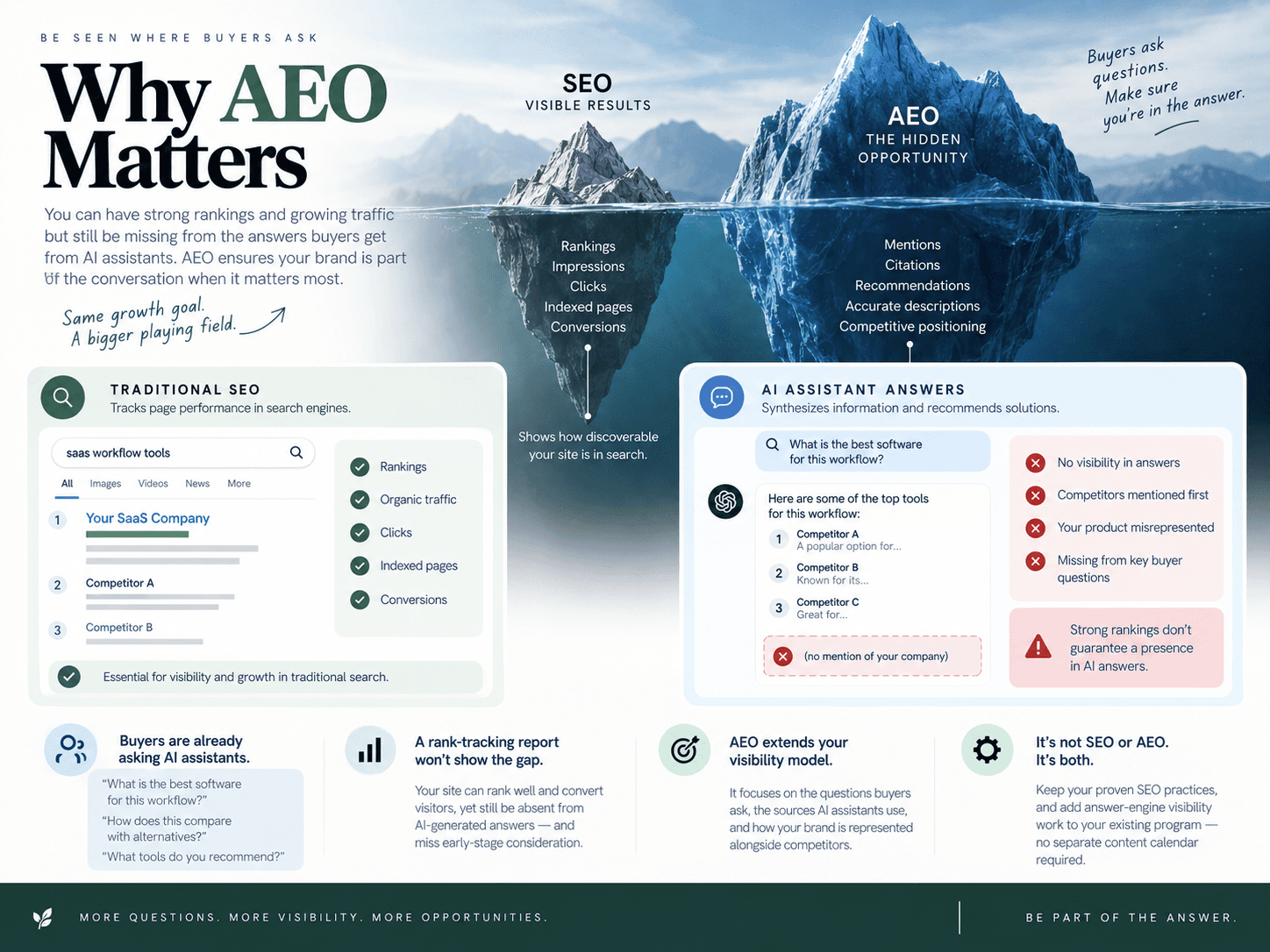
Why AEO Matters is simple: a SaaS company can report healthy rankings, growing organic traffic, and improving conversions while still being absent when prospective buyers ask AI assistants which tools to consider, how to solve a workflow problem, or what alternatives fit their needs.
Traditional SEO reporting remains indispensable. Rankings, impressions, clicks, indexed pages, and conversion paths show whether your site is discoverable in conventional search. But they do not directly show whether an AI assistant mentions your brand, cites your documentation, recommends a competitor first, or describes your product accurately during a high-intent research conversation.
That is the emerging AI search visibility gap. A buyer may ask an answer engine, “What is the best software for this workflow?” or “How does this product compare with its alternatives?” before they ever enter a branded query or visit a search results page. If your company is missing from that synthesized answer, a strong rank-tracking report may not reveal the lost consideration.
This does not make SEO obsolete. Answer engine optimization extends the visibility model from pages and rankings to answer-led discovery: the questions buyers ask, the sources an assistant can use, and the way your brand is represented alongside competitors. For a foundational view, see what answer engine optimization means for SaaS teams.
The business question is not whether to abandon proven search practices for a new trend. It is whether your current measurement and content operation covers the buyer moments that increasingly shape SaaS growth. This article makes that case, identifies what rank tracking misses, and outlines how to add answer-engine visibility work to an existing SEO program without creating a disconnected channel.
AEO Reaches Buyers Before They Search for Your Brand
Answer engine optimization is the practice of improving the likelihood that your company, product, and supporting information are represented accurately when AI answer engines respond to relevant buyer questions. It is not about manipulating an answer or assuming inclusion can be guaranteed. It is about making your expertise, product fit, documentation, proof, and terminology clear enough to support a useful and accurate response.
Traditional search often begins with a known category or brand: “best CRM for startups” or “Project management software pricing.” AI-assisted research can start much earlier, with a buyer describing the work they are trying to complete: “How can a small customer-success team reduce onboarding churn?” or “What tools help agencies standardize client reporting without hiring more analysts?”
That change matters because a buyer may form an initial shortlist before they ever search for your company name. A strong AEO program helps SaaS teams publish the material that makes them understandable and relevant during those early, answer-led research moments. For a deeper foundation, see what answer engine optimization means for SaaS teams.
Category discovery begins with problem-language prompts
Category discovery increasingly begins with conversational, problem-language questions rather than a clean software-category query. Prospects ask about a workflow, a role, a constraint, or an outcome—and may not yet know the product category that addresses it.
For example, a prospect may ask an assistant:
“How should a SaaS team prioritize content opportunities from Search Console data?”
“What is the best way to automate internal links across a growing knowledge base?”
“How can a founder publish useful SEO content consistently without a large content team?”
These buyer prompts reveal the language, context, and desired outcome behind demand. They also create an opportunity for companies with useful educational pages, workflow guides, use-case content, and clearly explained product capabilities to enter the conversation before the buyer translates their problem into a category search.
The practical response is not to create thin pages for every possible question. Build durable content that explains a real problem, names the relevant constraints, gives actionable guidance, and connects the guidance to a credible solution path. Clear headings, direct definitions, concrete examples, accessible page structure, and supporting product documentation all make a page more useful to people and easier for systems to interpret.
AI answers can shape the initial consideration set
An AI answer may do more than summarize information. It can introduce categories, suggest evaluation criteria, identify implementation considerations, and name products that appear relevant to the buyer’s situation. That means the first consideration set can be shaped before a prospect visits a conventional results page, compares vendor sites, or submits a demo request.
For SaaS marketers, the objective is accurate representation: ensure the public content around your brand explains who the product is for, what workflow it supports, where it fits well, and what a buyer should evaluate. Pages that offer specific use cases, implementation guidance, product details, customer proof, and honest fit criteria give both buyers and answer engines more substance to work with than generic positioning alone.
This is additive to SEO, not a replacement for it. Technical accessibility, intent-aligned content, crawlable pages, internal links, structured information, and organic performance data still matter. AEO extends that foundation to an additional question: when a prospective customer asks an answer engine for help, does the resulting answer represent your company accurately enough to earn consideration?
The Business Case: Discovery, Trust, Comparison, and Pipeline
Answer-engine visibility matters commercially because it can shape which vendors enter a buyer’s consideration set, which claims they believe, and which options they investigate next. The opportunity is not to treat every AI mention as revenue. It is to improve representation during buyer moments that conventional search reporting may not fully capture.
Earn earlier category discovery
Many SaaS buying journeys begin before a prospect knows the product category, relevant terminology, or vendor names. Instead of searching for a known solution, they ask questions such as: “How can a distributed marketing team keep publishing consistent content?” or “What is the best way to reduce manual reporting across client accounts?”
These problem-led questions are often where answer engines introduce categories, approaches, and potential solutions. A company that only publishes product pages and branded content may be absent from this first round of discovery, even if it ranks well for terms buyers use later.
To earn a place in these early conversations, create clear content around the problem, audience, workflow, and desired outcome—not only the name of your software category. Useful assets include use-case pages, workflow guides, role-specific explainers, and practical implementation examples. The aim is to make it easy for both buyers and answer engines to understand what problem you solve, for whom, and in which situations your product is a strong fit.
Build confidence with verifiable buyer evidence
Discovery earns attention; trust determines whether attention becomes evaluation. Buyers increasingly use AI assistants to pressure-test claims: what a product does, how difficult it is to implement, which integrations matter, what limitations to expect, and whether it fits their team size or workflow.
That makes buyer trust a content and documentation problem. High-quality product information should be specific, current, and easy to locate across your site. Describe capabilities plainly, show relevant use cases, document implementation steps, explain integrations, and include proof that helps a buyer assess fit. Where trade-offs exist, explain them directly rather than relying on broad positioning language.
This approach improves more than AI-answer representation. It gives prospects material to validate during self-serve research, gives sales teams pages to share after calls, and reduces ambiguity when buyers compare your product with a familiar alternative. A vague feature page may attract a visit; a well-structured explanation of the feature, its practical workflow, and its best-fit customer can support a more confident decision.
Capture comparison-stage and alternative demand
The commercial stakes rise when a buyer moves from “What should we use?” to “Which option should we choose?” At this stage, prompts and searches commonly focus on alternatives, versus comparisons, best tools for a particular use case, pricing trade-offs, integrations, and implementation constraints.
These are not pages to approach with generic promotional copy. Strong decision-stage content helps a buyer evaluate options using relevant criteria, acknowledges where another product may fit better, and explains where your product is the better choice for a defined audience or workflow. That combination is more useful to prospective customers and more durable than one-sided claims.
For comparison and alternatives pages, maintain a defensible editorial standard:
Use accurate, specific product information for your own offer.
Link competitor statements to identifiable public sources.
Evaluate products against criteria that matter to the intended buyer, such as workflow, integrations, usability, or implementation needs.
Include fit guidance rather than declaring a universal winner.
Review pages with a human editor and refresh them when products or pricing change.
For a deeper framework, see how to build comparison pages that support buyer decisions. Well-maintained commercial pages can serve organic search, answer-led research, sales enablement, and retargeting workflows at the same time.
Connect assisted visibility to pipeline influence
AI-answer exposure should be treated as an influence signal, not a simplistic last-click attribution channel. A buyer may encounter your company in an answer about suitable tools, later search for your brand, revisit through direct traffic, read a comparison page, and eventually book a demo. No single touchpoint explains the outcome.
The practical question is whether stronger representation in priority buyer conversations coincides with healthier demand signals. Track AI visibility alongside branded search demand, direct traffic, assisted conversions, demo paths, sales-call themes, and qualified pipeline. Ask sales teams what prospects already believe or ask when they arrive: Are buyers mentioning competitors that frequently appear in AI responses? Are they asking questions your documentation answers well? Are they entering calls with a clear understanding of your category?
This produces a more useful view of pipeline influence. If a brand becomes more visible and accurately described across high-value buyer questions, then sees growth in branded discovery, qualified visits, or assisted opportunities, the pattern is worth investigating and scaling. If visibility rises only for broad, low-intent questions with no movement in meaningful demand indicators, the team can redirect effort toward more commercially relevant prompt themes.
The business case, then, is not that answer engines replace search or that every citation creates a deal. It is that SaaS teams should be present with accurate, credible information at the moments when buyers discover a category, build confidence, compare options, and choose what to investigate next.
Why Rank Tracking Alone Leaves a Measurement Gap
Rank tracking remains essential. SaaS teams still need to know which queries they rank for, how visibility changes over time, which pages earn clicks, whether important pages are indexed, and which organic paths produce trials, demos, or revenue. Google Search Console, analytics, technical monitoring, and conversion reporting are foundational—not legacy metrics to discard.
The gap is that these systems primarily measure activity around traditional search results. They do not directly show how a brand appears when a prospective buyer asks an AI assistant a question such as “What is the best tool for this workflow?”, “What are alternatives to this platform?”, or “How should a small team implement this process?”
What conventional rank tracking measures well
Traditional SEO reporting answers valuable questions: Which pages are visible in organic results? Which queries drive impressions and clicks? Where are rankings improving or declining? Is technical accessibility limiting performance? Are organic visitors converting?
Those signals reveal whether your site can be found through search engines and whether content is producing measurable traffic. They also help teams prioritize updates, diagnose losses, and connect content investment to on-site outcomes.
But a healthy ranking report can coexist with a meaningful blind spot. A buyer may receive a synthesized answer before clicking a result, encounter a competitor recommendation, or form a shortlist from sources they never visit directly. Your brand can be absent from that answer even when a related page ranks well—or present in an inaccurate or unhelpful way that rank reports never capture.
What it cannot show about AI-assisted research
Rank tracking does not measure brand representation inside selected AI answers. It cannot reliably tell you whether an answer engine mentions your company, cites your website, recommends your product in a relevant position, describes your capabilities accurately, or favors a competitor for a priority buyer question.
That matters most for commercially important research moments. For example, a project-management SaaS may rank for a broad educational term but fail to appear when buyers ask for tools suited to distributed product teams. A security platform may earn traffic to a feature page but be omitted from implementation questions where buyers ask what evidence, integrations, or rollout support they need.
The unit of analysis should not be a single isolated question. Use prompt clusters: grouped buyer questions that represent the same research need, audience, use case, or stage of evaluation. A cluster might include variations around “best tools for agencies,” “software alternatives for agency reporting,” and “how to migrate agency reporting workflows.”
One representative prompt is useful for directional testing, but it cannot stand in for every wording, context detail, or follow-up question a buyer might use. Consistent prompt sets and repeated testing are what make AI visibility measurement useful for trend analysis rather than anecdotal screenshots.
For a deeper implementation framework, see a practical guide to tracking AI search visibility.
A practical AI visibility scorecard
Build a scorecard around a limited set of high-value buyer questions, then review it on a consistent cadence. The goal is not to create a vanity metric. It is to identify where buyer-facing information is incomplete, unclear, unsupported, or losing visibility to competitors.
Prompt-cluster coverage: The share of priority buyer clusters assessed across discovery, evaluation, implementation, and expansion questions.
Brand mentions: Whether and how often the brand appears in answers for the selected prompts.
Website citations: Whether the answer points to your domain or relies on other sources when describing your product or category.
Recommendation position: Where applicable, whether the brand is presented as a leading option, a secondary option, or omitted from a recommendation set.
Sentiment and factual accuracy: Whether the description is favorable, neutral, or negative—and, more importantly, whether product capabilities, audience fit, and limitations are described correctly.
Competitor presence: Which competitors are mentioned, cited, or recommended for the same buyer need.
Missing content assets: The pages or proof gaps suggested by the results, such as an integration guide, implementation documentation, use-case page, alternatives page, or clearer product evidence.
Organic performance: Rankings, impressions, clicks, indexed-page health, engagement, and organic conversions for the supporting content.
Business outcome indicators: Branded search growth, direct traffic, assisted conversions, demo activity, sales-call themes, and influenced pipeline alongside—not substituted for—organic reporting.
This combined view prevents two common mistakes. The first is treating an organic ranking as proof that the brand is represented in AI-assisted buying research. The second is treating an AI mention as proof of revenue impact. Both are incomplete. The useful question is whether stronger representation in priority buyer conversations coincides with better discovery, more qualified visits, stronger consideration, and downstream demand signals over time.
In practice, the most valuable scorecard is small enough to act on: a defined set of priority clusters, a repeatable measurement method, clear competitor comparisons, and a content backlog tied to each gap. That turns AI-answer visibility from an abstract trend into a measurable extension of the SEO reporting system your team already trusts.
How SaaS Teams Operationalize AEO Without Replacing SEO
SaaS teams should treat answer-engine work as an extension of the existing content and SEO operating model: identify the buyer questions that matter, find where the site lacks useful support, publish the right assets, and measure whether representation improves. The goal is not a separate “AI content” program. It is a more complete AEO strategy that turns buyer-language gaps into high-quality pages that can perform in conventional search and support accurate AI-assisted research.
1. Map buyer questions across the full journey
Start with questions buyers ask before, during, and after vendor evaluation. A keyword list alone is too narrow because buyers often describe a problem, workflow, or desired outcome rather than searching for a product category by name.
Awareness: “How do SaaS teams reduce manual SEO publishing work?”
Research: “What should a small SaaS company look for in an SEO automation platform?”
Consideration: “Which tools help teams turn Search Console insights into content plans?”
Decision: “What are the best alternatives to [competitor] for small teams?”
Implementation: “How do I publish SEO content to WordPress or Framer?”
Expansion: “How can a growing content team build topical clusters without adding manual linking work?”
Cluster related prompts into a single page opportunity rather than creating one thin page per question. A cluster about CMS publishing, for example, may justify an integration guide, implementation documentation, and supporting help content. A cluster about alternatives may require a comparison page, migration guidance, and product documentation that explains real workflow differences.
For a repeatable operating process, connect these clusters to the same planning discipline used for organic search. How to turn Search Console and competitor data into a weekly publishing plan is a useful model: research should end in a prioritized queue, not a disconnected report.
2. Prioritize gaps by commercial value and evidence needs
Not every unanswered prompt deserves a new asset. Score each cluster using a practical set of filters:
Revenue potential: Is the question associated with a valuable ICP, use case, or product line?
Intent: Does it indicate early education, active evaluation, implementation need, or expansion potential?
Competitive pressure: Are competitors consistently present in relevant answers or search results?
Existing authority: Does the site already have related pages, product proof, customer examples, or organic traction to build on?
Content and proof gaps: Is the missing asset a category explanation, use-case page, integration guide, documentation page, or commercial comparison?
This prioritization prevents teams from treating every AI prompt as a content request. A decision-stage question may be more valuable than dozens of broad educational prompts, but it also requires stronger proof, more careful positioning, and a higher editorial standard.
That is especially true for alternatives and versus pages. Build verified comparison pages around a defined audience and use case, clear evaluation criteria, and balanced fit guidance. Product and competitor statements should link to identifiable public sources, receive human review before publication, and be refreshed when functionality, integrations, or pricing change. Useful commercial content explains both where your product fits and where another option may better suit a buyer. For a deeper framework, see how to build comparison pages that support buyer decisions.
3. Publish useful, connected, machine-readable assets
Once a priority cluster is approved, choose the page format that best resolves the buyer’s question. The most valuable portfolio usually combines:
Category explainers for problem-aware buyers learning how a category works.
Use-case pages that connect a specific workflow, audience, or pain point to a practical solution.
Implementation documentation that answers setup, adoption, and operational questions with specificity.
Integration guides for buyers evaluating how a product fits their CMS, analytics stack, or workflow.
Alternatives and comparison pages for active evaluators weighing trade-offs.
The production standard remains familiar SEO work: match the page to intent, make it crawlable, use clear headings, maintain accurate internal links, publish consistently, and monitor performance after release. Add structured data where appropriate to help search systems interpret page content, but do not treat markup as a substitute for clear explanations and substantiated information.
An integrated workflow makes this manageable for lean teams. SEO Autopilot can combine website analysis, Google Search Console signals, competitor patterns, and intent mapping into a Unified Backlog. From there, teams can turn selected opportunities into briefs and articles, add internal links and natural CTAs, choose a Manual, Brief First, or Full Auto workflow, and schedule publishing to WordPress, Contentful, or Framer. Its JSON-LD generation and indexing workflow support help teams carry content through the post-publication steps as well.
4. Measure, refresh, and feed findings back into the roadmap
Publishing is not the end of the process. Re-run the same high-priority prompt clusters on a consistent cadence and review whether the brand is mentioned, cited, accurately characterized, or recommended when applicable. Record competitor presence alongside the content assets that may be missing or outdated.
Then connect those findings to established performance signals: organic impressions and clicks, engaged traffic to decision-support pages, branded search growth, assisted conversions, demo requests, and recurring sales questions. An AI mention alone is not a pipeline metric, but a sustained improvement in representation around commercially important questions is a useful leading indicator to evaluate alongside demand data.
Use the results to decide what to improve next: strengthen a weak use-case page, add proof to implementation content, refresh a comparison, create a missing integration guide, or connect isolated pages through internal links. This loop preserves what SEO already does well while ensuring the content roadmap reflects how modern SaaS buyers actually research, evaluate, adopt, and expand products.
Start With a 90-Day AEO Pilot, Then Scale What Influences Demand
The practical way to add answer-engine work is to run a focused 90-day pilot—not to rebuild the entire marketing program around an emerging channel. Choose one category, ICP, or product line where buyers ask commercially meaningful questions and where your team can publish supporting content quickly. The goal is to establish a repeatable link between buyer-question coverage, AI-answer representation, and demand signals.
Days 1–30: Establish the baseline and opportunity map
Start with a narrow set of buyer questions, grouped into prompt clusters rather than treated as isolated queries. For example, a workflow SaaS company might focus on prompts about solving a specific operational problem, selecting software for a defined team, comparing leading options, implementing the tool, and expanding usage after adoption.
For each cluster, record a baseline: whether the brand is mentioned, cited, recommended, accurately described, or absent; which competitors appear; and which pages or proof points seem missing. Use the same representative prompts in future assessments so changes can be compared over time. A single prompt will never represent every variation, but a consistent cluster creates a useful directional measure.
Then audit the site against the questions buyers are asking. Look for gaps such as:
Category or use-case pages that explain the problem in buyer language.
Implementation and integration documentation that answers practical adoption questions.
Customer proof, product detail, and clear fit guidance that support accurate representation.
Alternatives and comparison pages for evaluation-stage demand.
Internal links that connect decision pages, educational content, and relevant product pages.
Turn the resulting opportunities into a prioritized content roadmap. A lean team should favor clusters with high commercial intent, visible competitor presence, a clear content gap, and a realistic path to creating stronger buyer evidence.
Days 31–60: Publish priority decision-support content
Use the middle of the pilot to publish a small set of high-value assets—not dozens of broad articles. In many SaaS categories, the highest-leverage mix includes a use-case page, an implementation or integration guide, a category explainer, and one or two comparison-stage pages.
Commercial content needs a higher editorial standard than generic thought leadership. Comparison and alternatives pages should explain evaluation criteria, acknowledge different buyer needs, use current product information, and link competitor statements to identifiable public sources. Human review matters before publication, especially when describing features, pricing, integrations, or fit. For a stronger framework, see how to build comparison pages that support buyer decisions.
Keep conventional SEO practices in the workflow. Each page should match intent, be crawlable, include descriptive headings, link naturally to related assets, and use structured data where appropriate. An execution platform such as SEO Autopilot can help teams move from prioritized opportunities to briefs, internally linked content, scheduled publishing, and indexing support without turning the pilot into a spreadsheet-heavy side project.
Days 61–90: Compare visibility changes with demand signals
Repeat the original assessment using the same prompt clusters. Do not judge the pilot by one favorable answer or one unattributed conversion. Review change across a set of leading and lagging indicators.
Leading indicators: prompt-cluster coverage, brand mentions, citations, recommendation placement when applicable, accuracy of brand descriptions, competitor presence, published-page completion, and content refreshes.
Lagging indicators: qualified organic traffic to pilot assets, branded search demand, direct visits, demo assists, sales conversations that reference the relevant problem or category, and influenced pipeline.
The key question is not whether every new page immediately creates pipeline. It is whether better coverage of high-value buyer questions corresponds with stronger brand presence and more qualified paths into evaluation. Where it does, expand the model to adjacent ICPs, use cases, integrations, or product lines. Where it does not, inspect the prompt selection, content quality, proof depth, competitor advantage, and conversion path before increasing output.
AEO is an iterative visibility and content-quality discipline, not an instant acquisition channel. The strongest pilots preserve the SEO systems already producing results, add a repeatable way to measure answer-led discovery, and feed the findings into the existing publishing queue. Teams can use how to turn Search Console and competitor data into a weekly publishing plan to ensure new visibility gaps become scheduled work rather than a separate research exercise.
Conclusion: Treat AI Visibility as a Missing Growth Signal
AI-assisted buying is changing where SaaS brands enter the consideration set. A buyer may ask an answer engine which tools fit a workflow, how to solve an implementation problem, or what alternatives suit a specific team long before they run a branded search. If your company is absent, inaccurately described, or displaced by competitors in those answers, healthy rankings alone will not reveal the gap.
That does not make conventional search obsolete. SEO and AEO work best as one operating model: retain the foundations that make content discoverable and useful—intent alignment, technical accessibility, structured information, internal links, indexing, and conversion measurement—then add visibility measurement for the buyer questions that influence evaluation.
The practical priority is not to chase every possible prompt. Identify the category, comparison, implementation, and expansion questions closest to revenue; assess whether your brand is mentioned, cited, recommended, and accurately represented; then close the highest-value gaps with clear product documentation, useful use-case assets, and balanced decision-support pages.
For commercial content, credibility matters as much as coverage. Comparison and alternatives pages should help readers understand fit, trade-offs, and relevant criteria. Keep product facts current, link competitor statements to identifiable public sources, require human review, and refresh pages as products and pricing evolve. That standard produces content that is more useful to buyers and more durable than one-sided promotional copy.
Your next step is straightforward: choose a focused set of priority buyer prompts, establish a baseline alongside organic and pipeline indicators, and turn the gaps into a publishable roadmap. A disciplined 90-day pilot can show where answer-engine representation strengthens your broader growth strategy—without abandoning the SEO practices already working for your team.

About the author: SEO Autopilot — Get recommended by Google and AI
SEO Autopilot is the SEO operating system for SaaS teams: it finds what to write from your site, competitors, and Search Console — then publishes evidence-verified comparison pages and intent-matched content on autopilot to WordPress, Framer, and more.
Areas of expertise: seo, aeo, geo, Search Engine Optimization, Answer Engine Optimization, Generative Engine Optimization, SEO Expert, Article Writer