Key Strategies for AEO: 9 Steps to Build AI Visibility
Key Strategies for AEO: Start With Buyer Questions
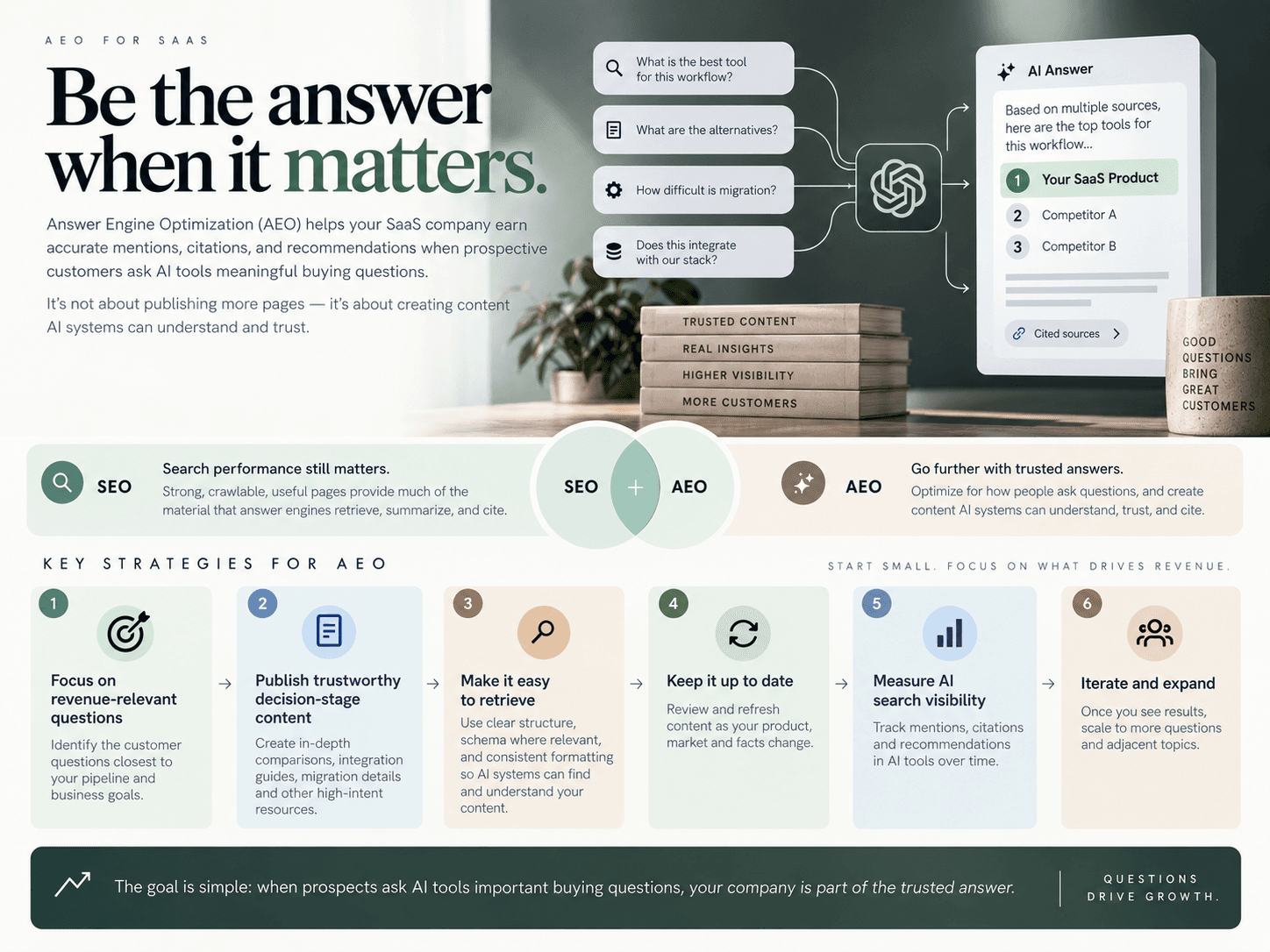
Key Strategies for AEO begin with a practical goal: help your SaaS company earn accurate mentions, citations, and recommendations when prospective customers ask AI tools meaningful buying questions. That means creating content AI systems can both understand and trust—not simply publishing more pages with AI-friendly formatting.
Answer Engine Optimization complements conventional SEO. Search performance still matters because strong, crawlable, useful pages provide much of the material that answer engines retrieve, summarize, and cite. The difference is that AI-assisted research often begins with full questions: “What is the best tool for this workflow?”, “What are the alternatives?”, “How difficult is migration?”, or “Does this integrate with our stack?”
For lean teams, the priority is not optimizing every existing page at once. Start with the questions closest to revenue, publish trustworthy decision-stage assets, make those assets easy to retrieve, maintain them as facts change, and measure whether your AI search visibility improves over time.
Why keyword lists alone miss AI-assisted buying intent
Keyword research remains useful, but a list of phrases rarely captures the full context behind an AI conversation. A buyer may ask one assistant to compare two platforms for a five-person marketing team, then ask how each option connects to WordPress, what onboarding requires, and whether it suits a specific use case. Those are connected decision questions, not isolated keywords.
Map questions across the buying journey, especially where the answer could influence a shortlist or purchase decision:
Evaluation: “How should a SaaS team evaluate SEO automation software?”
Comparison: “What is the difference between [Product A] and [Product B] for small teams?”
Alternatives: “What are the best alternatives to [Competitor]?”
Use case: “What tool helps a small team publish SEO content consistently?”
Implementation: “How do we set up an SEO content workflow?”
Integration: “Which platforms publish directly to WordPress or Framer?”
Migration and adoption: “What should we prepare before switching content tools?”
Pricing and fit: “What should a startup look for before paying for an SEO platform?”
These questions reveal what buyers need to verify before they trust a recommendation: audience fit, product capabilities, setup requirements, proof, tradeoffs, and current details. A broad article that defines a category may attract attention, but a focused page that resolves a real decision is more useful when an answer engine needs to make a specific recommendation.
How to prioritize questions by commercial value and evidence needs
Use a simple prioritization filter: buyer value, specificity, existing proof, and ability to maintain accuracy. The highest-impact questions are usually not the largest-volume topics. They are the prompts where a buyer is comparing options, validating a fit, or preparing to implement a solution—and where your team can provide a clear, well-supported answer.
Start with commercial proximity. Prioritize comparisons, alternatives, “best tool” questions, integration needs, migration concerns, and use-case-specific evaluations before broad educational topics.
Choose narrow, defensible angles. “Best SEO tools” is crowded and vague. “SEO automation tools for small teams publishing to Framer” is more specific, easier to support, and closer to a real buying decision.
Check the proof required to answer well. If a page needs product facts, competitor statements, customer outcomes, technical setup steps, or pricing details, gather and review those details before drafting.
Favor questions you can keep current. Decision-stage content loses value quickly when integrations, features, workflows, or market positioning change. Assign an owner and a refresh cadence from the outset.
A practical starting set for a small SaaS team might be one alternatives or comparison page, one audience-specific use-case page, and one implementation or integration guide. Together, these assets cover the questions buyers ask when moving from interest to action.
Comparison content deserves particular care. A credible page uses a defined audience and use case, consistent evaluation criteria, accurate first-party information, source-backed competitor details, transparent strengths, and relevant limitations. It should help readers choose—not act as a generic competitor attack page. For a deeper framework, see how to build credible alternatives and comparison pages.
Once the question map is in place, turn it into a ranked publishing queue rather than a sprawling spreadsheet. SEO Autopilot’s Prompt Universe can map buyer-oriented prompts across research, evaluation, purchase, implementation, and expansion, group them into opportunities, and test selected prompts for brand and competitor presence in OpenAI answers. Combined with Search Console signals and competitor gaps, that gives lean teams a more practical way to decide what deserves production effort first.
The guiding principle is simple: earn trust before optimizing presentation. Clear headings, direct answers, tables, and structured data can make a page easier to extract. But formatting cannot compensate for thin claims, stale product information, or content that does not answer the buyer’s actual question. Start with the highest-value questions your company can answer credibly, then build the operational system to publish and maintain those answers consistently.
The 9 AEO Tactics That Build an AI-Ready Content Engine
AI answer inclusion is earned through a combination of relevance, clarity, and trust. A SaaS site needs pages that directly address meaningful buyer questions, support important statements with proof, and make the information easy for systems and people to assess. For lean teams, the highest-return work is not publishing more generic posts. It is building a small, connected library of decision-ready content around the questions customers ask when choosing, implementing, and evaluating software.
1. Map the questions buyers ask before they buy — Highest impact
Start with buyer-language questions, not a broad keyword export. AI-assisted research often takes the form of detailed prompts: “What is the best CRM for a five-person agency?” “How do I migrate from Tool A to Tool B?” or “Which project management platform supports client approvals?” These questions reveal the context, urgency, and proof a prospect needs before taking action.
Why it matters: AI systems answer prompts, not isolated keywords. A page built around a specific decision question has a clearer chance of being relevant when that question or a close variation appears in an AI conversation.
SaaS example: A customer-support platform could map questions across the journey, including “best help desk for B2B SaaS,” “help desk software with Slack integration,” “how to migrate from Zendesk,” and “how much does help desk software cost for a small team?”
Execution note: Group questions into clusters by buyer job and page type: comparison, alternatives, use case, integration, pricing, migration, implementation, and evaluation. Prioritize clusters where the question indicates a live buying decision and where your team can provide useful product detail or proof. SEO Autopilot’s Prompt Universe can turn product and market context into buyer-oriented prompt clusters, including visibility signals and content gaps for selected AI answers.
2. Prioritize high-intent comparison and alternative queries — Highest impact
Comparison, alternatives, and “best tool for” queries deserve disproportionate attention because they appear late in the buying journey. The reader is no longer asking whether a category exists; they are weighing options, constraints, and tradeoffs.
Why it matters: These pages can give an AI system a direct, well-scoped source for recommendations. They also let your brand explain fit in practical terms rather than relying on a generic feature list.
SaaS example: Instead of publishing “Best marketing automation tools,” create pages such as “Marketing automation tools for product-led SaaS teams,” “Alternatives to [Competitor] for startups that need simpler workflows,” or “[Your Product] vs. [Competitor] for teams using HubSpot.”
Execution note: Define the audience and use case before drafting. A page for enterprise procurement teams should not use the same criteria as a page for founders managing their first growth stack. Use consistent criteria such as implementation effort, integrations, workflow fit, usability, support model, and relevant capabilities. For a deeper framework, build credible alternatives and comparison pages around a real buyer decision rather than a broad competitor attack page.
3. Build verified comparison pages with balanced criteria — Highest impact
A credible comparison page helps a buyer decide; it does not pretend every competitor is weak. State where each option fits, include meaningful limitations, and support factual assertions with sources that can be reviewed and refreshed.
Why it matters: Commercial pages are especially vulnerable to distrust when they make sweeping claims, use stale pricing or feature details, or hide tradeoffs. Specific, balanced information is more useful to buyers and more defensible when AI systems evaluate available sources.
SaaS example: A “[Your Product] vs. [Competitor] for small agencies” page might compare onboarding, client permissions, reporting workflows, integrations, and pricing model. It should also explain when the competitor is a better fit—for example, for organizations that need a particular workflow your product does not prioritize.
Execution note: Every comparison page should include:
A defined audience, use case, and decision context.
The same evaluation criteria for every product.
Accurate first-party product information.
Source-backed statements about competitors, with dates for time-sensitive facts.
Competitor strengths and transparent product limitations.
Human review before publication and scheduled refreshes as products change.
SEO Autopilot’s Comparison Builder supports brand-versus-competitor, alternatives, and best-tools pages using verified offer details, live competitor research, source URLs, retrieval dates, and editorial approval. Its workflow is designed to stop unsupported statements from moving into automatic publication.
4. Add first-party proof and named expert evidence — Highest impact
Formatting can make a page easier to quote, but it cannot make weak content trustworthy. Add the details that generic summaries lack: named experts, implementation steps, product documentation, customer outcomes where substantiated, screenshots or workflow examples, dates, and clear boundaries around who the product serves best.
Why it matters: Useful evidence gives readers—and systems evaluating source quality—reasons to treat your page as more than a rewritten category description. It also makes your content harder for competitors to replicate with generic AI copy.
SaaS example: An article about reducing SaaS onboarding drop-off could include a product leader’s bylined recommendations, the exact activation events the team monitors, a documented onboarding workflow, and a dated customer example with a clearly stated result.
Execution note: Build a reusable proof library. Collect approved customer stories, implementation notes, expert quotes, integration details, product release information, security documentation, and relevant metrics. Assign an owner to review facts that can change, especially commercial claims, integration details, and customer results.
5. Publish implementation, integration, and migration guidance
Decision-stage visibility does not end once a buyer selects a category. Prospects ask how a product works with their current stack, what rollout requires, and how difficult it is to leave an incumbent platform. These are high-value questions because they expose purchase friction.
Why it matters: Implementation content demonstrates operational credibility. It gives AI answers concrete material for prompts about setup, compatibility, migration risk, adoption, and day-to-day use.
SaaS example: A finance platform could publish “How to connect [Product] to QuickBooks,” “A month-end close workflow for multi-entity SaaS companies,” and “How to migrate expense policies from [Competitor].”
Execution note: Make guides specific enough to complete a task: prerequisites, numbered steps, permissions required, expected outcomes, common failure points, and links to relevant documentation. Avoid publishing an integration page that merely says two tools “work together.” Explain what data moves, who configures it, and what the workflow enables.
6. Format pages for fast extraction and clear attribution
Clear structure helps answer engines identify the most relevant passage, but extractability is an amplifier—not a substitute for relevance and proof. A concise answer under a descriptive heading is more useful than a long introduction that delays the point.
Why it matters: Well-structured pages make definitions, recommendations, procedures, and tradeoffs easier to locate and represent accurately in an answer.
SaaS example: A page answering “How long does CRM implementation take?” could open with a direct range and the variables that affect it, then use sections for timeline, preparation checklist, migration steps, ownership, and common delays.
Execution note: Use descriptive headings, short answer-first paragraphs, comparison tables where criteria are consistent, ordered lists for processes, and explicit labels for dates and sources. Add relevant JSON-LD structured data where appropriate. Do not use schema, FAQs, or tables to disguise thin content; they cannot compensate for unsupported claims or an irrelevant page.
7. Connect related assets with intentional internal links
AI-ready content works better as a system than as isolated posts. A comparison page should lead to use-case guidance, integration documentation, migration resources, pricing explanations, and product pages that deepen the buyer’s understanding.
Why it matters: Internal links help visitors navigate the evaluation journey and reinforce the relationship between pages across a topic. They also make it easier for search systems to discover and understand the supporting context behind a commercial page.
SaaS example: An “Alternatives to [Competitor]” page can link to a migration guide, a feature-specific workflow page, an integration guide, and a customer story for the same audience.
Execution note: Link with descriptive anchor text that explains the next step. Prioritize links between product, use-case, comparison, and implementation content over arbitrary “related posts” widgets. You can connect related pages through an internal linking strategy that turns isolated assets into a navigable topic cluster. SEO Autopilot automatically adds internal links between related articles as part of its content workflow.
8. Maintain a consistent publishing and refresh cadence
AEO is an operating rhythm, not a one-time site project. Buyer questions change as competitors launch features, integrations evolve, terminology shifts, and customers adopt new workflows. Stale commercial pages lose value quickly.
Why it matters: Regular publishing expands coverage of genuine buyer needs, while refreshes protect the accuracy of high-intent assets that may influence recommendations.
SaaS example: A security SaaS company might refresh its compliance comparison pages after framework changes, publish timely guidance following a major platform update, and update integration documentation when APIs or setup flows change.
Execution note: Maintain a ranked backlog that combines buyer questions, Search Console signals, competitor gaps, product releases, and freshness opportunities. Schedule reviews for commercial pages more frequently than evergreen definitions. A unified workflow for briefs, drafts, links, publishing, indexing support, and analytics reduces the operational burden of maintaining momentum.
9. Track AI answer visibility and close the gaps
Measure whether your brand appears for commercially meaningful prompts, then use the findings to decide what to improve next. The goal is not to chase every possible AI mention; it is to identify the questions where visibility would matter and determine whether your existing content provides a credible answer.
Why it matters: Conventional rankings and traffic reports do not fully show how a brand appears in AI-generated research. Recurring prompt tests reveal whether your company is mentioned, cited, recommended, described positively or negatively, or overshadowed by competitors.
SaaS example: A workflow automation company can test prompts such as “best automation platform for RevOps,” “alternatives to [Competitor],” and “how to automate lead routing in Salesforce.” For each result, record brand presence, citations, recommendation position where observable, competitor mentions, sentiment, and the missing page or proof asset that may explain the gap.
Execution note: Test representative prompts from priority clusters on a recurring schedule and compare results over time. Convert gaps into work: create an integration guide, strengthen an unclear comparison, add expert documentation, refresh outdated facts, or publish a missing implementation page. To establish a repeatable baseline, learn how to identify and prioritize AI-search visibility gaps. SEO Autopilot’s AI Visibility runs analyze selected OpenAI prompt responses for brand mentions, website citations, recommendation position, sentiment, competitor rankings, and missing content assets.
What Lean SaaS Teams Should Do First
Lean teams should not attempt to optimize every existing page for AI answers. Start with a small, connected set of assets that answers high-value buyer questions, contains reviewable proof, and gives prospects a clear path from evaluation to implementation. This is the most practical way to apply the Key Strategies for AEO without creating an enterprise-sized content program.
A minimum viable AEO content set
Begin with a focused prompt and question map, then select two to four question clusters with direct commercial relevance. A useful first set includes:
One core comparison or alternatives page: Address a real decision question, such as “best alternatives to [competitor] for small SaaS teams” or “[your product] vs [competitor] for content operations.” Define the audience, use case, and evaluation criteria before writing.
One use-case or pain-point page: Answer the problem buyers experience before they know which product to choose. For example: “How can a small SaaS team turn Search Console data into a weekly content plan?”
One implementation or integration guide: Explain what happens after purchase: setup steps, workflows, expected inputs, integrations, roles, and practical constraints. This is especially valuable for questions about WordPress, Framer, migrations, or connecting existing data sources.
Supporting proof assets: Publish or improve product documentation, expert-authored explanations, substantiated customer outcomes, feature details, and clear answers to common evaluation questions.
This small set supports multiple buyer moments. The comparison page helps with selection, the use-case page captures problem-aware demand, and the implementation guide reduces adoption uncertainty. Supporting documentation gives each commercial page stronger factual grounding.
For commercial pages, human review is non-negotiable. Review product facts, competitor statements, customer outcomes, and final positioning before publication. A credible page acknowledges audience fit, explains tradeoffs, uses consistent criteria, and includes competitor strengths where relevant. For a deeper framework, see how to build credible alternatives and comparison pages.
A 30-day execution sequence
Days 1–5: Build the buyer-question map. Collect questions from sales calls, onboarding conversations, support tickets, Search Console, competitor pages, and AI-assisted research. Group them into comparison, alternatives, use case, pricing, implementation, integration, migration, and evaluation clusters. Score each cluster by commercial value, existing proof, buyer urgency, and the effort needed to create a complete answer.
Days 6–10: Choose the first three pages and verify the facts. Select one decision-stage comparison or alternatives topic, one pain-point topic, and one implementation or integration topic. Gather the source material each page needs: current product details, documentation links, screenshots where useful, named expert input, dated customer evidence, and accurate competitor references. Do not leave factual review until the final editing pass.
Days 11–15: Create briefs built around answer completeness. Each brief should define the exact buyer question, audience, use case, desired outcome, must-include facts, limitations, sources, and internal pages to reference. Structure the page around direct answers, decision criteria, practical steps, and concise explanations that can stand alone when quoted.
Days 16–23: Draft, review, and publish the first content set. Have a product owner or subject-matter expert validate all commercial claims. Confirm that comparisons remain fair, implementation instructions match the current product experience, and customer proof is approved for use. Then publish the three core pages and the most important supporting documentation.
Days 24–27: Connect the cluster. Add contextual links between the comparison page, use-case page, implementation guide, pricing or product pages, and supporting documentation. Related pages should help a reader move naturally from “Is this the right tool?” to “How would this work for us?” Teams can connect related pages through an internal linking strategy to reinforce those relationships for users and crawlers.
Days 28–30: Establish an AI visibility baseline. Test representative prompts from each priority cluster and record the date, answer, brand mention, website citation, recommendation presence or position when observable, sentiment, competitor mentions, and missing proof or content assets. The goal is not to expect a guaranteed mention; it is to identify where the brand lacks the content, specificity, or authority needed for a stronger answer. Use the findings to learn how to identify and prioritize AI-search visibility gaps.
Keep the operating model simple: question research feeds a ranked backlog, the backlog produces reviewed briefs, briefs become connected pages, and recurring prompt tests determine what to improve next. This approach makes content prioritization a revenue-focused decision rather than a race to publish more generic articles.
SEO Autopilot can support this workflow by mapping buyer-oriented prompts with Prompt Universe, organizing opportunities into a Unified Backlog, generating briefs and structured drafts, adding internal links, and publishing to WordPress, Contentful, or Framer based on the team’s chosen review mode. Its Comparison Builder is designed for commercial pages that require source-backed competitor research and human approval before unsupported statements can progress to automatic publication.
Once the first cluster is live, repeat the cycle with the next highest-value buyer question. To keep production disciplined, use search performance signals and competitor gaps to turn buyer demand into a weekly publishing plan.
Measure Visibility, Then Improve the Missing Evidence
AI answer visibility should be treated as a repeatable measurement process, not a one-time brand search. Test the commercially meaningful questions your buyers actually ask, record what each answer contains, identify why competitors appear, and turn the gaps into specific content or proof improvements.
Metrics that matter beyond rankings and traffic
Build a small prompt set around high-value buying moments: “best [category] for [audience],” “[competitor] alternatives,” “[your product] vs [competitor],” “how to integrate [tool] with [tool],” “how to migrate from [competitor],” and “how much does [solution type] cost.” Use representative prompts from each question cluster rather than testing dozens of near-identical variations.
For every test, log the full prompt, AI system tested, answer date, and answer text or saved URL where available. Then track the signals that reveal whether your content is earning consideration:
Brand mention: Whether your company is named at all.
Citation presence: Whether the answer cites your website, documentation, product page, or another owned asset.
Recommendation presence and position: Whether the brand is recommended and, when the response provides an ordered list, where it appears.
Characterization and sentiment: How the answer describes your product: strong fit, neutral option, niche choice, or poor fit.
Competitor presence: Which competitors are mentioned, cited, or placed ahead of your brand.
Cited sources: The third-party pages, review sites, documentation, or articles the answer relies on.
Missing assets: The comparison, integration guide, implementation page, pricing explanation, proof point, or expert source that would make your positioning easier to support.
A mention alone is not the goal. A brand can appear in an answer yet be framed as unsuitable for the buyer’s use case, omitted from citations, or consistently placed behind a competitor. Conversely, a citation on a detailed implementation question may signal stronger commercial relevance than a broad, unqualified mention on a “best tools” list.
Run the same prompt set on a regular schedule and compare results by cluster, not just by total mentions. AI-generated responses can vary by model, date, prompt wording, and available sources, so no single test is conclusive. The useful signal is the pattern: where your brand repeatedly appears, where it is absent, and what information the answer appears to need.
For a practical framework and recurring baseline, learn how to identify and prioritize AI-search visibility gaps.
How to turn AI-answer gaps into a publishing backlog
Each result should produce an action, not a vague instruction to “improve AI SEO.” Translate observed gaps into a ranked backlog based on commercial value, how often the gap appears across related prompts, and the effort required to close it.
Fix unclear positioning. If answers describe your product too broadly or recommend it for the wrong audience, strengthen audience, use-case, and outcome language on core product and use-case pages.
Add supportable proof. If an answer lacks a reason to cite or recommend your brand, add precise documentation, named expert input, implementation details, substantiated customer outcomes, dates, and transparent product boundaries.
Create the missing decision-stage asset. If competitors appear for alternatives, migration, integration, or evaluation prompts while you do not, build the page that directly answers that buyer question.
Refresh stale facts. Update product capabilities, integrations, screenshots, process steps, and comparison details when they change. Old information weakens the usefulness of otherwise strong pages.
Retest the relevant prompt cluster. After publication or refresh, rerun the same representative prompts and record what changed in mentions, citations, positioning, and competitor visibility.
For example, if a competitor is repeatedly cited for “best project management software for small agencies” because its pages explain onboarding and client permissions, do not respond with a generic blog post. Prioritize an agency-specific use-case page, a documented workflow, and any relevant implementation proof. If buyers ask for alternatives and your site has no fair comparison asset, publish a page with defined evaluation criteria, practical fit guidance, and current product details.
This closes the loop between research and execution. SEO Autopilot’s Prompt Universe can organize buyer-oriented prompts into opportunity clusters and assess selected OpenAI answers for mentions, citations, recommendation position, sentiment, competitor visibility, and missing assets. Those findings can then move into a prioritized content queue alongside Search Console and competitor opportunities.
The operating discipline matters more than chasing a perfect score: test meaningful prompts, document what is missing, publish the strongest answer your company can substantiate, and measure again. Over time, this approach turns isolated content gaps into a focused pipeline of pages and proof that better serve both buyers and answer engines.
Build the Engine Before Chasing Every AI Mention
Sustainable AI visibility is not the result of chasing isolated mentions or publishing a large volume of generic articles. It comes from a dependable operating system that turns buyer-language research into verified, useful, connected, and maintained content.
For constrained SaaS teams, the highest-return investments are straightforward:
Map high-intent buyer questions across comparison, pricing, integration, implementation, and migration decisions.
Publish evidence-backed commercial pages that help a specific audience evaluate real options using fair, consistent criteria.
Add first-party proof and expert context through product documentation, named specialists, implementation details, dated sources, and transparent fit guidance.
Make pages easy to extract with direct answers, descriptive headings, scannable tables, clear definitions, and appropriate structured data.
Measure recurring AI-answer results and use missing mentions, citations, proof, and content assets to decide what to improve next.
Formatting supports retrieval, but it cannot make weak content trustworthy. A concise answer box, schema markup, and a comparison table help answer engines interpret a page. Specific product facts, credible sources, useful implementation guidance, and honest limitations give them a reason to rely on it.
The practical goal is an AI-ready content engine: research creates a prioritized question map; the map becomes briefs and publishable pages; pages link to related comparisons, use cases, and documentation; regular reviews keep facts current; and visibility tests reveal the next gap worth fixing.
Keep the workflow small enough to run consistently. Start with a focused set of commercially meaningful questions, publish the strongest missing decision-stage assets, and improve them as buyer needs and product details evolve. Then use your findings to learn how to identify and prioritize AI-search visibility gaps rather than relying on intuition or one-off prompt checks.
That discipline is what connects answer-engine work to durable SaaS growth: not visibility for its own sake, but more accurate representation when prospective customers ask the questions that shape their purchasing decisions. Assess where your brand is absent, unclear, unsupported, or outranked today—and turn the highest-priority gaps into the next publishing plan.

About the author: SEO Autopilot — Get recommended by Google and AI
SEO Autopilot is the SEO operating system for SaaS teams: it finds what to write from your site, competitors, and Search Console — then publishes evidence-verified comparison pages and intent-matched content on autopilot to WordPress, Framer, and more.
Areas of expertise: seo, aeo, geo, Search Engine Optimization, Answer Engine Optimization, Generative Engine Optimization, SEO Expert, Article Writer