AI Search Visibility Tracking for SaaS Teams Guide
Introduction: Why SaaS Teams Need AI Search Visibility Tracking
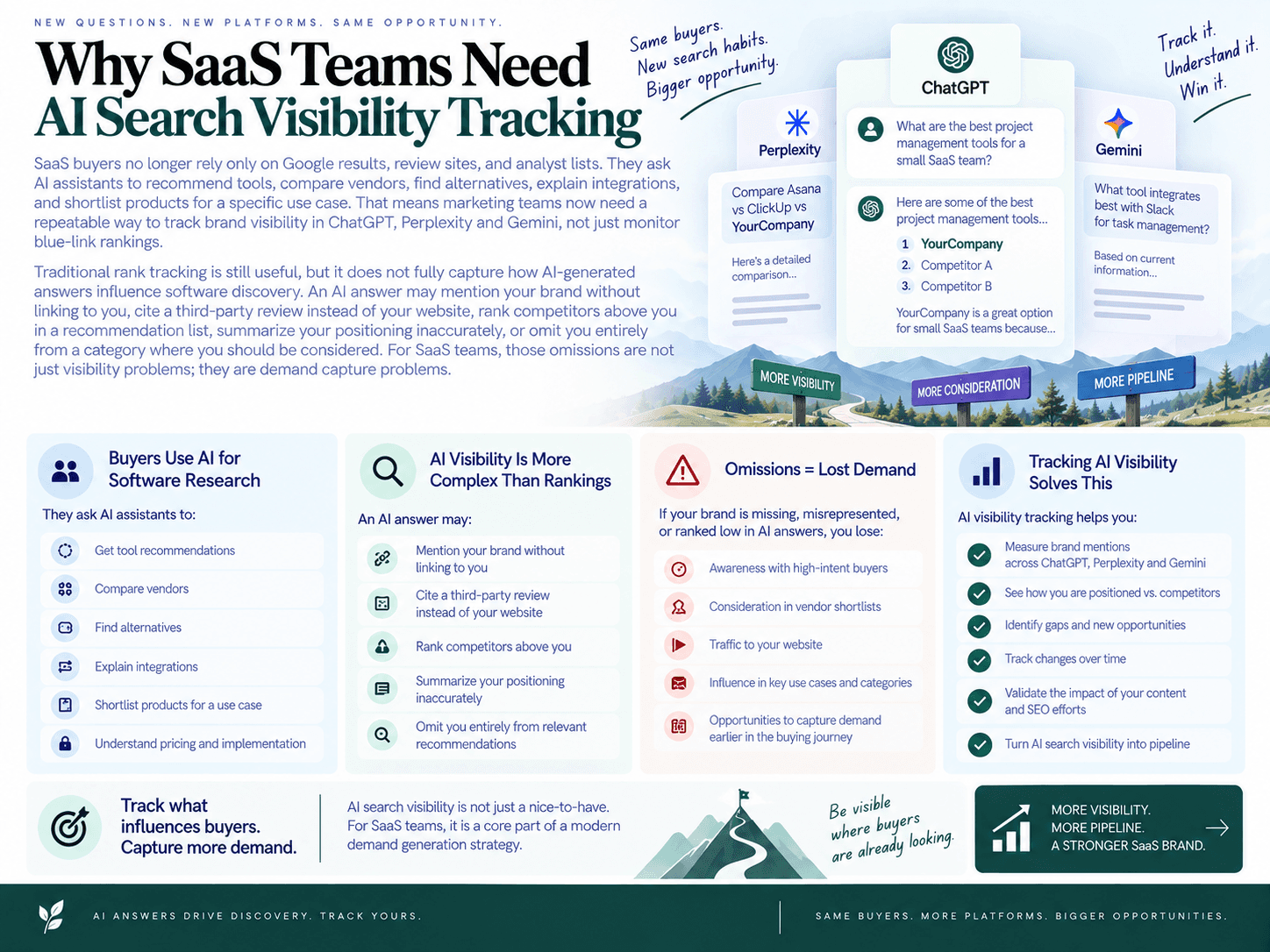
SaaS buyers no longer rely only on Google results, review sites, and analyst lists. They ask AI assistants to recommend tools, compare vendors, find alternatives, explain integrations, and shortlist products for a specific use case. That means marketing teams now need a repeatable way to track brand visibility in ChatGPT Perplexity and Gemini, not just monitor blue-link rankings.
Traditional rank tracking is still useful, but it does not fully capture how AI-generated answers influence software discovery. An AI answer may mention your brand without linking to you, cite a third-party review instead of your website, rank competitors above you in a recommendation list, summarize your positioning inaccurately, or omit you entirely from a category where you should be considered. For SaaS teams, those omissions are not just visibility problems; they are demand capture problems.
AI search visibility tracking is the process of repeatedly testing representative buyer prompts and measuring how your brand appears in AI-generated answers over time. A practical tracking system looks at:
Brand mentions: whether your company appears in the answer at all.
Recommendation position: whether you are listed first, buried below competitors, or only mentioned as an afterthought.
Citations: whether the assistant cites your website, documentation, comparison pages, reviews, or other credible sources.
Sentiment and positioning: whether the answer describes your product accurately and favorably.
Competitor presence: which vendors appear more often, in which prompt clusters, and with what supporting sources.
This is part of the broader shift toward learn the fundamentals of answer engine optimization: creating content that helps answer engines understand, cite, and recommend your company when buyers ask high-intent questions. But measurement has to come first. Without a benchmark, teams end up sharing random screenshots from ChatGPT or Perplexity instead of knowing whether visibility is improving across the buying journey.
The goal is not to treat AI answers like a perfect rank tracker. Outputs can vary by model, prompt wording, timing, browsing mode, personalization, and source availability. The right approach is directional and trend-based: test the same buyer-intent prompts consistently, compare your results against competitors, and turn missing mentions into specific content assets that improve the evidence available to AI systems.
This guide gives SaaS marketing, SEO, and growth teams a tactical operating system for AI recommendation tracking: how to build a prompt set, benchmark major AI search surfaces, score share of voice, diagnose competitor advantages, and convert visibility gaps into a publishing roadmap.
Build a Buyer-Intent Prompt Set Before You Measure Anything
The quality of your AI visibility data depends on the quality of your prompts. If you only test a few obvious questions like “best CRM software” or “top project management tools,” you will get a shallow view of how buyers actually discover, compare, and validate SaaS products in AI answers.
A strong prompt set should model the real buying journey: the problems buyers describe before they know your category, the tools they compare when building a shortlist, the implementation questions they ask before committing, and the expansion questions they ask after adoption. This is the foundation for reliable prompt benchmarking because it gives you a consistent set of buyer-intent questions to test over time.
Map prompts to the SaaS buying journey
Start by organizing prompts around buying stages rather than isolated keywords. AI assistants are often used for exploratory, conversational research, so your prompt set should include natural questions a buyer would ask when trying to make a decision.
Awareness prompts: “How do I solve [pain point]?” “What is the best way to manage [workflow] for a SaaS team?” “How can [team type] reduce [manual process]?”
Category research prompts: “What types of software help with [use case]?” “What should I look for in a [category] platform?” “Software for [team type] that needs [outcome].”
Best-tool prompts: “Best tools for [use case].” “Top [category] platforms for startups.” “Best [software category] for small SaaS teams.”
Alternative prompts: “Alternatives to [competitor].” “Cheaper alternatives to [tool].” “Best [competitor] alternatives for [audience].”
Comparison prompts: “[Your brand] vs [competitor].” “[Competitor A] vs [Competitor B] for [use case].” “Which is better for [team type], [tool A] or [tool B]?”
Decision prompts: “Is [brand] good for [use case]?” “What are the pros and cons of [brand]?” “Which [category] tool has the best ROI?”
Implementation prompts: “How to implement [category] software.” “Tools that integrate with [platform].” “Best [category] software for teams using [CRM, CMS, data warehouse, or support platform].”
Expansion prompts: “How to scale [workflow] across multiple teams.” “Advanced use cases for [category].” “How to improve adoption of [software type].”
This structure helps you measure more than simple ChatGPT brand visibility. It shows where your brand appears in the buyer’s path, where competitors are introduced, and where AI systems lack enough context to recommend you confidently.
Cluster prompts by use case, audience, and commercial value
Once you have raw prompts, group them into clusters that reflect how your market buys. A SaaS company might cluster prompts by use case, company size, role, industry, integration, competitor, pain point, or funnel stage.
For example, a content operations platform could create clusters such as:
Use case: AI content planning, internal linking, content briefs, CMS publishing, content refreshes.
Audience: SaaS founders, SEO managers, content marketers, agencies, small marketing teams.
Platform fit: WordPress workflows, Framer websites, Contentful publishing, Google Search Console-driven planning.
Competitor intent: “[Competitor] alternatives,” “[brand] vs [competitor],” “tools like [competitor].”
Commercial urgency: pricing, ROI, implementation effort, time savings, migration, proof, and integrations.
Prioritize clusters based on revenue relevance, sales importance, competitive pressure, and whether the answer could influence a shortlist. A low-volume decision prompt can be more valuable than a broad educational prompt if it appears at the moment a buyer is choosing vendors.
Your prompt language should come from real customer inputs, not only keyword tools. Pull phrases from sales calls, demo notes, support tickets, Google Search Console queries, competitor pages, review sites, community discussions, customer interviews, and internal Slack conversations with sales or customer success. This is where AI visibility research starts to go beyond keyword lists and build a stronger SEO system.
Separate representative benchmarks from long-tail variants
Do not try to manually test every prompt every week. Build a large prompt universe first, then select a representative benchmark set from the highest-value clusters.
A practical approach is:
Create 500 to 1,000 raw buyer prompts across awareness, research, comparison, decision, implementation, and expansion.
Cluster related prompts by buyer intent, use case, audience, competitor, integration, and funnel stage.
Score each cluster by commercial value, relevance to your ICP, competitive pressure, and likelihood of influencing vendor selection.
Select 3 to 10 representative prompts per priority cluster for recurring measurement across AI search surfaces.
Keep long-tail variants in reserve for deeper diagnosis when a cluster underperforms.
For example, the cluster “best SEO automation tools for small SaaS teams” might include variants such as “best tools to automate SEO content workflows,” “software for SaaS founders to publish SEO content faster,” and “SEO tools for teams using WordPress and Google Search Console.” You may choose one or two benchmark prompts for recurring measurement, then use the variants when investigating why your brand is missing or why a competitor is being recommended.
This distinction matters for AI share of voice. The unit of analysis should not be one random prompt. It should be the cluster: a group of related buyer questions that represent a real decision moment. When you measure visibility at the cluster level, you can see whether your brand is consistently present for an opportunity area or only appearing in isolated answers.
Benchmark ChatGPT, Perplexity, and Gemini Consistently
To measure AI visibility reliably, SaaS teams need a repeatable benchmark, not a collection of random screenshots. Run the same representative buyer prompts across ChatGPT, Perplexity, and Gemini on a fixed cadence, then record the answer, citations, brand mentions, competitor mentions, and recommendation order in the same format every time.
Standardize the testing environment
AI answers can change based on model version, browsing mode, account history, location, and phrasing. You cannot remove all variability, but you can document enough context to make each run comparable.
For every benchmark run, capture:
AI surface: ChatGPT, Perplexity, or Gemini.
Model or product version: Record the visible model name, mode, or plan where available.
Date and time: Include timezone so month-over-month comparisons are clear.
Account state: Note whether the test used a logged-in account, a clean browser profile, or a company account.
Location: Record country or region if results may vary by market.
Search or browsing setting: Note whether web access, search, browsing, or citation mode was enabled.
Prompt wording: Save the exact prompt, including punctuation and constraints.
Follow-up prompts: If you ask a second question, record it separately instead of blending it into the original result.
This is especially important for prompt benchmarking because small wording changes can shift the answer. “Best CRM for seed-stage SaaS companies” may produce a different shortlist than “best CRM for B2B SaaS sales teams with HubSpot integration.” Treat each prompt as a controlled test case.
Create a simple naming convention for each prompt so your team can compare results across tools and time. For example: DECISION_BEST_TOOL_CRM_STARTUP_001 or IMPLEMENTATION_INTEGRATION_SLACK_003. The label should show the funnel stage, prompt type, use case, and sequence number.
Capture answers, citations, and source context
The raw answer matters as much as the score. Store the complete output before summarizing it, because future reviewers may need to check whether a brand was recommended, merely mentioned, cited as a source, or described inaccurately.
For each AI answer, save:
Raw text output: Copy the complete answer into your tracking sheet or repository.
Screenshot or export: Keep a visual record for important commercial prompts, especially “best,” “alternative,” and “versus” queries.
Citations and URLs: Record every cited source, the linked page title, domain, and whether the citation points to your site, a competitor, a review site, documentation, or editorial content.
Named competitors: List every competitor mentioned, even if they are not formally recommended.
Recommendation order: Capture the position of each vendor if the answer provides a ranked or ordered list.
Answer summary: Add a short human-readable note describing how the model framed your brand and the category.
For Perplexity, citations are often central to the answer, so Perplexity brand tracking should pay close attention to which sources support the recommendation. If competitors are cited from comparison pages, review platforms, or detailed documentation while your brand is uncited, that is a different problem from being completely absent.
For Gemini, track both the visible answer and the source context when available. Gemini AI visibility can vary based on whether the experience is using search-grounded results, account context, or a more conversational answer mode. Do not compare a citation-rich run against a non-browsing run as if they were the same test.
Control for model volatility without overreacting
AI visibility tracking is directional and trend-based. A single answer is not proof that your brand “ranks” or “does not rank” for a buyer question. Outputs can vary by model, prompt wording, timing, personalization, browsing mode, and source availability.
Use these rules to keep the data useful:
Run the same benchmark set on a regular cadence. Weekly works for fast-moving categories; monthly is often enough for stable SaaS markets.
Compare at the prompt-cluster level. Look at patterns across “best tool,” “alternatives,” “integration,” or “implementation” prompts rather than reacting to one response.
Separate core benchmarks from exploratory prompts. Core prompts should stay stable so trends remain comparable. Exploratory prompts can be used to discover new buyer language.
Flag anomalies instead of rewriting strategy immediately. If one run suddenly omits every known category leader, rerun the prompt later before treating it as a real market signal.
Measure repeated presence. A brand that appears in 8 of 10 relevant prompts over three runs has stronger visibility than a brand that appears once in a high-profile screenshot.
A practical cadence is to test 25 to 100 representative prompts across ChatGPT, Perplexity, and Gemini at the same time each reporting period. Keep the environment as consistent as possible, preserve the raw outputs, and score the results only after the capture is complete. That gives your team a defensible benchmark for how AI assistants describe your category, which competitors they surface, and where your brand is missing from commercially important recommendations.
Score Brand Visibility, Share of Voice, and Recommendation Quality
If your goal is to track brand visibility in ChatGPT Perplexity and Gemini, do not stop at “were we mentioned?” A SaaS brand can appear in an AI answer and still lose the recommendation: it may be listed below competitors, described vaguely, cited from weak sources, or framed with outdated positioning. Your scorecard should measure both visibility and recommendation quality.
Core metrics to track
Use a consistent scorecard for every benchmark prompt so your team can compare performance across prompt clusters, competitors, and time periods. The most useful metrics are:
Mention rate: the percentage of tested answers where your brand appears at least once.
Citation rate: the percentage of answers that cite your website, documentation, blog, comparison page, or a credible third-party source when discussing your brand.
Recommendation position: where your brand appears when the answer ranks or lists vendors, such as first, top three, mentioned but not recommended, or omitted.
Top recommendation inclusion: whether your brand is included in the shortlist a buyer is most likely to consider.
Competitor mention frequency: how often each competitor appears across the same tested prompts.
Sentiment: whether the answer describes your product positively, neutrally, negatively, or with caveats.
Message accuracy: whether the answer correctly describes your category, audience, use cases, features, integrations, pricing model, or positioning.
Source quality: whether citations come from authoritative pages, your own up-to-date assets, respected review sites, documentation, analyst-style pages, or low-quality summaries.
AI share of voice should be calculated at the prompt cluster level, not from a single query. For example, if you test 40 “best tools for product onboarding” prompts and your brand appears in 18 answers, while Competitor A appears in 28 and Competitor B appears in 12, your cluster-level visibility is materially different from a one-off screenshot where you happened to appear first.
A simple scoring model for SaaS teams
Create a lightweight scoring model that gives your team a comparable number for each answer. The exact weights can vary, but the model should reward mentions, recommendations, citations, and accuracy while flagging misleading or outdated responses.
Signal | Suggested score | Why it matters |
|---|---|---|
Brand mentioned | +1 | Your brand is present in the answer set. |
Brand recommended | +2 | The assistant positions your product as a viable option. |
Ranked first or strongest fit | +3 | You are the default recommendation for that buyer need. |
Cited with your company website | +2 | The answer is grounded in your controlled messaging. |
Cited with credible third-party source | +2 | External validation may strengthen trust in the recommendation. |
Positioning and features described accurately | +2 | The buyer receives a useful, accurate summary. |
Outdated, incorrect, or misleading description | -2 or flag | Visibility can hurt if the answer creates the wrong expectation. |
Competitor recommended instead | -1 or flag | The prompt may represent a content, proof, or positioning gap. |
For each answer, total the points and add qualitative notes. A score of 8 with accurate positioning and strong citations is very different from a score of 2 where the brand is merely named in a long list. This makes AI recommendation tracking more useful than binary mention reporting.
What to measure beyond brand mentions
Brand presence is only the first layer. The more valuable analysis is why the assistant selected one vendor over another. For each prompt cluster, compare your brand against competitors on visibility, position, citation type, described strengths, and missing proof. This turns competitor visibility tracking into a diagnostic workflow rather than a vanity metric.
Use this cluster-level formula for share of voice:
Brand share of voice = brand appearances across tested answers ÷ total appearances of all tracked brands across those answers.
For example, assume a cluster contains 25 benchmark prompts and the answer set includes 60 total vendor mentions. If your brand appears 15 times, your share of voice is 25%. If a competitor appears 30 times, their share is 50%. If they also rank first more often and receive stronger citations, the gap is not just awareness; it likely reflects stronger comparison content, clearer use-case pages, better documentation, or more trusted external validation.
Finally, separate visibility issues from quality issues. Omission means the brand is not being considered. Low ranking means the brand is considered but not preferred. Weak citations mean the assistant may lack strong sources. Inaccurate descriptions mean your public content may not be clear enough for AI systems or buyers to interpret correctly. Each issue should be tagged differently so the fix is specific, measurable, and tied to a real buyer prompt cluster.
Track Competitors and Diagnose Why They Win AI Recommendations
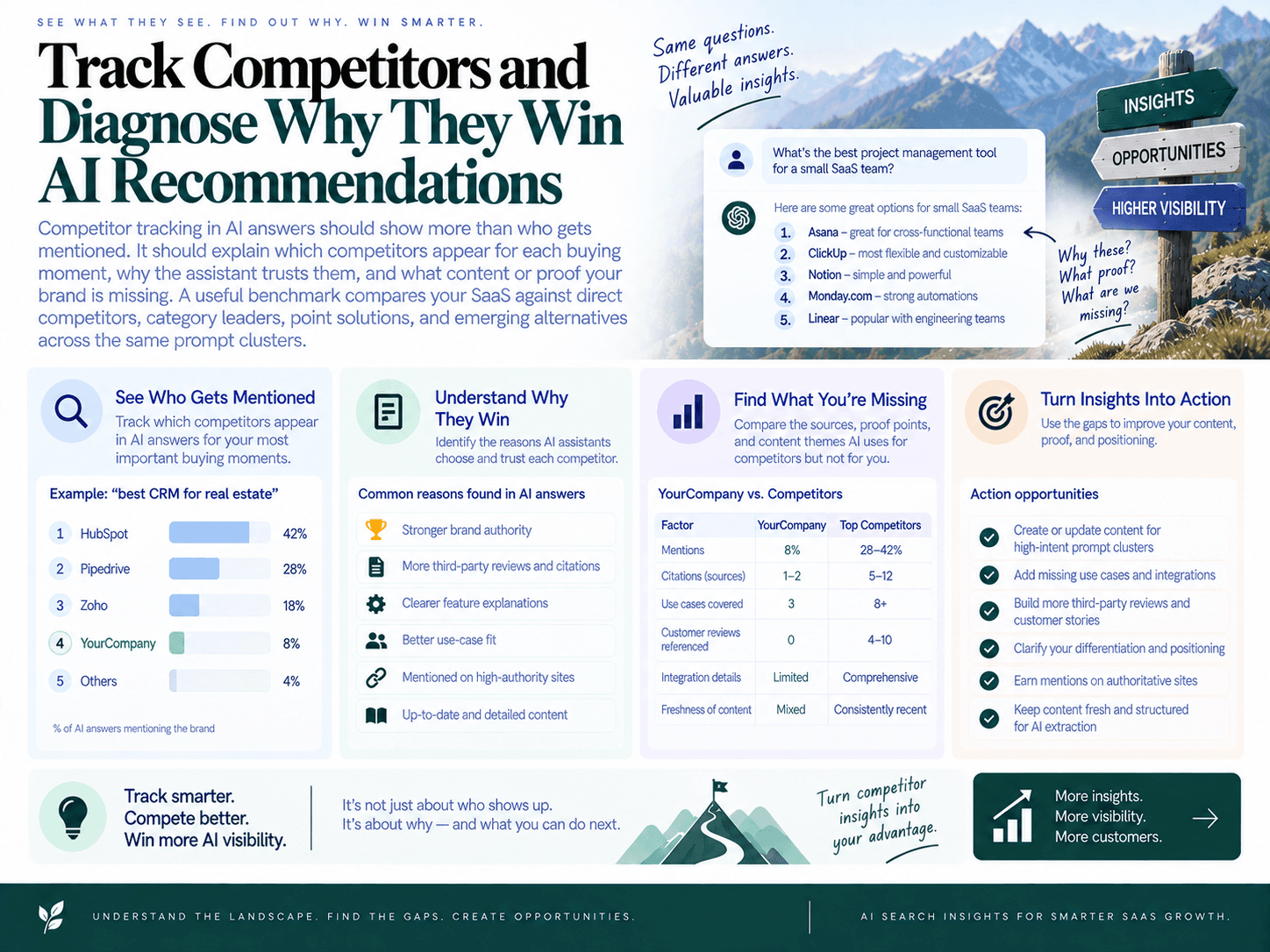
Competitor tracking in AI answers should show more than who gets mentioned. It should explain which competitors appear for each buying moment, why the assistant trusts them, and what content or proof your brand is missing. A useful benchmark compares your SaaS against direct competitors, category leaders, point solutions, and emerging alternatives across the same prompt clusters.
Create a competitor visibility matrix
Build the matrix at the prompt-cluster level, not just the individual prompt level. For example, group prompts into clusters such as “best tools for customer onboarding,” “alternatives to [competitor],” “software that integrates with HubSpot,” or “tools for reducing support ticket volume.” Then record which brands appear consistently across ChatGPT, Perplexity, and Gemini.
Your competitor visibility tracking matrix should include:
Prompt cluster: The use case, audience, or decision moment being tested.
Your brand mentioned: Yes or no, plus whether the mention is prominent or incidental.
Competitors mentioned: Direct competitors, larger category players, niche tools, marketplaces, or open-source options.
Recommendation order: Whether your brand appears first, mid-list, last, or only in a caveat.
Citations used: Your website, competitor websites, review platforms, listicles, documentation, integration pages, or community discussions.
Strengths described: The capabilities or positioning the AI assistant associates with each vendor.
Weaknesses mentioned: Pricing concerns, missing features, complexity, audience mismatch, or implementation friction.
Missing proof: The evidence buyers would need but the answer does not cite, such as case studies, ROI data, integration documentation, or comparison content.
This structure turns a vague observation like “Competitor X keeps showing up” into a practical diagnosis: “Competitor X wins implementation prompts because their documentation is cited repeatedly, while our implementation content is thin or not discoverable.”
Identify the content assets AI assistants rely on
When a competitor wins a recommendation, inspect the sources and language behind the answer. AI assistants often favor brands with clear, specific, and externally corroborated information. Strong ChatGPT brand visibility, for example, may come from a combination of explicit product pages, third-party mentions, and comparison content that makes the vendor easy to summarize.
Look for patterns in the citations and answer summaries:
Comparison pages: Does the competitor have clear “X vs Y” or “alternatives to X” pages that explain fit, tradeoffs, and use cases?
Integration documentation: Are they cited for specific workflows with Salesforce, HubSpot, Slack, Shopify, WordPress, Framer, or other platforms your buyers care about?
Use-case pages: Do they have pages for distinct audiences such as startups, agencies, RevOps teams, customer success teams, or enterprise buyers?
Third-party validation: Are review sites, partner directories, analyst pages, customer stories, or trusted blogs reinforcing their claims?
Category positioning: Is their product category easier for an AI system to understand because the site uses consistent terminology?
Freshness: Are their pages more current, better maintained, or more aligned with recent market language?
This is where competitor tracking overlaps with practical turn competitor research into a practical content plan workflows. The goal is not to copy a rival’s content calendar. It is to understand which assets make their product easier to recommend for high-intent buyer questions.
Turn omissions into content gaps
If your brand is absent from a high-value AI recommendation, treat the omission as a content and positioning signal. The assistant may not have enough reliable information to connect your product to that use case, audience, integration, or buying criterion.
Common causes of visibility gaps include:
Unclear category language: Your site describes the product creatively, but not in terms buyers and AI systems can map to a known problem.
Missing decision-stage pages: Competitors have comparison, alternative, or “best tools” content while your site only has broad feature pages.
Thin proof: Claims are not supported by customer examples, metrics, screenshots, reviews, or implementation detail.
Weak integration coverage: Buyers ask for tools that work with specific platforms, but your integration pages are missing, shallow, or hard to cite.
No implementation depth: Competitors explain onboarding, migration, setup, security, or workflow deployment more clearly.
Outdated source ecosystem: Older third-party pages, listicles, or directories describe competitors more accurately than they describe you.
The right response is not to “game” AI answers. The durable approach to answer engine optimization is to create clearer, better-cited, more useful assets that resolve the questions buyers are already asking. If AI assistants consistently recommend a competitor for “best SaaS tool for [use case],” your next action might be a use-case landing page, a comparison page, an integration guide, or a proof asset that makes your fit obvious and verifiable.
Over time, the competitor matrix should help your team separate brand awareness problems from content gaps. If competitors are cited because they have stronger documentation, build documentation. If they win because they are clearer about audience fit, sharpen positioning. If they appear because third-party sources validate them, prioritize review generation, partner listings, and customer proof. AI visibility improves when the web contains enough accurate, specific, and useful information for assistants to confidently include your brand.
Create a Reporting Workflow That Leads to Published Content
A useful AI visibility report is not a collection of screenshots. It is an operating rhythm that turns benchmark results from ChatGPT, Perplexity, Gemini, and other answer surfaces into decisions: which buying moments you are winning, where competitors are being recommended instead, which answers are inaccurate, and what content should be published next.
For most SaaS teams, the right cadence is weekly for fast-moving categories and monthly for more stable markets. The goal of AI search visibility tracking is to spot directional trends across prompt clusters, not to overreact to one fluctuating answer.
Report trends by prompt cluster, not isolated prompts
Organize every report around the way buyers evaluate software. Instead of listing 200 individual prompts, roll them up by funnel stage, use case, audience, competitor, and content gap. This makes the report useful for SEO, product marketing, demand generation, and sales enablement.
A practical dashboard should include:
Overall visibility score: a blended score across mention rate, citation rate, recommendation position, accuracy, sentiment, and source quality.
Mention rate: the percentage of benchmark answers where your brand appears.
Citation rate: how often your website or credible third-party sources are cited when your brand is mentioned.
Top winning clusters: prompt groups where your brand is consistently mentioned, recommended, or cited.
Top losing clusters: commercially important prompt groups where your brand is absent, ranked low, or described inaccurately.
Competitor share of voice: which competitors appear most often by cluster, and whether they are recommended above you.
Inaccurate answer issues: outdated positioning, missing features, wrong audience fit, unsupported claims, or incorrect pricing and integration assumptions.
Recommended content actions: the specific asset needed to improve the answer quality for that buying moment.
The key reporting unit is the cluster. A single “best tools for X” response may vary, but if your brand is missing from 18 out of 20 high-intent prompts about the same use case, that is a strategic content gap.
Prioritize fixes by revenue potential
Not every visibility gap deserves immediate production work. Prioritize clusters where three things overlap: high commercial intent, strong product fit, and weak current visibility. This prevents the team from chasing broad awareness prompts while decision-stage buyers are being routed to competitors.
Use a simple action matrix:
Competitor appears in “X vs Y” prompts and you do not: create or improve comparison pages with clear positioning, use cases, limitations, and proof.
Competitors dominate “alternatives to [brand]” prompts: publish alternatives pages that explain fit, migration paths, and evaluation criteria.
Your brand is absent from integration-related prompts: create integration landing pages, setup guides, and workflow examples.
AI answers mention implementation concerns: publish onboarding documentation, deployment guides, security pages, or role-specific implementation content.
Buyers ask about business value: create pricing explainers, ROI pages, calculators, customer proof, or outcome-based case studies.
The category is misunderstood: publish category education that defines the problem, explains options, and clarifies when your product is a fit.
This is where reporting should connect to execution. Visibility gaps should not sit in a spreadsheet for a quarter. They should become ranked topics, briefs, and publishable assets. If your team already manages SEO operations, use the same discipline you would use to build a prioritized publishing backlog from SEO opportunities.
Use automation to connect visibility gaps to execution
Manual reporting can work at the beginning, but it becomes fragile as your prompt set expands. SaaS teams need a repeatable way to discover buyer questions, group them into opportunities, measure visibility, and convert gaps into content work.
SEO Autopilot’s Prompt Universe is built for this workflow. It maps buyer-oriented prompts across research, comparison, purchase, implementation, and expansion moments, then groups those prompts into actionable content opportunities. Its AI Visibility runs test representative prompts from priority clusters with OpenAI and analyze brand mentions, website citations, recommendation position, sentiment, competitor mentions, competitor rankings, and missing content assets.
That matters because AI share of voice is only useful if the next step is clear. If the report shows that competitors win “best tools” prompts because they have stronger comparison content, your team needs comparison assets. If the gap is implementation trust, you need documentation and proof. If the gap is source quality, you need clearer pages that AI systems and buyers can cite.
For decision-stage gaps, SEO Autopilot’s Comparison Builder can help create evidence-backed brand-versus-competitor pages, competitor-alternative pages, and best-tools articles using verified product information and live competitor research. That gives teams a safer way to produce commercial content for high-intent prompts while keeping claims grounded and reviewable.
The final workflow is simple: measure visibility, diagnose the missing asset, prioritize by revenue impact, create the brief, publish the page, and re-run the benchmark. When this loop is connected to your content operation, answer engine optimization becomes a publishing system rather than a reporting exercise. For teams that want to operationalize the full path from insight to live page, the next step is to connect briefs, drafts, links, and publishing in one workflow.
Conclusion: A 30-Day Rollout Plan for AI Visibility Measurement
The fastest way to make AI visibility measurable is to treat it like an operating rhythm, not a one-time audit. In 30 days, a SaaS team can move from anecdotal screenshots to a repeatable system for testing buyer prompts, scoring recommendations, comparing competitors, and turning gaps into published assets.
Week 1: Build your buyer-question map.
Collect questions from sales calls, demo requests, support tickets, customer interviews, Search Console queries, community threads, competitor pages, and product-led onboarding conversations. Group them into prompt clusters such as best tools, alternatives, comparisons, pain points, integrations, implementation, ROI, and use-case-specific recommendations. The goal is not to capture every possible wording. It is to create a structured prompt universe that reflects how buyers actually ask for help.
Week 2: Select benchmark prompts and run your first tests.
Choose representative prompts from the highest-value clusters and run them across ChatGPT, Perplexity, and Gemini using a consistent process. Document the exact prompt, date, model or surface where visible, browsing or search mode, raw answer, citations, recommendation order, your brand’s presence, and competitor mentions. This becomes your baseline for future prompt benchmarking.
Week 3: Score visibility, recommendation quality, and competitor share.
Review each answer for mention rate, citation rate, recommendation position, sentiment, accuracy, competitor presence, and source quality. Score at the cluster level, not just the individual prompt level. If a competitor appears in seven out of ten “best software for X” answers and your brand appears in two, that cluster has a visibility problem worth investigating.
Week 4: Turn the highest-value gaps into an execution plan.
For every important missing mention, ask what asset would make the answer easier for an AI system and a buyer to trust. That may be a comparison page, alternatives page, integration guide, implementation document, pricing or ROI resource, customer proof page, or clearer category education. Do not let findings sit in a spreadsheet; build a prioritized publishing backlog from SEO opportunities and assign briefs, owners, and publish dates.
This is where AI search visibility tracking becomes useful: not when it produces a perfect score, but when it creates a clear action loop. If your product is absent from a high-intent recommendation prompt, create the missing proof. If the answer describes your positioning inaccurately, improve your product pages and documentation. If competitors dominate a comparison cluster, publish stronger decision-stage content that answers the question directly and credibly.
SEO Autopilot can support this workflow by helping teams move from research to execution. Prompt Universe maps buyer-oriented prompts, groups them into content opportunities, checks OpenAI visibility on representative prompts, and analyzes mentions, citations, recommendation position, sentiment, competitor mentions, rankings, and missing content assets. For commercial gaps, Comparison Builder helps create evidence-backed comparison, alternatives, and best-tools pages using verified product information and live competitor research. From there, teams can connect briefs, drafts, links, and publishing in one workflow.
Keep the final caveat in mind: AI answers are directional. They can change by model, prompt wording, timing, personalization, browsing mode, and available sources. Do not overreact to one response. Measure trends across representative prompt clusters, repeat the process on a regular cadence, and connect every visibility insight to a content asset, proof point, or positioning improvement that makes your SaaS easier to recommend.

About the author: SEO Autopilot — Get recommended by Google and AI
SEO Autopilot is the SEO operating system for SaaS teams: it finds what to write from your site, competitors, and Search Console — then publishes evidence-verified comparison pages and intent-matched content on autopilot to WordPress, Framer, and more.
Areas of expertise: seo, aeo, geo, Search Engine Optimization, Answer Engine Optimization, Generative Engine Optimization, SEO Expert, Article Writer