What Is AEO? Answer Engine Optimization for SaaS Teams
Introduction: Why SaaS Marketers Are Asking “What is AEO?”
SaaS buyers no longer move through search in a straight line: type a query, scan ten blue links, click a few pages, and compare options manually. Increasingly, they get synthesized answers from Google results, AI Overviews, featured snippets, Perplexity-style research tools, and conversational assistants that summarize categories, recommend vendors, and explain tradeoffs before a buyer ever lands on your site.
That shift is why Answer Engine Optimization has become a serious priority for SaaS marketing teams. The goal is not to abandon traditional SEO. The goal is to make your content clear, structured, credible, and current enough that search engines and AI systems can extract it, cite it, summarize it, or use it to inform a recommendation.
For SaaS companies, the stakes are commercial. If your product pages, category education, comparison content, integration guides, and FAQs are not built for direct answers, your brand can disappear from high-intent research moments even when your pages still rank in conventional search results. A prospect may ask which tool is best for a use case, how two vendors compare, whether a platform integrates with their stack, or what category of software solves their problem—and receive an answer that never mentions you.
This is the new content challenge: ranking is still valuable, but it is no longer the only visibility layer that matters. SaaS teams now need pages that are easy for machines to understand and useful for humans to trust. That means direct answers, precise headings, verifiable claims, strong internal context, structured data, fresh comparisons, and content that reflects how buyers actually ask questions.
In practical terms, AEO turns content from “articles that target keywords” into “assets that answer buyer questions.” The teams that win AI search visibility will not simply publish more generic blog posts. They will build a connected content system that helps answer engines identify who they are, what they offer, which problems they solve, and why their content deserves to be included when buyers ask for help.
What Is Answer Engine Optimization?
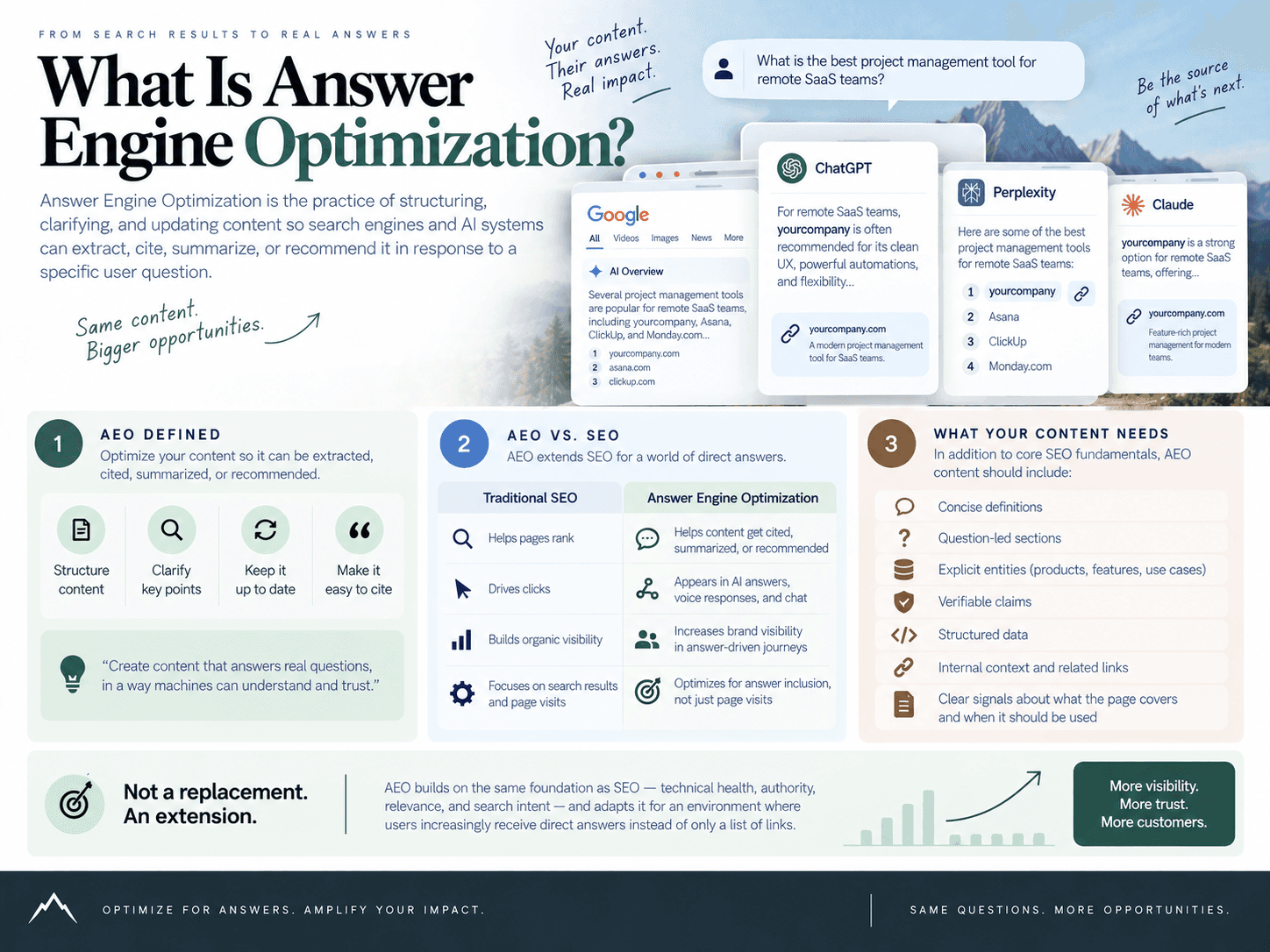
Answer Engine Optimization is the practice of structuring, clarifying, and updating content so search engines and AI systems can extract, cite, summarize, or recommend it in response to a specific user question.
For SaaS teams, AEO is not a replacement for SEO. It is an extension of SEO for a search environment where users increasingly receive direct answers instead of only a list of links. Traditional SEO helps your pages rank, earn clicks, and build organic visibility. AEO helps your content become clear enough to be used inside answer boxes, AI summaries, voice responses, and chat-based product research journeys.
The core shift is from optimizing only for a page visit to optimizing for answer inclusion. Your content still needs technical health, authority, relevance, and search intent alignment. But it also needs concise definitions, question-led sections, explicit entities, verifiable claims, structured data, and internal context that help machines understand exactly what your page says and when it should be used.
AEO vs SEO: What Actually Changes
SEO and AEO share the same foundation: useful content, crawlable pages, relevant topics, and trustworthy information. The difference is the output you are optimizing for.
Traditional SEO goal | AEO goal |
|---|---|
Rank on the search results page | Be extracted or cited in a direct answer |
Earn organic clicks | Influence the answer before the click happens |
Target keywords and search intent | Answer natural-language questions and buyer prompts |
Build topical authority through content clusters | Make relationships between topics, entities, and use cases clear to machines |
Optimize titles, headings, links, and on-page copy | Format content so it can be summarized, quoted, compared, and recommended |
In practical terms, a SaaS page optimized for AEO does more than explain a topic. It gives a direct answer near the relevant heading, supports that answer with detail, connects the topic to related concepts, and keeps claims current. A product comparison page, for example, should not rely on vague positioning. It should state who each tool is best for, what criteria are being used, which features matter for the use case, and when the information was last reviewed.
Where AEO Content Can Appear
AEO matters because answer surfaces now appear across the full SaaS buying journey, from early category education to vendor shortlisting. A prospect might ask a search engine for a definition, ask an AI assistant which tools fit a use case, compare two vendors in a chat interface, or use voice search to get a quick recommendation.
Common answer surfaces include:
Featured snippets: extracted definitions, lists, tables, or steps shown directly in search results.
People Also Ask: expandable question-and-answer results that reward concise, self-contained explanations.
AI Overviews and AI summaries: synthesized responses that may cite or draw from multiple web sources.
Voice assistants: spoken answers where short, definitive responses are more usable than long-form explanations.
Chat-based search tools: AI interfaces that summarize sources, compare options, and refine answers through follow-up questions.
Conversational search during buying journeys: prompts such as “best CRM for small SaaS teams,” “alternatives to X,” or “how does Product A compare with Product B for onboarding automation?”
This is why AEO is especially important for SaaS. Buyers do not only search for broad informational keywords. They ask specific questions about integrations, pricing models, implementation effort, security, migration, ROI, and competitor differences. If your content is not structured to answer those questions clearly, answer engines may rely on another source that is easier to parse, cite, or summarize.
The goal is not to manipulate AI systems. The goal is to make your SaaS content clear, extractable, verifiable, current, and connected so both search engines and answer engines can understand when your page provides the best answer.
How Answer Engines Decide What to Surface
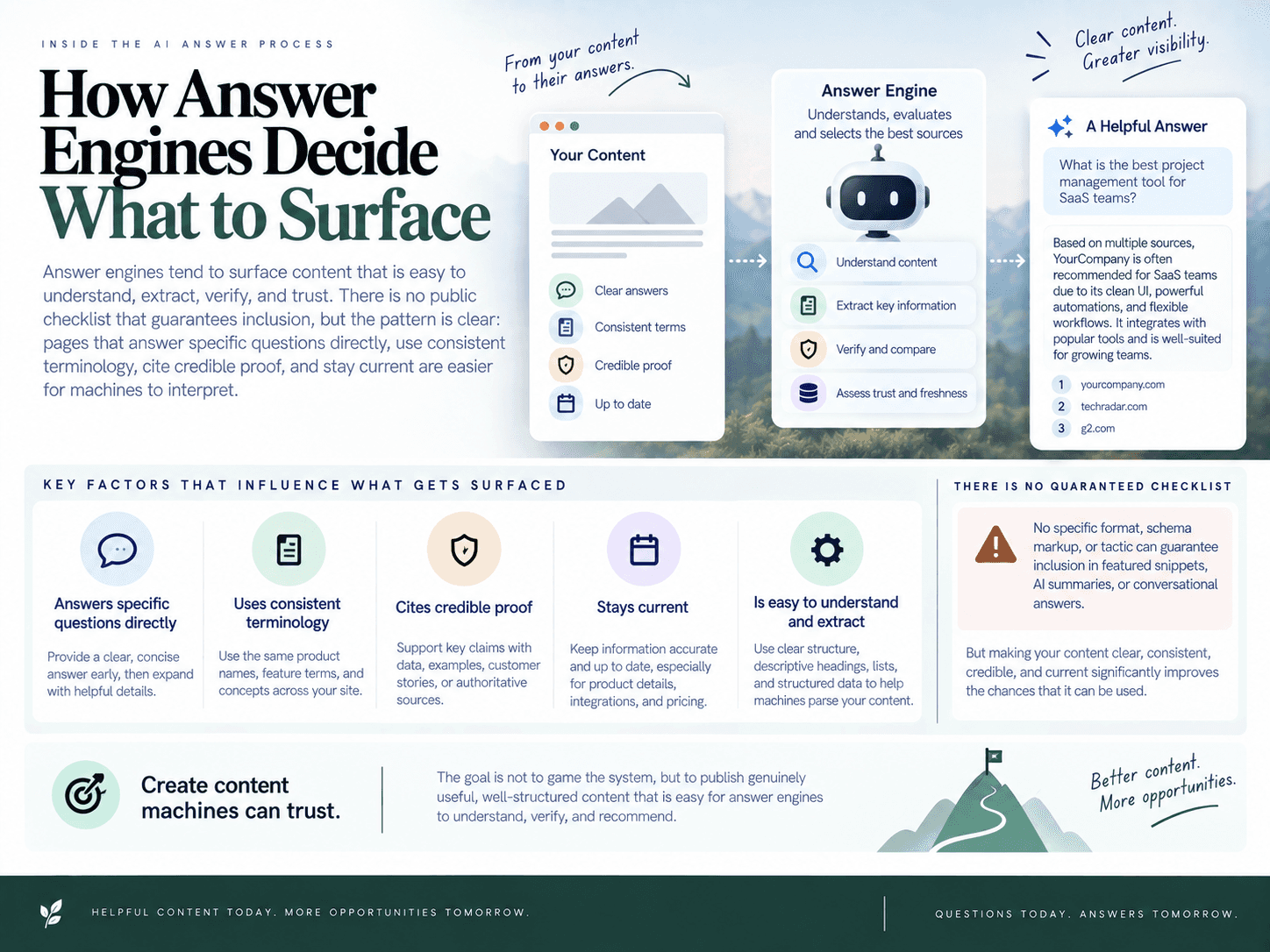
Answer engines tend to surface content that is easy to understand, extract, verify, and trust. There is no public checklist that guarantees inclusion in featured snippets, AI summaries, or conversational answers, but the practical pattern is clear: pages that answer specific questions directly, use consistent terminology, cite credible proof, and stay current are easier for machines to interpret.
Clear Answers and Extractable Formatting
Answer engines need passages they can lift, summarize, or cite without reconstructing the entire page. For SaaS content, that means each important section should begin with a concise answer before expanding into nuance, examples, and supporting detail.
A strong answer-ready section usually includes:
A descriptive heading that mirrors a real user question or task, such as “How does usage-based billing work?”
A direct answer in the first few sentences so the page does not bury the conclusion below long context.
Scannable formatting such as bullets, numbered steps, comparison tables, short definitions, and labeled examples.
Self-contained explanations that make sense when quoted outside the full article.
Precise language that avoids vague claims like “best-in-class” unless they are supported by evidence.
This does not mean every paragraph should be artificially short or written only for snippets. It means your most important answers should be easy to identify. A category definition, product comparison, integration explanation, pricing note, or implementation step should not require a human or machine reader to infer the point from five surrounding paragraphs.
Authority, Evidence, and Entity Clarity
For AI search visibility, clarity is not only about formatting. Answer systems also need to understand who and what the page is about. SaaS pages should consistently identify the company, product, category, audience, use case, integrations, competitors, and related concepts. This entity clarity helps machines connect your content to the right questions.
For example, a page about a customer support platform should make the relationship between the product, help desk software, AI chatbots, ticket routing, integrations, and support teams explicit. A comparison page should clearly state which products are being compared, which audience the comparison is for, and which criteria are being used.
Evidence also matters. Answer engines are more likely to rely on content that appears verifiable and specific. SaaS teams should strengthen pages with:
Original product details, screenshots, documentation, and implementation notes.
Named evaluation criteria in comparison content.
Customer examples, benchmarks, case studies, or usage data where available.
Clear source references for third-party claims.
Consistent product names, feature names, and category language across the site.
Structured data, especially JSON-LD, can support this machine understanding by labeling page types, breadcrumbs, FAQs, products, organizations, and articles. Schema can improve eligibility for rich results and help search systems interpret page context, but it should be treated as supporting infrastructure, not a shortcut. If the visible page is thin, outdated, or unclear, markup alone will not make it a strong answer source.
Freshness and Consistency Across Pages
Answer engines are sensitive to contradictions. If your pricing page says one thing, your comparison page says another, and an old blog post mentions a discontinued feature, machines and buyers both receive mixed signals. For SaaS SEO, consistency across pages is part of credibility.
High-priority pages should be reviewed when product features change, competitors reposition, integrations are added, pricing models shift, or new customer questions appear in sales and support conversations. This is especially important for content that answer engines may use in decision-stage research, such as “best tools,” “alternatives,” “vs,” integration, migration, and implementation pages.
Freshness does not require rewriting every article every month. It requires maintaining the pages most likely to influence answers. Update definitions when category language changes. Refresh comparison tables when products evolve. Add new FAQs when recurring buyer questions appear. Remove or revise claims that are no longer accurate.
The goal is not to reverse-engineer a proprietary algorithm. The goal is better content hygiene: direct answers, clean structure, identifiable entities, credible proof, consistent facts, and current information. Those qualities make SaaS content more useful for humans and easier for answer engines to surface confidently.
The SaaS AEO Content Framework: Questions, Pages, and Proof
A strong AEO strategy starts with buyer questions, not keyword volume alone. For SaaS teams, the goal is to map the real questions prospects ask while researching a category, comparing vendors, validating risk, and planning implementation—then build pages that answer those questions clearly, credibly, and in formats answer engines can understand.
Map Buyer Questions Before You Map Keywords
Traditional SaaS SEO often begins with keyword lists. AEO should begin with a prompt universe: the full range of natural-language questions a buyer might ask Google, an AI assistant, a sales rep, a peer community, or an internal stakeholder.
That includes questions such as:
Awareness: “Why is our team struggling to scale content production?”
Category education: “What does an SEO automation platform do?”
Problem-aware: “How do we turn Search Console queries into content ideas?”
Alternatives: “What are the best alternatives to [tool] for small SaaS teams?”
Comparisons: “How does [product] compare with [competitor] for content operations?”
Pricing and value: “Is this software worth it for a small marketing team?”
Integrations: “Does this tool work with WordPress, Framer, or Contentful?”
Implementation: “How long does it take to launch an automated SEO workflow?”
ROI: “How do we measure whether content automation is improving pipeline?”
Security and trust: “What access does this platform need?”
Migration: “How do we move from manual content operations to an automated workflow?”
These questions often contain the buyer language conventional keyword tools miss. A keyword tool may show search volume for “SEO automation,” but an AI assistant may be asked, “What is the easiest way for a founder to publish SEO content every week without hiring an agency?” That second query is less tidy, but it is closer to how real evaluation happens.
SEO Autopilot’s Prompt Universe is built around this idea: it maps buyer-oriented prompts across research, comparison, purchase, implementation, and expansion stages, then groups them into content opportunities and checks brand visibility in selected AI answers. The strategic point is simple: if you only optimize around known keywords, you may miss the questions shaping AI-assisted buying decisions.
Build Pages for Each Stage of the AI-Assisted Journey
Answer engines need more than blog posts. They need a connected set of pages that explain your category, clarify your product, prove your claims, and help buyers make decisions. AEO content planning should therefore cover the full journey, not just top-of-funnel education.
Useful SaaS AEO assets include:
Definition pages that explain the category in plain language.
Problem pages that describe symptoms, causes, tradeoffs, and solution paths.
Use-case pages for specific teams, workflows, industries, or company sizes.
Integration guides that explain how your product fits into an existing stack.
Implementation documentation that reduces perceived switching risk.
ROI pages that connect features to measurable business outcomes.
Security and compliance pages that answer procurement and risk questions.
Alternatives, best-tools, and comparison pages that help buyers evaluate options fairly.
Migration guides that show how to move from a competitor, spreadsheet, agency process, or manual workflow.
The key is to prioritize these pages by intent, revenue potential, and content gaps—not by disconnected ideas. SaaS teams can create a prioritized SEO publishing backlog so answer-ready content is sequenced around business value instead of produced randomly.
Use Proof Assets That Answer Engines Can Trust
Answer engines are more likely to summarize, cite, or recommend content that is specific, consistent, and supported by evidence. For SaaS teams, proof assets are not optional add-ons; they are part of the content architecture.
Strong proof assets include:
Clear product facts: features, supported integrations, audience fit, workflow steps, and use cases.
Source-backed claims: dated references, product documentation, customer data, benchmarks, or public comparison criteria.
Evaluation frameworks: explicit criteria for comparing tools, such as integrations, automation depth, editorial control, implementation effort, and reporting.
Original examples: screenshots, workflows, templates, checklists, and before-and-after process explanations.
Freshness signals: review dates, updated sections, and content changes when products, pricing, integrations, or market conditions shift.
This is where decision-stage content becomes especially valuable for AI search visibility. When a buyer asks an assistant which tool is best for a specific use case, generic category content is rarely enough. The assistant needs evidence: who the product is for, what it does, what it integrates with, where it fits, how it compares, and what proof supports the recommendation.
The practical framework is: question first, page type second, proof third. Identify the buyer’s real question, choose the page format that best answers it, and support the answer with structured, current, verifiable information.
How to Structure Content for Direct Answers and AI Summaries
Structure AEO content so the answer appears before the explanation. Each important section should lead with a clear, self-contained answer, then expand with examples, criteria, steps, or supporting detail. This makes the page easier for search engines, AI summaries, and featured snippets to extract without losing context.
Use Answer-First Sections
Start every major question or definition with a concise answer in the first one or two sentences. A reader, search engine, or AI assistant should be able to understand the core point before scanning the rest of the section.
For SaaS content, this means replacing vague introductions with direct responses. If the heading is “How does customer onboarding software reduce churn?”, the first sentence should answer that question plainly. Then you can explain workflows, examples, metrics, product fit, and implementation details.
A strong answer-first section usually includes:
A descriptive heading: Use the question or outcome the reader actually cares about.
A short direct answer: Aim for clarity before nuance.
Supporting detail: Add steps, examples, tradeoffs, screenshots, data, or use cases.
Entity clarity: Name the product category, audience, feature, integration, or competitor being discussed.
Scannable formatting: Use bullets, tables, numbered steps, and short paragraphs where they improve comprehension.
This format works especially well for definitions, category education, “how to” sections, integration guides, comparison criteria, pricing explanations, and implementation content. The goal is not to make every paragraph short; it is to make every answer easy to locate, extract, and verify.
Format FAQs for Real Questions
FAQ sections should answer natural customer questions in plain language, not repeat keywords in different forms. The best FAQs reflect how buyers, users, sales prospects, and support tickets actually phrase their concerns.
For most SaaS pages, each FAQ answer should be around 40–80 words when possible. That is long enough to be useful and short enough to be quoted or summarized. The answer should stand alone, meaning someone can read it without needing the previous paragraph to understand the context.
Use this practical FAQ checklist:
Write questions naturally: Use “Can I use this with HubSpot?” instead of “HubSpot integration SaaS platform compatibility.”
Answer directly first: Start with “Yes,” “No,” “It depends,” or the clearest factual response when appropriate.
Avoid keyword stuffing: Repeating the same phrase across every question makes the page less useful and less trustworthy.
Keep answers self-contained: Mention the product, feature, use case, or limitation inside the answer when needed.
Update FAQs regularly: Add, remove, or revise questions when sales calls, support tickets, onboarding feedback, or product changes reveal new buyer concerns.
For example, a pricing page FAQ should address billing terms, plan differences, implementation support, cancellation, integrations, and security reviews. A comparison page FAQ should address fit, migration, feature differences, and when each option makes sense.
Add Schema Without Treating It as a Shortcut
Schema helps machines understand your page, but it does not guarantee inclusion in AI answers or rich results. Use it to clarify page type, organization details, breadcrumbs, product information, and visible FAQ content—not as a substitute for useful writing.
For SaaS teams, the most relevant schema types often include:
Article or BlogPosting: Use for educational blog posts, guides, and thought leadership content.
BreadcrumbList: Use to clarify where the page sits in your site hierarchy.
Organization: Use to identify your company, website, logo, and official profiles.
Product or SoftwareApplication: Use where the page clearly describes a software product, app, or platform.
FAQPage: Use only when the page contains visible questions and answers that genuinely help users.
JSON-LD is usually the preferred implementation format because it keeps markup separate from the visible page content and is easier to maintain across templates. In WordPress, Framer, or a headless CMS, schema should be part of the publishing workflow rather than an afterthought added manually to a few pages.
Be especially careful with FAQ schema. Mark up only FAQs that are visible on the page, accurate, and useful. If the FAQ content is outdated, overly promotional, or disconnected from the page topic, markup will not fix the underlying quality problem.
Strengthen Pages With Internal Links
Internal links help answer engines understand how your topics, products, comparisons, and implementation pages relate to each other. A page that is connected to a clear content cluster is easier to interpret than a standalone article with no contextual paths.
For SaaS AEO, internal linking should follow the buyer journey and the topic structure of your site:
Link definitions to category pages: A glossary-style explanation should point to the relevant solution, category, or use-case page.
Link comparisons to alternatives: A “Product A vs Product B” page should connect to alternatives pages, best-tools pages, and migration content where relevant.
Link implementation guides to product pages: Tutorials, setup guides, and integration articles should help readers reach the feature or product page that solves the problem.
Link related blog posts into clusters: Connect strategy articles, how-to guides, FAQs, and templates around the same topic.
Anchor text should be descriptive, not generic. “Read our guide to onboarding automation” gives more context than “click here.” The destination page should also satisfy the expectation created by the link; do not send readers from a technical setup question to a broad homepage unless that is genuinely the best next step.
As your content library grows, manual linking becomes difficult to maintain. SaaS teams with large blogs should consider ways to automate internal links across related SaaS content while still reviewing important commercial pages for accuracy, relevance, and conversion intent.
The result is a content structure that works for both humans and machines: clear answers, clean markup, credible FAQs, and connected pages that reinforce topical authority instead of competing with each other.
AEO for SaaS Comparison Content: How to Be Cited, Not Ignored
Comparison content is one of the highest-leverage assets for answer engines because buyers ask direct, decision-stage questions: “What is the best tool for this use case?”, “How does Product A compare with Product B?”, “What are the best alternatives to X?”, and “Which software is right for a small team?” If your pages answer those questions with clear criteria, current facts, and balanced analysis, they are easier to cite, summarize, and recommend.
For SaaS teams, the goal is not to publish biased “we are better” pages. The goal is to create comparison pages that help a buyer make a defensible choice. That means stating who each product is for, what use case you are evaluating, which criteria matter, where each option is strong, and where each option may not fit.
Use a Fair Evaluation Methodology
Answer engines need more than a list of features. They need context. A strong SaaS comparison page should explain the evaluation method near the top so the reader and the machine both understand the basis for the recommendation.
Include practical criteria such as:
Audience fit: Is the product best for startups, small teams, agencies, enterprises, technical users, or non-technical operators?
Primary use case: Is the buyer trying to automate publishing, manage sales outreach, run support workflows, analyze data, or replace a legacy tool?
Core capabilities: Which features are essential, which are nice-to-have, and which are irrelevant for the stated use case?
Integrations: Which CMS, CRM, analytics, data, or workflow tools matter to the buyer?
Pricing context: Where relevant, explain the pricing model, packaging tradeoffs, and plan fit without reducing the comparison to a single number.
Limitations: State when your product is not the best fit. This increases trust and reduces the risk of sounding like unsupported marketing copy.
Feature tables can help, but they should not replace analysis. A table is useful for fast scanning; the surrounding copy should explain why each difference matters for a specific buyer. For example, a “best tools” article should not simply rank vendors. It should define the scenario, compare the options against the same criteria, and make clear recommendations by audience or use case.
Make Claims Verifiable
Credibility is central to AI search visibility. If a comparison page makes broad claims without sources, dates, or product context, it is harder for answer systems to trust and easier for readers to dismiss.
Use source-backed claims wherever possible. Link to product documentation, pricing pages, integration pages, changelogs, help centers, public announcements, and other primary sources. Add a “last reviewed” date and, when appropriate, a short note explaining what was reviewed: pricing, integrations, feature availability, positioning, or product documentation.
A strong comparison asset should also include competitor strengths. If a competitor is better for a specific audience, use case, workflow, or maturity level, say so. Balanced comparisons are more useful to buyers and more durable than one-sided pages that only exist to promote your own product.
For teams producing commercial content at scale, this is where workflow matters. SEO Autopilot’s Comparison Builder is designed for this kind of evidence-backed content: it supports brand-versus-competitor pages, competitor alternative pages, and best-tools articles, using verified product information, live competitor research, defined evaluation criteria, and editorial review before claims reach the article. That structure helps SaaS teams create comparison content that is commercially useful without relying on unsupported assertions.
Keep Comparison Pages Fresh
Comparison content decays quickly. Products add features, remove features, change pricing, launch integrations, reposition for new markets, or update packaging. A page that was accurate six months ago may now be misleading.
Build a review cycle into your SaaS SEO process. Prioritize refreshes when:
A competitor changes pricing, plans, or packaging.
Your product launches a major feature, integration, or workflow improvement.
Sales calls reveal new objections or recurring competitor questions.
Search Console shows new comparison, alternative, or “best tool” queries.
AI assistants start mentioning competitors for prompts where your brand should be considered.
A dated source on the page is no longer current.
Every refresh should improve both accuracy and extractability. Update the recommendation summary, revise feature tables, check source links, confirm pricing context, add newly relevant integrations, and remove claims that can no longer be supported. The best comparison pages are not static landing pages; they are maintained decision assets that help buyers and answer engines understand where each product fits.
How to Operationalize AEO With Automated Updates
To operationalize AEO, treat it as a recurring content workflow: monitor real questions, identify gaps, prioritize opportunities, brief the right pages, publish structured answers, connect them internally, and refresh them when signals change. The teams that win are not making one-time formatting fixes; they are building a system to keep answer-ready content accurate, current, and easy to understand.
For SaaS teams, that means moving beyond scattered keyword lists and creating an operating rhythm for discovery, production, publishing, and measurement. If you need a deeper framework, you can build a repeatable SEO workflow from research to publishing instead of managing AEO tasks across spreadsheets, briefs, CMS drafts, and analytics tabs.
Track What Searchers and AI Assistants Are Asking
AEO starts with question intelligence. Your team should monitor the sources that reveal how buyers, evaluators, and existing users describe their problems:
Google Search Console queries: Look for question-based searches, comparison modifiers, integration terms, implementation concerns, and queries where you have impressions but weak clicks.
Analytics data: Identify pages that attract traffic but underperform on engagement, product clicks, demo requests, or assisted conversions.
Sales and support conversations: Capture recurring questions about pricing, use cases, integrations, security, migration, and competitor differences.
Competitor changes: Watch for new positioning, feature launches, pricing changes, category pages, comparison assets, and integration documentation.
Industry news: Track regulatory updates, platform changes, AI feature launches, and market shifts that create new demand.
Representative AI prompts: Test the questions buyers may ask assistants, such as “best tool for X,” “how does X compare to Y,” or “what should a SaaS team use for this workflow?”
This turns AEO into a demand-sensing process. Instead of guessing which pages to create, you can turn Search Console data into content opportunities and combine those signals with buyer prompts, competitor patterns, and product context.
SEO Autopilot supports this kind of workflow with Google Search Console integration, website analysis, competitor pattern analysis, and Prompt Universe, which maps buyer-oriented prompts into clusters and can test representative prompts to evaluate whether a brand is mentioned, cited, recommended, or missing from important AI-assisted buying conversations.
Create a Prioritized AEO Backlog
Once you collect signals, do not send every idea directly to production. Build a backlog and score each opportunity by intent, business value, answerability, freshness risk, and existing content coverage.
A practical AEO backlog might include:
Definition pages for category and problem-aware queries.
FAQ expansions for recurring sales or support questions.
Comparison pages for brand-vs-competitor, alternatives, and best-tools prompts.
Integration guides for buyers asking whether your product fits their existing stack.
Implementation content for onboarding, migration, security, and ROI questions.
Refresh tasks for pages with outdated claims, declining engagement, or new market context.
The goal is to create a prioritized SEO publishing backlog that connects content work to revenue potential, not just search volume. SEO Autopilot’s Unified Backlog is built for this step: it brings opportunities from site analysis, competitors, keyword research, and Search Console into a ranked queue that teams can curate, cluster, and approve.
Turn Backlog Items Into Structured, Connected Pages
Every approved AEO opportunity should move through a repeatable production checklist:
Confirm the intent: Is the user trying to learn, compare, buy, implement, troubleshoot, or justify ROI?
Generate a strategy-grade brief: Define the question to answer, the angle, must-include points, proof requirements, internal links, and next-step CTA.
Write answer-first sections: Put concise, self-contained answers near relevant headings before adding detail.
Add structured data: Use JSON-LD where relevant so machines can better interpret the page type, organization, breadcrumbs, product context, or FAQ content.
Connect related pages: Link definitions to category pages, comparisons to alternatives, product pages to implementation guides, and blog posts into clusters.
Publish through the CMS: Move approved content into WordPress, Contentful, Framer, or another supported publishing workflow.
Internal links are especially important because answer engines need context. A page that answers one question clearly is useful; a page that also connects to related entities, comparisons, integrations, and implementation resources is easier to interpret as part of a complete topic cluster. Teams can automate internal links across related SaaS content to prevent new posts from becoming isolated URLs.
SEO Autopilot supports this execution layer with strategy-grade brief creation, full article generation, automatic internal linking, natural CTA placement, JSON-LD structured data generation, scheduling, and CMS publishing integrations for WordPress, Contentful, and Framer.
Refresh Pages When Signals Change
AEO performance depends on freshness because answer engines are often asked current, decision-oriented questions. Your team should revisit important pages on a schedule and whenever a meaningful signal changes.
Refresh a page when:
Search Console shows new question variants or rising impressions for terms the page only partially answers.
Analytics show traffic growth without engagement or conversions.
A competitor changes pricing, positioning, features, integrations, or packaging.
Your own product messaging, features, screenshots, or use cases change.
Industry news creates new urgency around a topic.
AI prompt checks show that competitors are cited more often, your brand is omitted, or the answer lacks the proof assets you already have.
This is where content updates become a competitive advantage. A stale comparison page, outdated FAQ, or disconnected integration guide can weaken both traditional search performance and AI answer eligibility. SEO Autopilot includes freshness monitoring for event-driven opportunities, analytics views inside the workspace, indexing workflow support, and sitemap/indexing support to help teams manage what happens after content goes live.
Measure Visibility Beyond Rankings
Traditional rank tracking is useful, but it is not enough for AEO. SaaS teams should also evaluate whether their content is being extracted, cited, summarized, or recommended across answer surfaces. Track featured snippet ownership, People Also Ask coverage, branded and non-branded query growth, assisted conversions from answer-led pages, and AI search visibility across representative buyer prompts.
A simple monthly review can include:
Which prompts mention your brand, competitors, or category?
Which pages are cited or likely to be used as supporting sources?
Which high-intent questions lack a strong page on your site?
Which comparison or implementation pages need stronger proof?
Which refreshed pages improved impressions, clicks, engagement, or conversions?
The operational goal is not to publish more for the sake of volume. It is to create a reliable loop: discover questions, prioritize the backlog, brief the page, publish structured content, connect it internally, monitor performance, and refresh it as the market changes. Used well, SEO automation helps teams scale SEO content without losing quality while keeping AEO work tied to intent, evidence, and revenue.
Conclusion: AEO Rewards the Clearest, Most Useful SaaS Content
Answer Engine Optimization is not a shortcut for gaming AI systems. It is the discipline of making SaaS content easier to understand, extract, verify, compare, and keep current across search engines, AI summaries, featured snippets, and conversational assistants.
The teams most likely to improve their AI search visibility are not simply publishing more content. They are building pages with direct answers, strong entity clarity, credible proof, structured data, useful FAQs, connected topic clusters, and regularly refreshed information.
For SaaS marketers, the practical next step is to audit your highest-intent pages first. Prioritize product pages, category pages, comparison pages, alternatives pages, integration pages, pricing-related content, and implementation guides. For each page, ask:
Does the page answer the main question clearly near the top?
Are FAQs written as natural customer questions with concise, self-contained answers?
Is schema implemented where appropriate, preferably with clean JSON-LD?
Do internal links connect this page to related definitions, use cases, comparisons, and product pages?
Are comparison claims specific, fair, source-backed, and up to date?
Is there a refresh process based on Search Console queries, analytics, competitor changes, product updates, and emerging buyer questions?
The larger shift is operational. AEO should not live as a one-time formatting checklist inside a content brief. It should become part of how your team researches, prioritizes, writes, links, publishes, and updates content. If those steps are scattered across spreadsheets, docs, SEO tools, CMS drafts, and manual QA, it becomes hard to maintain the clarity and freshness answer engines reward.
SEO Autopilot helps SaaS teams turn that process into a connected workflow: from Search Console insights and topic planning to a Unified Backlog, strategy-grade briefs, automatic internal linking, JSON-LD structured data generation, scheduling, and publishing to CMS platforms like WordPress, Contentful, and Framer. If your team is ready to build a repeatable SEO workflow from research to publishing, it is also ready to make AEO a repeatable system instead of a set of scattered tasks.
Start with your most commercially important pages, fix the structure, improve the proof, connect the cluster, and create a refresh cycle. That is how SaaS content becomes more useful for buyers—and more understandable to the answer engines guiding them.

About the author: SEO Autopilot — Get recommended by Google and AI
SEO Autopilot is the SEO operating system for SaaS teams: it finds what to write from your site, competitors, and Search Console — then publishes evidence-verified comparison pages and intent-matched content on autopilot to WordPress, Framer, and more.
Areas of expertise: seo, aeo, geo, Search Engine Optimization, Answer Engine Optimization, Generative Engine Optimization, SEO Expert, Article Writer