How to Integrate AEO Using Traditional SEO Strategies: 2026
Introduction: Add AEO to SEO, Not Beside It
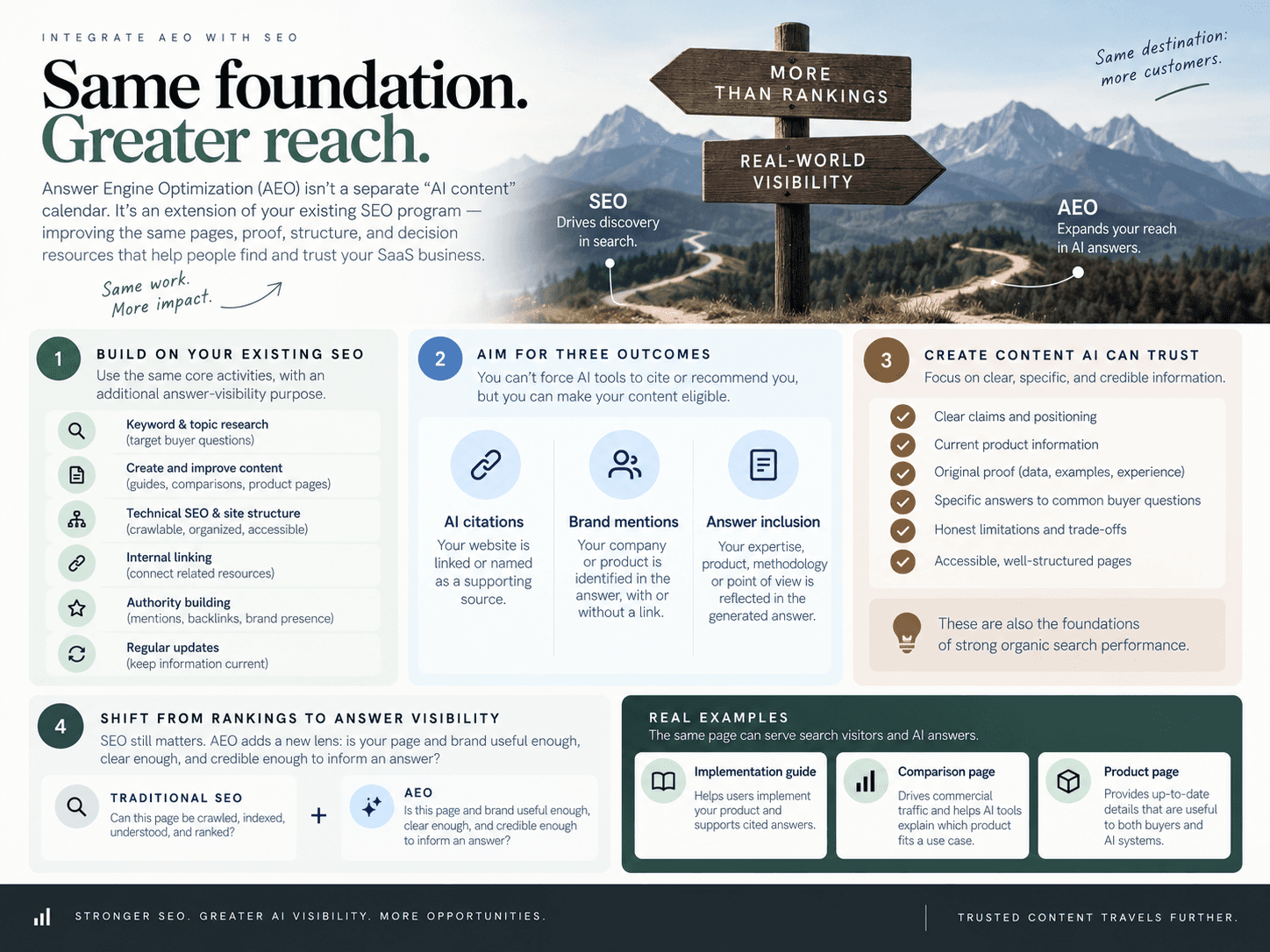
How to integrate AEO using traditional SEO strategies starts with one important correction: do not create a separate “AI content” calendar. Answer Engine Optimization is an extension of the SEO program you already run—improving the same pages, proof, site structure, and decision resources that help people find and trust your SaaS business.
The goal is broader than ranking a page. You want your company and content to be eligible to appear when an AI assistant generates a response to a buyer’s question. In practice, that means working toward three distinct outcomes:
AI citations: your website is linked or named as a supporting source for a factual statement or recommendation.
Brand mentions: the assistant identifies your company or product in its answer, whether or not it links to your site.
Answer inclusion: your expertise, product, methodology, or point of view is reflected in a generated answer to a relevant question.
These outcomes matter because buyers increasingly ask assistants to explain categories, compare vendors, solve implementation problems, and recommend tools. But they are outcomes controlled by the AI system—not deliverables a publisher can promise. No page, schema markup, backlink, or content format can guarantee that an AI platform will cite, mention, or recommend your brand.
What your team can control is far more useful: publishing accessible pages with clear claims, current product information, original proof, specific answers, and honest limitations. Those are also the foundations of durable organic search performance.
The shift from rankings alone to answer visibility
Traditional SEO asks whether a page can be crawled, indexed, understood, and ranked for a relevant search. AEO adds a practical question: is this page and brand useful enough, clear enough, and credible enough to inform an answer?
That does not replace rankings. It changes how you evaluate existing SEO work. A well-structured implementation guide can serve search visitors and support a cited answer. A transparent comparison page can capture commercial organic traffic while helping an assistant explain which product fits a particular use case. A current product page with specific documentation is more useful to both human buyers and systems assembling answers.
The operating principle is simple: strengthen trustworthy, accessible, decision-useful assets rather than producing generic pages designed only to sound answer-ready. The work remains familiar—research, technical hygiene, content hubs, internal links, authority building, commercial pages, and refreshes—but each activity gets an additional answer-visibility purpose.
What this guide means by citations, mentions, and answer inclusion
A citation is the most visible signal because it connects an answer back to a source. A brand mention can still shape consideration even when no link appears. Answer inclusion is the broadest outcome: the assistant may use your material to construct a response without quoting or visibly attributing every source.
For SaaS teams, the practical implication is to optimize for eligibility and evidence quality, not a promise of placement. Make important pages easy to access, make key facts easy to verify, and make the page genuinely helpful for a buyer making a decision. That approach improves the odds of useful visibility across search results and AI-generated answers without forcing your team to run a disconnected content operation.
Start With an AEO Layer on Your Existing SEO Priorities
Do not replace keyword research with a separate list of AI prompts. Keep the search demand, ranking opportunity, and search intent signals that already guide your SEO program, then add a second input: the questions buyers ask AI assistants while they research, evaluate, buy, implement, and expand a solution.
The goal is not to publish a page for every wording variation. It is to recognize the underlying decision a group of related questions represents, then create or improve the single best asset that can answer it credibly.
Turn keyword lists into buyer-question clusters
Traditional keyword research reveals what people type into a search box. AEO research should reveal the fuller language of the buying journey: how prospects describe a problem, compare approaches, ask for recommendations, validate a purchase, and look for implementation help.
For a SaaS company, one cluster might include questions such as:
What is the best way to automate SEO content production for a small team?
Which SEO tools help turn Search Console data into content ideas?
How can a founder create an SEO publishing workflow without a large team?
What should a small SaaS team look for in an SEO automation platform?
These are distinct buyer questions, but they may point to one commercial guide, use-case page, or comparison asset—not four thin articles. Group prompts when they share the same audience, problem, stage of evaluation, and useful answer. Split them only when the reader needs materially different proof, a different page type, or a different next step.
A practical cluster should contain:
The decision: what the prospect is trying to choose, solve, or accomplish.
The audience and context: for example, a founder, content lead, or lean growth team.
The journey stage: awareness, evaluation, purchase, implementation, or expansion.
The best page type: educational guide, feature page, integration guide, comparison page, implementation resource, or customer proof.
The proof required: product documentation, examples, screenshots, methodology, pricing context, or first-party results.
This approach prevents a common failure mode: producing dozens of generic FAQ posts because an AI assistant could theoretically receive dozens of related prompts. A well-structured, detailed page is more useful than a collection of shallow pages competing with one another.
Prioritize prompts by commercial value and content gaps
High query volume alone is not a sufficient reason to create an AEO-focused asset. Prioritize the opportunities where your company can provide a specific, well-supported answer and where that answer connects to a meaningful customer decision.
Use four questions to rank each cluster:
Is the question commercially relevant? Favor prompts tied to a costly problem, active tool evaluation, implementation friction, or expansion opportunity.
Do we have a credible answer? The page needs real product fit, practical expertise, and defensible details—not a broad claim that any competitor could make.
What proof can we show? Prioritize topics supported by documentation, original analysis, customer examples, transparent methodology, or product-specific guidance.
Is there a clear content gap? Look for absent decision-stage pages, incomplete implementation guidance, outdated explanations, or questions currently answered only by third parties.
For example, “what is SEO automation?” may attract broad awareness traffic, but “how can a small team turn Search Console opportunities into a weekly publishing workflow?” is often closer to a real operational problem. If your product and expertise directly address that problem, it deserves stronger priority even if its conventional volume estimate is lower.
SEO Autopilot’s Prompt Universe can help teams turn product and market context into structured buyer-oriented prompts, group them into content opportunities, and assess AI visibility in selected OpenAI answers. Use that output as a planning signal: it can reveal commercially important language, competitor presence, and missing assets that keyword tools may not surface clearly.
However, treat each representative prompt as directional rather than exhaustive. One tested question stands in for a broader cluster; it cannot capture every phrasing, user context, model response, or future answer variation. The operational decision should remain the same: improve the strongest page for the underlying buyer need, then measure changes using a consistent set of prompts over time.
The result is one prioritized SEO backlog rather than two competing calendars. Your existing keyword, Search Console, competitor, and conversion data continue to identify opportunities; the AEO layer makes sure those opportunities reflect the questions customers ask when an answer engine becomes part of their buying process.
Make Technical SEO Easier for Search and AI Systems to Use
Technical SEO is the delivery layer for answer-ready content. Before a page can be surfaced, interpreted, or potentially used in an AI-generated response, search systems need to find it, render it, understand its primary purpose, and distinguish it from similar pages on your site.
The goal is not to create an “AI schema” project. It is to make your existing website consistently accessible, machine-readable, and factually coherent. These improvements strengthen eligibility for search discovery and clearer interpretation; they cannot guarantee that an AI system will cite, mention, or recommend your brand.
Preserve crawlability, indexing, and clear page architecture
Start with the pages that matter most in a buyer journey: core product pages, implementation guides, comparison pages, pricing documentation, and high-performing educational articles. Each should be available to crawlers, useful to visitors, and connected to the rest of the site through logical navigation.
Allow important pages to be crawled and indexed. Check that priority URLs are not accidentally blocked by robots directives,
noindextags, password protection, faulty redirects, or orphaned from the sitemap and internal navigation.Use one preferred URL for each substantive topic. Apply canonical tags consistently when similar pages, campaign URLs, CMS-generated duplicates, or parameterized versions exist. A canonical is a signal rather than an absolute command, but inconsistent canonicals make it harder to consolidate page meaning and authority.
Make navigation descriptive. A link labeled “API integrations” communicates more than “learn more.” Use descriptive anchor text in menus, breadcrumbs, related-resource modules, and contextual links so users and crawlers can understand the destination before opening it.
Give every page a specific title and heading structure. The title tag, H1, and H2s should explain the page’s subject in plain language. A guide to SSO setup should clearly say that it covers SSO setup, rather than relying on a branded or clever headline alone.
Keep the substantive answer in the rendered page. Do not hide essential definitions, pricing conditions, feature details, comparison criteria, or implementation instructions behind interactions that fail to load reliably. JavaScript can support a modern product experience, but the meaningful page content must render consistently for visitors and search systems.
Maintain a fast, usable experience. Slow pages, unstable layouts, intrusive overlays, and hard-to-use mobile interfaces reduce the likelihood that a visitor can validate what they found. Optimize images, limit unnecessary scripts, and test core templates on mobile as well as desktop.
Think of each priority URL as a self-contained source. A reader should be able to identify what the page is about, who it is for, the answer it provides, and where to go next without reconstructing that information from surrounding pages.
Use structured data to clarify, not fabricate, meaning
Structured data gives search engines an explicit representation of page elements such as an article, product, organization, breadcrumb path, or FAQ. JSON-LD can improve machine understanding and support eligibility for applicable rich search results, especially when it mirrors clear on-page information.
It is not a direct AI-citation switch. Adding markup does not make a page more authoritative than its underlying content, nor does it force a model to include the brand in an answer. Treat schema as a clarity mechanism: it helps systems parse information you have already published accurately and accessibly.
Use a simple validation rule: every material fact should agree across the page copy, JSON-LD, product documentation, pricing or feature pages, and public company profiles. For example, if a product page says an integration is available, the same integration should not be absent from the relevant documentation or described differently in organization markup.
Mark up only content that is visible and supported on the page.
Use the schema type that matches the page’s actual purpose rather than applying the same markup everywhere.
Keep product names, brand descriptions, URLs, logo references, and key feature language consistent across properties.
Review markup after CMS template changes, product updates, redesigns, and content migrations.
For teams managing a growing publishing operation, this work should be part of the production checklist rather than a post-publication repair task. SEO Autopilot can generate JSON-LD for SEO articles and supports sitemap and indexing workflows, while its CMS integrations for WordPress, Contentful, and Framer help keep publishing connected to the broader execution process.
The practical standard is straightforward: publish pages that are accessible, canonically clear, easy to navigate, and internally consistent. That technical foundation gives search systems—and the answer systems that depend on accessible web information—a reliable source to evaluate.
Build Content Hubs That Answer Questions With Evidence
Existing topic clusters become stronger AEO assets when every page resolves a distinct buyer question with a clear answer and enough proof for a reader to evaluate it. The goal is not to create dozens of shallow AI-focused posts. It is to make your existing educational, product, and commercial pages easier to understand, verify, and navigate.
Create a hub-and-spoke structure around a buyer problem
Build a hub around a meaningful customer problem, then create supporting pages for the questions that arise at each stage of evaluation. For a SaaS company, a hub about “customer onboarding software” might connect to pages on onboarding checklists, implementation timelines, integrations, pricing considerations, migration steps, and comparisons.
The hub should establish the broader concept and direct readers to the most useful next question. Each supporting page should own one clear job rather than repeat the same generic definition in different words.
Hub page: Defines the problem, explains the main approaches, and routes visitors to deeper resources.
Educational spokes: Answer how-to, definition, framework, and troubleshooting questions.
Product and implementation spokes: Explain capabilities, setup requirements, integrations, workflows, and constraints.
Decision-stage spokes: Help buyers assess alternatives, fit, cost considerations, and tradeoffs.
This structure gives users a logical research path and gives search systems clearer context for how pages relate. It also reduces the temptation to publish thin FAQ pages that answer a question in two sentences but offer no explanation, proof, or practical next step.
Format pages for extractable, verifiable answers
Start each page with a concise, direct response to its primary question. Then earn confidence with detail. A useful answer-ready page generally follows a simple sequence: answer first, explain the reasoning, show the process or example, state relevant limitations, and guide the reader to the next action.
For example, a page answering “How long does SaaS implementation take?” should not open with a broad history of implementation. It should give a qualified answer—such as the variables that determine the timeline—then break down stages, dependencies, responsibilities, and realistic exceptions.
Use descriptive headings that state the question or conclusion, not vague labels such as “Overview” or “Key Insights.”
Define terms when the audience may interpret them differently.
Use numbered implementation steps when explaining a process.
Add comparison tables when buyers need to evaluate options against consistent criteria.
Include examples that show what the advice looks like in practice.
State limitations, prerequisites, and cases where a recommendation is not the best fit.
First-party evidence is what separates a useful page from a polished summary. Where relevant, include product documentation, annotated screenshots, methodology, pricing notes, implementation requirements, original data, customer-backed outcomes, or clearly attributed expert input. Keep those details consistent with your product pages and public documentation.
Avoid repetitive AI-generated summaries that restate familiar advice without adding a testable detail. Do not make performance, pricing, integration, or competitor claims you cannot support. Clear, specific claims with context are more useful to buyers and more resilient than broad statements such as “best-in-class” or “works for every team.”
Use internal links to show relationships between topics
Relevant internal linking connects the hub to its supporting pages and lets each supporting page point back to the broader decision. Use descriptive anchor text that tells readers what they will learn next—for example, “implementation requirements for enterprise teams” instead of “click here.”
Links help visitors and crawlers discover related resources, reinforce topical relationships, and prevent new pages from becoming isolated. They do not force an AI system to cite, mention, or recommend your brand. Their value is structural: they make the underlying expertise easier to explore and maintain. Teams that need a repeatable process can use internal linking to strengthen topic clusters without turning every paragraph into a link target.
A practical linking pattern is to connect each page to its parent hub, two or three genuinely relevant sibling pages, and the next logical decision-stage resource. Review these links whenever you add or consolidate content so the cluster continues to reflect the buyer journey rather than a publishing chronology.
SEO Autopilot can operationalize this workflow by adding internal links between related articles as content moves from brief to publication. That supports connected clusters over time, while your team retains responsibility for the accuracy, usefulness, and proof behind every page.
Turn Authority and Commercial Pages Into AEO Assets
Authority-building and decision-stage content already belong in a strong SEO program. For answer engines, their role expands: they give systems and buyers clearer reasons to recognize your company as a credible source, include it in relevant answers, and surface it when a prospect is evaluating options. The goal is not to manufacture mentions. It is to publish resources that are accurate, distinctive, easy to reference, and genuinely useful in a buying decision.
Earn mentions through genuinely useful, quotable resources
Traditional link earning remains valuable because independently referenced work can strengthen the public footprint around your brand. Focus digital PR and outreach on assets that contribute information others cannot easily reproduce, rather than generic thought-leadership posts.
Original research: Publish survey findings, anonymized product benchmarks, market analyses, or operational data with a clear methodology.
Useful tools and templates: Create calculators, checklists, implementation templates, or frameworks that solve a narrow, recurring problem.
Expert commentary: Give specific, attributable perspectives on an industry change, supported by practical experience and examples.
Transparent methodology: Explain how data was collected, how products were evaluated, what the scope includes, and where conclusions may not apply.
Durable reference pages: Maintain glossaries, implementation guides, technical documentation, and practical explainers that other publishers can confidently point to.
Make each resource easy to quote accurately. Lead with the finding or conclusion, define important terms, show supporting detail, and distinguish facts from interpretation. Include author or company context where it helps readers assess expertise. A useful source is more likely to earn links, journalist references, and brand mentions than a page built only to target a keyword.
Do not treat third-party coverage as a direct route to AI inclusion. Models control whether they cite or recommend a source. Your controllable work is to create public, consistent, well-supported information that is worth referencing across your site and the wider web.
Build comparison pages that are fair, specific, and traceable
High-intent buyers ask answer engines questions such as “What is the best tool for this workflow?” or “Which alternative fits a small team?” Your comparison, alternatives, and best-tools pages should answer those questions directly—without pretending that every buyer has the same needs.
A credible comparison page establishes its evaluation method before declaring a winner. State the audience and use case in the introduction, then assess every option against the same relevant criteria. For example, a comparison for a lean SaaS content team may evaluate workflow automation, editorial control, CMS integrations, internal linking, analytics visibility, and fit for the team’s operating model.
Define the intended buyer, company stage, and job to be done.
Use consistent criteria across all products in the comparison.
Describe where competitors are strong as well as where their fit differs.
Document meaningful limitations and tradeoffs for every option, including your own.
Link factual statements to public product pages, documentation, or pricing pages where appropriate.
Record when facts were retrieved internally and establish a review date for the published page.
Update the page after material changes to features, integrations, positioning, or pricing.
This approach produces pages that help a prospect make a decision rather than pages that simply repeat “best” claims. For a detailed framework, see how to build comparisons that support purchase decisions.
SEO Autopilot’s Comparison Builder supports three commercial formats: brand-versus-competitor pages, competitor-alternatives pages, and best-tools or best-services articles. It combines verified information about your offer with live competitor research, then keeps human review in the workflow so teams can approve, correct, or reject researched statements before an article progresses to publication. That is particularly useful when commercial pages need to stay fair, consistent, and current without turning every update into a manual research project.
Match the page type to the decision being made
Use a page format that matches the buyer’s question. A broad educational guide is rarely the best answer for a prospect comparing two named vendors, while a head-to-head page is too narrow for someone still defining the category.
Brand vs. competitor: Use when buyers are deciding between two named products and need a direct, use-case-specific evaluation.
Alternatives page: Use when a buyer wants options beyond a category leader or is looking to switch from a current tool.
Best-tools page: Use when the buyer needs a shortlist for a defined audience, budget context, or workflow.
Implementation guide: Use when the key question is how to adopt, connect, or operationalize a solution after purchase.
Category explainer: Use when the buyer is still diagnosing the problem and needs definitions, approaches, and selection criteria.
Each page should make its recommendation conditional: explain who a product is best for, which workflow it supports, and when another option may be more suitable. That specificity improves buyer trust and gives search and AI systems a clearer, more defensible answer to extract.
Refresh, Measure, and Scale the Combined SEO-AEO Program
The sustainable way to improve answer visibility is not to publish a separate stream of “AI content.” It is to run a recurring quality-and-distribution loop across the pages already driving, or capable of driving, qualified demand. Refresh factual pages, strengthen proof, fix technical and linking gaps, publish only the missing assets that matter, and measure the same buyer questions over time.
Use a recurring refresh loop for pages and proof
Start with pages that have commercial value, declining organic performance, outdated product details, or weak supporting evidence. A content refresh should improve the usefulness and reliability of the page—not simply change dates or rewrite copy.
Update product and market facts: Review features, integrations, workflows, pricing references, implementation details, and policy statements against current documentation.
Recheck comparison pages: Confirm competitor capabilities, positioning, and decision criteria still reflect the market. Preserve useful competitor strengths rather than turning the page into a one-sided sales pitch.
Add missing proof: Include product documentation, screenshots, methodology, examples, customer-backed outcomes, expert input, or clearly defined constraints where appropriate.
Consolidate overlapping pages: Merge pages that answer the same buyer question with minor wording differences. Choose one canonical, comprehensive page and redirect or repurpose weaker duplicates.
Repair stale links: Replace broken internal links, update links to moved documentation, and add relevant connections to newer hub and commercial pages.
Respond to market changes: New integrations, regulatory changes, competitor moves, and category shifts create fresh buyer questions. Publish timely pages when your team has a specific, well-supported answer.
Use an editorial trigger rather than a fixed calendar alone. A page deserves review when Search Console impressions or clicks decline, conversion performance weakens, a product claim changes, a linked resource disappears, or recurring customer questions reveal a missing explanation. This keeps publishing tied to real demand and evidence gaps.
Measure leading indicators alongside business outcomes
Your scorecard should connect conventional SEO performance with repeatable observations of how AI systems represent your market. Rankings and traffic still matter because they reveal discoverability and demand. They are not, however, a complete view of whether your brand appears in AI-assisted research journeys.
Track three layers of performance:
SEO measures: indexed priority pages, impressions, clicks, rankings for priority terms, organic sessions, assisted conversions, and organic conversions.
Content-quality measures: percentage of priority pages with current proof, evidence coverage for key claims, freshness of product and comparison facts, claim accuracy, broken-link count, and duplicate-content consolidation progress.
AI-visibility observations: brand mentions, website citations, recommendation position when the answer provides one, competitor presence, sentiment, and missing assets for a fixed set of buyer prompts.
Keep the prompt set stable enough to make changes interpretable. For example, use a representative group of questions across problem awareness, category evaluation, alternatives, implementation, and use-case fit. Record the answer date, prompt wording, brands mentioned, cited domains, recommendation order, and notable gaps. Then rerun the same set on a consistent schedule.
This is where track AI search visibility for your SaaS brand becomes an operational discipline rather than an occasional manual check. A mention or citation can change as models, sources, competitors, and product information change. Treat it as an observation to investigate—not a guaranteed outcome or a standalone KPI.
SEO Autopilot’s Prompt Universe can help teams organize buyer-oriented prompts into opportunity clusters and check selected representative prompts for OpenAI visibility, including mentions, citations, recommendation position, sentiment, competitor appearances, and missing content assets. Use those findings alongside Search Console and conversion data to decide what to improve next.
A practical 90-day implementation sequence
A lean SaaS team can establish this process in one quarter without pausing its existing SEO roadmap.
Days 1–30: Audit and select priority clusters. Inventory existing hubs, commercial pages, product documentation, and high-performing or declining articles. Identify the clusters closest to revenue, then map their buyer questions and select a fixed baseline prompt set. Flag pages with stale facts, thin proof, duplicate intent, weak internal links, or missing decision-stage assets. If planning is scattered across spreadsheets, Search Console exports, and briefs, create one prioritized queue before commissioning more content.
Days 31–60: Strengthen foundations and core assets. Resolve indexing, canonical, navigation, rendering, and broken-link issues on priority pages. Upgrade hub pages so they lead users to specific implementation, use-case, comparison, and proof content. Refresh the highest-value commercial pages with consistent criteria, current details, audience-specific guidance, and clear limitations. Improve internal pathways between related pages so each cluster is easier for users and crawlers to navigate.
Days 61–90: Publish gaps, refresh again, and compare results. Publish the small number of missing pages that prevent buyers from getting a complete answer—often alternatives, integrations, implementation guides, use-case pages, or original proof resources. Revisit refreshed pages for accuracy, submit or support indexing through your normal workflow, and rerun the same prompt set used in month one. Compare changes in organic visibility, conversions, citations, mentions, competitor presence, and content gaps.
At the end of the quarter, keep what produced qualified traffic, stronger buyer answers, and better representation in relevant AI responses. Turn the workflow into a monthly refresh review and a quarterly cluster review. Teams using SEO Autopilot can move prioritized opportunities through a Unified Backlog, generate briefs and content, add internal links, schedule publishing to WordPress, Contentful, or Framer, and monitor analytics from the same workspace.
AEO is a repeatable quality-and-distribution layer on your existing SEO program. Improve the pages buyers and systems can find, verify, understand, and use; measure the results consistently; then feed what you learn back into the next refresh and publishing cycle.

About the author: SEO Autopilot — Get recommended by Google and AI
SEO Autopilot is the SEO operating system for SaaS teams: it finds what to write from your site, competitors, and Search Console — then publishes evidence-verified comparison pages and intent-matched content on autopilot to WordPress, Framer, and more.
Areas of expertise: seo, aeo, geo, Search Engine Optimization, Answer Engine Optimization, Generative Engine Optimization, SEO Expert, Article Writer