AEO vs GEO: How SaaS Teams Build Visibility in AI Search
Introduction: Why AEO vs GEO Matters for SaaS Discoverability
Classic SEO was built around earning a place in a list of blue links. Today, many SaaS buyers begin with an AI-generated answer: a quick definition, a tool recommendation, an implementation plan, or a side-by-side comparison. AEO vs GEO matters because these experiences reward different kinds of content—and both now influence whether prospects encounter your product.
Answer Engine Optimization (AEO) helps a page become the direct, concise answer to a specific question. It is especially relevant when someone asks, “What is this?”, “How does it work?”, or “How do I solve this problem?” Clear definitions, step-by-step instructions, FAQs, and well-structured explanations make content easier for answer-oriented experiences to extract and present. If your team needs a deeper primer, learn the fundamentals of answer engine optimization.
Generative Engine Optimization (GEO) focuses on a broader outcome: helping your content become a source that AI systems can retrieve, synthesize, cite, and potentially recommend within a generated response. This is critical when a buyer asks for the best platform for a particular use case, compares alternatives, evaluates integrations, or seeks proof before purchase.
For SaaS companies, the stakes extend beyond traffic. AI assistants increasingly shape category education, product comparisons, implementation research, and shortlists before a prospect ever reaches a pricing page. A strong help article may answer an AEO-style question; an evidence-backed comparison page or implementation guide may help a generative system explain why your product fits a buyer’s context.
The practical goal is not to abandon conventional SEO. Crawlable pages, clear site architecture, topical authority, useful content, and consistent publishing remain foundational to AI search visibility. The opportunity is to build on that foundation: create content that answers individual questions cleanly while also giving AI systems credible, structured material to use when they summarize options and make recommendations.
This comparison shows how the two approaches differ, which SaaS content formats support each one, and how teams can turn buyer questions into an operational publishing system rather than treating AI discovery as a one-off content experiment.
AEO vs GEO: The Core Difference

The practical difference is simple: Answer Engine Optimization focuses on becoming the clearest direct answer to a specific question, while Generative Engine Optimization focuses on becoming a useful source that an AI system can retrieve, synthesize, cite, compare, or recommend.
Both approaches improve SaaS discoverability in AI-mediated search experiences, but they target different behaviors. A buyer asking, “What is product-led growth?” needs a concise definition. A buyer asking, “Which SEO automation platform is best for a small SaaS team using Framer?” expects the AI to evaluate options, combine information from multiple sources, and explain its reasoning.
What Answer Engine Optimization Means
Answer engine optimization makes content easy to extract and present as a direct response. It is most relevant when a searcher asks a focused, question-based query and expects a short, accurate answer.
Typical AEO opportunities include featured snippets, voice-assistant responses, AI answer boxes, FAQ-style results, troubleshooting queries, and definition-led searches. The goal is not merely to mention the topic—it is to state the answer clearly enough that a machine can identify the relevant passage without reconstructing it.
For a SaaS company, an AEO-ready page often includes:
An answer-first introduction that defines the topic in one or two sentences
Descriptive headings phrased around real customer questions
Numbered steps for setup, troubleshooting, or implementation tasks
Concise FAQ answers with precise product or category language
Clear distinctions between similar concepts, features, or workflows
For example, a page answering “How does automated internal linking work?” should lead with a plain-language explanation, then explain the process, conditions, and expected outcome. A lengthy introduction before the answer makes the page harder to use in answer-driven experiences. Readers who need a deeper primer can learn the fundamentals of answer engine optimization.
What Generative Engine Optimization Means
Generative engine optimization is designed for broader AI responses that assemble information from multiple sources. Rather than extracting a single sentence, a generative system may retrieve product pages, documentation, reviews, comparisons, research, and supporting articles before producing a tailored answer.
The optimization target is therefore broader: make your brand and content suitable for retrieval, synthesis, citation, and recommendation. A generative system needs enough context to understand what your product is, who it serves, how it differs from alternatives, and which claims it can safely include in a response.
This matters most for SaaS questions such as:
“What are the best tools for automating SEO content publishing?”
“What is the difference between an SEO platform and an AI writing tool?”
“Which solution fits a founder who needs WordPress or Framer publishing?”
“How should a SaaS team build comparison content without unsupported claims?”
Strong GEO content goes beyond polished prose. It provides clear product entities, specific use cases, transparent limitations, implementation details, proof points, and consistent explanations across related pages. Comparison pages, alternatives pages, integration guides, pricing explainers, implementation documentation, customer proof, and original research are especially valuable because they give AI systems material to evaluate in context.
In other words, AEO asks, “Can this page answer the question?” GEO asks, “Can this source help an AI produce a credible recommendation or synthesized explanation?”
Where Traditional SEO Still Fits
Traditional SEO remains the foundation for both approaches. Search engines and AI systems still need to discover, access, interpret, and trust your pages. Strong crawlability, clear site architecture, useful topical coverage, consistent entity signals, fast and accessible pages, and authoritative content improve the odds that your information can enter an AI system’s candidate set.
The overlap is substantial:
SEO helps pages get discovered and compete in conventional search results.
AEO makes individual passages clear, direct, and extractable for answer-focused experiences.
GEO builds the depth, proof, and contextual coverage needed for AI-generated summaries and recommendations.
A well-structured SaaS content library can support all three. A concise FAQ may serve an answer box. A detailed implementation guide can rank organically while supplying context for an AI assistant. A credible comparison page can help buyers evaluate alternatives while giving generative systems a clearer basis for mentioning your product.
The key is to avoid treating these as separate publishing programs. Build helpful, structured pages around genuine buyer needs, then connect related content so each new asset reinforces a coherent topic cluster. Teams can build stronger topic clusters with automated internal links rather than publishing isolated articles that are difficult for users and machines to contextualize.
How AI Assistants Select, Summarize, and Cite Sources
AI assistants do not all use the same source-selection process, but most work through a similar pattern: they identify relevant information, retrieve candidate sources, extract useful passages, and synthesize those passages into an answer. For SaaS teams, the practical implication is clear: a page must be easy to find, easy to interpret, and useful for the specific task a buyer asks an assistant to complete.
Strong traditional rankings can help, but they are not an automatic route to AI search visibility. An assistant may draw from search indexes, proprietary web indexes, connected web sources, knowledge graphs, product documentation, authoritative third-party references, and other available data sources. What appears in a response depends on the engine and the question—not simply on which page ranks first.
Retrieval: Which Sources Enter the Candidate Set
Before an assistant can summarize or cite a page, that page must enter its candidate set: the pool of sources considered relevant to the prompt. Retrieval systems often look for semantic relevance rather than exact keyword repetition. A buyer asking, “What is the best SEO workflow tool for a small SaaS team?” may surface pages about publishing automation, content planning, CMS integrations, or Search Console workflows—even when those exact words do not appear in the query.
Pages are more likely to be useful retrieval candidates when they provide clear signals about:
Entity clarity: who the company is, what the product does, who it serves, and how it differs from adjacent categories.
Task relevance: whether the page directly helps a reader compare tools, solve an implementation problem, understand a feature, or make a decision.
Topical depth: whether the site covers a subject through connected, complementary pages instead of one isolated article.
Claim consistency: whether product details, terminology, and positioning agree across product pages, documentation, comparisons, and supporting content.
Freshness: whether time-sensitive details such as integrations, workflows, pricing, product capabilities, or market changes remain current.
Accessibility: whether crawlers can access and understand the page, including its headings, links, metadata, and structured information.
This is why content architecture matters. A concise integration guide linked to setup documentation, feature pages, and relevant use cases can be more valuable than a broad, disconnected blog post. Teams that build stronger topic clusters with automated internal links give both users and machines clearer paths through related information.
Synthesis: How Answers Are Composed
Generative systems generally do not reproduce an entire source page. They extract and combine useful passages, then generate a response that addresses the user’s intent. That makes passage-level usefulness especially important.
A page does not need to be the longest resource on a topic. It needs sections that can stand on their own: a direct definition, a clear comparison table, a documented workflow, a limitation explained in context, or a specific implementation step. Each section should reduce ambiguity and answer a meaningful part of the buyer’s question.
For example, a generic statement such as “Our platform improves SEO” gives an assistant little to work with. A clearer passage explains the mechanism: “The platform turns Search Console signals, website analysis, and competitor patterns into prioritized content opportunities, then supports briefing, internal linking, scheduling, and CMS publishing.” The latter is easier to retrieve, summarize, and connect to a relevant prompt.
Structure makes those useful passages easier to interpret. Prefer descriptive headings, answer-first paragraphs, scoped lists, consistent terminology, and tables where readers need to evaluate options. Support important statements with concrete details rather than vague superlatives. Clear writing is not just a readability preference; it gives an AI system less room to misinterpret what your company offers.
Citation and Recommendation: Why Some Brands Appear
Source citations and brand recommendations are related, but they are not identical. An assistant may cite a page because it supplied a factual detail, while recommending another brand because that brand appears to fit the user’s stated audience, budget, use case, constraints, or desired outcome.
To earn inclusion in either scenario, SaaS content should make the following easy to verify:
What the product is and the category it belongs to.
Which audience and use cases it serves best.
How its workflow, integrations, and capabilities work in practice.
What proof supports important commercial claims.
When a customer should choose the product—and when another approach may be a better fit.
Third-party references can also influence trust, particularly for broad category and “best tool” prompts. But owned content still plays an essential role because it is where a company can publish accurate product details, implementation guidance, customer proof, and up-to-date explanations in its own words.
None of this creates a guaranteed citation or recommendation. AI-generated responses are probabilistic and can vary by engine, prompt wording, user location, personalization, available sources, and the freshness of indexed information. The goal is not to find a magic switch. It is to create clear, credible, retrievable content that gives assistants a strong reason to use your brand when the right buyer question appears.
Best Content Formats for AEO and GEO
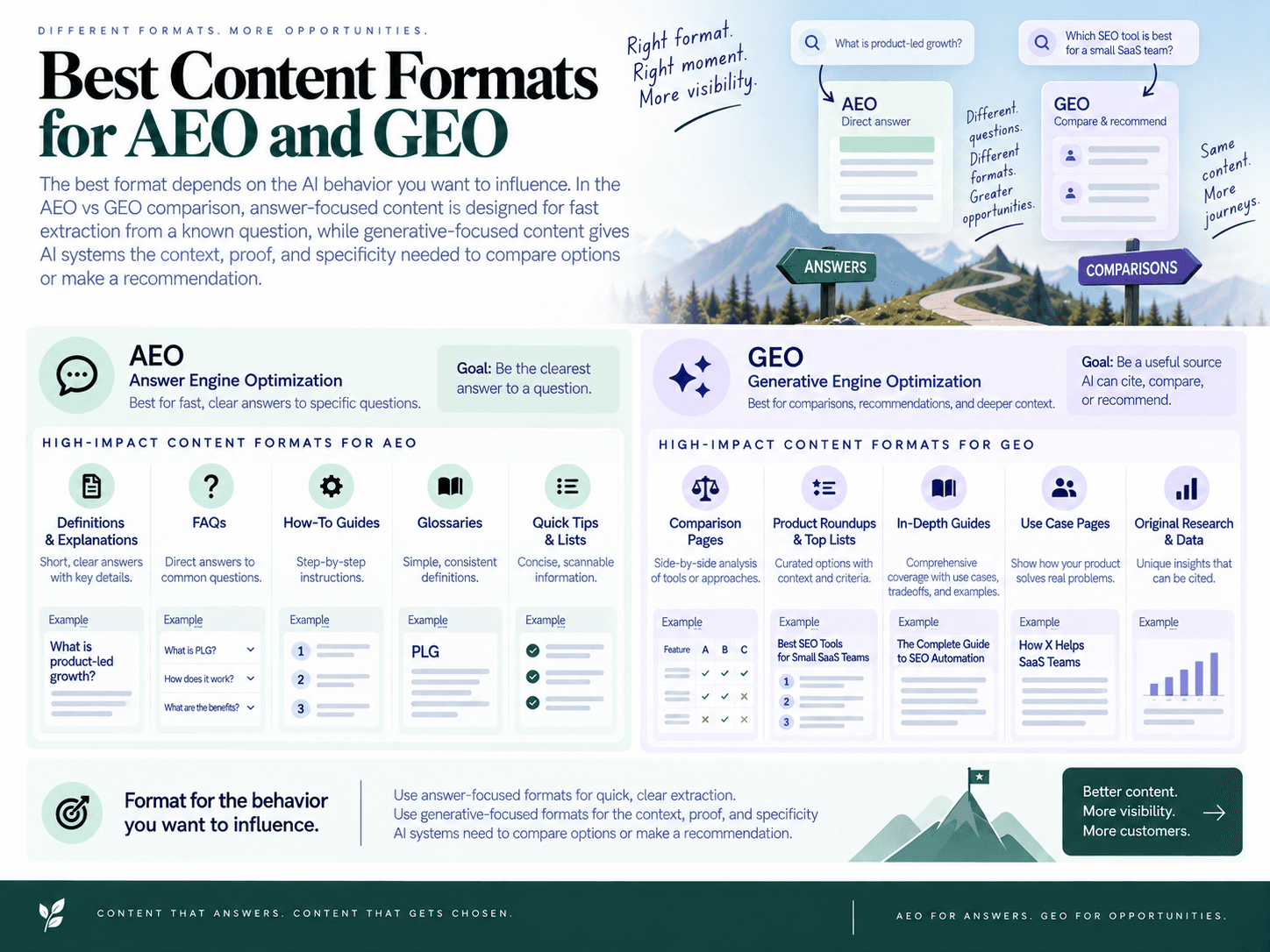
The best format depends on the AI behavior you want to influence. In the AEO vs GEO comparison, answer-focused content is designed for fast extraction from a known question, while generative-focused content gives AI systems the context, proof, and specificity needed to compare options or make a recommendation.
Formats That Work Best for AEO
AEO content should make the answer easy to find, isolate, and quote. Lead with a direct response, then provide the detail needed to validate it. A page can still be comprehensive, but its most useful passages should not require an assistant—or a reader—to infer the conclusion from several paragraphs.
Answer-first introductions: Open with a one- to three-sentence definition or recommendation before expanding on nuance.
Concise definition and glossary pages: Define category terms, metrics, workflows, and technical concepts in plain language.
FAQ sections: Use question-based headings followed by direct, self-contained answers.
How-to guides: Break implementation tasks into ordered steps, prerequisites, expected outcomes, and common mistakes.
Troubleshooting pages: Match a specific symptom to likely causes and clear resolution steps.
Comparison snippets: Include compact “best for,” “choose this when,” and feature-difference summaries within larger comparison content.
Schema-supported explanations: Use appropriate JSON-LD and clean page structure to help search systems interpret the topic and page elements.
For example, an AEO-oriented SaaS page answering “What is automated internal linking?” should begin with a direct definition, explain how it works in a short sequence, identify when it is useful, and link to deeper implementation guidance. Avoid burying the answer below product promotion, lengthy background, or vague claims.
Formats That Work Best for GEO
Generative engines need more than a neat definition when users ask, “Which platform is best for our team?” or “What should we use instead of this tool?” They need material that supports comparison, synthesis, qualification, and recommendation. The strongest pages present a clear point of view while giving specific, transparent reasons for it.
Evidence-backed comparison pages: Compare products against consistent criteria such as target user, workflow, integrations, implementation needs, and use-case fit.
Alternatives pages: Help buyers understand which options fit different constraints instead of treating every competitor as interchangeable.
“Best tools” pages: Evaluate options for a defined audience or job, such as “best SEO workflow tools for lean SaaS teams.”
Integration guides: Explain how a product connects to a specific platform, the setup path, and the workflow it enables.
Implementation documentation: Cover onboarding, configuration, roles, operational steps, and practical limitations.
Pricing and packaging explainers: Clarify how buyers should think about plans, usage, or team fit when making a purchase decision.
Customer proof pages: Use specific outcomes, use cases, quotes, and before-and-after operational context where available.
Original research and benchmark content: Publish data, methodology, trends, or unique analysis that gives assistants a reason to reference your site.
Expert point-of-view articles: Take a defensible position on a changing market, workflow, or technical decision—and support it with reasoning rather than slogans.
These assets are especially important for commercial prompts. A generic product page may describe what your software does; a strong comparison page explains who it is for, when it is the right fit, how it differs from alternatives, and what a buyer should consider before deciding. That is the context a generative response needs to produce a useful recommendation.
Formats That Support Both
The most durable SaaS content is built to serve direct-answer and generative use cases at the same time. A detailed integration guide, for instance, can answer “Does this tool work with Framer?” in one extractable section while also supplying enough setup context for an assistant to recommend it to a team evaluating Framer-based publishing.
Content format | Best use for answer engines | Best use for generative engines |
|---|---|---|
FAQ or glossary page | Definitions and direct question answers | Supporting context for broader explanations |
How-to or troubleshooting guide | Step-by-step task completion | Implementation recommendations and workflow summaries |
Comparison or alternatives page | Quick feature and fit distinctions | Commercial evaluation, synthesis, and recommendations |
Integration guide | Compatibility and setup questions | Use-case-specific product recommendations |
Customer proof or benchmark page | Specific proof-point extraction | Trust-building context for recommendations |
Regardless of format, strong AI content optimization follows a few practical rules:
Use descriptive headings that state the question or decision being addressed.
Place short answer blocks near relevant headings, not only in a conclusion.
Use tables, bullets, steps, and summaries where they make distinctions clearer.
Make product, feature, and audience claims precise and consistent across pages.
Support important assertions with transparent, source-backed statements where appropriate.
Add structured data when it fits the page type and content.
Link related explainers, guides, proof assets, and commercial pages so each new asset strengthens a connected topic cluster rather than becoming an isolated URL.
That last point matters for both visibility models. A concise FAQ answer can earn discovery for a narrow question, but a connected library of definitions, guides, integrations, documentation, and commercial pages gives AI systems a clearer picture of your product and topical expertise. Teams looking to scale this work can build stronger topic clusters with automated internal links rather than relying on one-off pages to carry the entire discoverability strategy.
A SaaS Workflow for Optimizing Both AEO and GEO
The most effective approach is to treat AI-era discoverability as a repeatable content operation: identify the questions buyers ask, prioritize the prompts closest to revenue, create the right asset for each question, then publish, connect, and measure those assets over time. Keywords still matter, but they are only one input. SaaS buyers increasingly ask full questions that reveal their role, constraints, urgency, and desired outcome.
Start With Buyer Questions, Not Just Keywords
Map questions across the complete buying journey, not just top-of-funnel education. A useful prompt map covers six stages:
Awareness: “How can a small SaaS team publish SEO content consistently?”
Research: “What is the difference between an AI writer and an SEO automation platform?”
Comparison: “What are the best SEO automation tools for founders?”
Purchase: “Which tool is best for a solo founder who needs automated SEO publishing?”
Implementation: “How do I publish SEO content automatically to Framer?”
Expansion: “How can I use Search Console data to find my next content opportunities?”
Conventional keyword research can surface demand, but it may miss this buyer-language detail. A phrase such as “SEO automation software” is useful, yet it does not reveal whether the buyer needs WordPress publishing, editorial approval, comparison content, internal linking, or a workflow that a founder can manage without a large SEO team.
Capture questions from sales calls, support tickets, onboarding conversations, product reviews, community discussions, Search Console queries, competitor pages, and AI-assisted research. Group similar prompts into clusters around a buyer job rather than treating every wording variation as a separate article.
Prioritize Prompts by Business Value and Competitive Context
Not every question deserves a new page. Prioritize clusters using four practical inputs:
Intent: Is the person learning, evaluating options, solving an implementation problem, or ready to choose?
Revenue potential: Does the question connect to a high-value use case, target segment, product capability, or conversion path?
Difficulty: Can your team produce a more useful, clearer, or more credible resource than the pages already competing for attention?
Competitive pressure: Are competitors already being cited, recommended, or ranking for this buyer need?
Start with a balanced queue. Publish a few high-intent commercial assets alongside educational and implementation content that makes your product easier to understand. This creates coverage for direct questions while also building the deeper topical context that helps generative systems assess whether your brand is relevant to a broader request.
First-party search data is especially valuable here. Teams can use Search Console data to prioritize a publishing backlog around queries where they already have impressions, partial visibility, or a clear content gap.
Match Each Question Cluster to the Right Content Asset
Question clusters should determine page type. Trying to answer every buyer need with a generic blog post produces thin coverage and weak commercial relevance.
Explainers and answer pages: Use these for definition, workflow, troubleshooting, and “how does this work?” prompts. Lead with a concise answer, then provide steps, examples, and clear headings that can be retrieved independently.
Comparison and alternatives pages: Use these for “best tool,” “X vs. Y,” and replacement prompts. Define the audience, evaluation criteria, fit scenarios, tradeoffs, and product differences clearly.
Integration guides: Use these for implementation questions, such as connecting a CMS, analytics platform, or adjacent tool. Include prerequisites, setup steps, expected outcomes, and common issues.
Proof pages: Use these for decision-stage prompts. Demonstrate outcomes with customer stories, measurable examples, product walkthroughs, transparent capability details, and relevant use cases.
Documentation and onboarding resources: Use these for customers evaluating effort, adoption, and post-purchase success. Strong implementation content can influence both acquisition and retention conversations.
A single cluster can require multiple linked pages. For example, a SaaS company targeting automated publishing may need an answer-first guide about the workflow, a product page explaining its publishing capabilities, a WordPress integration guide, a Framer integration guide, a comparison page, and proof that clarifies who benefits most.
Build Pages That Are Easy to Retrieve, Assess, and Act On
Each asset needs an editorial brief before drafting begins. The brief should specify the buyer question, search and business intent, target audience, required product details, supporting proof, competing alternatives, internal links, and the desired next action.
Write with passage-level usefulness in mind. Open with the answer, use descriptive headings, define product entities consistently, keep claims specific, and give readers enough context to understand when a recommendation applies. Avoid vague assertions such as “best-in-class” when a concrete capability, workflow, or use case would be more useful.
For commercial content, accuracy matters as much as clarity. A comparison page should explain who each option suits, how the tools differ for the stated use case, and what a buyer should consider before deciding. That makes the page more valuable to readers and more usable when an AI assistant needs to synthesize a balanced response.
Connect, Publish, and Keep Pages Fresh
Publishing is not the final step. A durable SEO automation workflow includes the operational details that turn individual articles into a discoverable content system:
Create and approve a brief with a clear buyer question and page purpose.
Write or generate the draft, then review product facts, examples, positioning, and calls to action.
Add contextual links to related explainers, comparison pages, integration guides, and product resources.
Include natural CTAs that match the reader’s stage, such as viewing a demo, starting a trial, reading implementation documentation, or comparing options.
Add appropriate structured data so search engines can interpret key page information more clearly.
Schedule publishing through the CMS, support indexing, and confirm that the live page is accessible and internally connected.
Monitor organic performance alongside brand mentions, citations, recommendation presence, competitor visibility, and unanswered buyer prompts.
Internal links are particularly important because new pages should not become isolated content islands. Related pages give visitors and crawlers a clearer path through your expertise while helping establish contextual relationships between educational, commercial, and implementation assets. Teams can build stronger topic clusters with automated internal links as their library grows.
Finally, review priority pages on a regular schedule. Product capabilities change, competitors reposition, integrations evolve, and buyers phrase their questions differently over time. Refreshing important comparison, pricing, implementation, and proof content keeps it useful for people and strengthens long-term AI search visibility.
The goal is not to publish more pages indiscriminately. It is to create a connected set of answerable, credible, conversion-oriented resources that address the questions buyers ask before and after they choose a SaaS product. To operationalize that process at scale, teams can turn SEO ideas into a brief-to-publish workflow rather than managing prompts, briefs, drafts, links, and publishing steps across disconnected tools.
How SEO Autopilot Helps SaaS Teams Operationalize AEO and GEO
SEO Autopilot provides the workflow layer for teams that need to turn AI-search opportunities into publishable, connected content assets. Rather than treating answer visibility, commercial comparisons, and traditional organic performance as separate projects, teams can move from buyer research to prioritized topics, briefs, articles, publishing, and measurement in one system.
Prompt Universe Turns Buyer Language Into an AI Visibility Roadmap
Keywords reveal what people type into search engines. Buyer prompts reveal how prospects may ask an AI assistant to diagnose a problem, compare products, choose a vendor, implement a tool, or expand usage after purchase.
SEO Autopilot’s Prompt Universe maps 1,000 buyer-oriented prompts across the full SaaS journey: awareness, research, consideration, decision, implementation, and growth. It organizes those questions into actionable content opportunities, helping a team distinguish broad educational demand from the prompts most likely to influence revenue.
For example, a conventional keyword may suggest an article about “SEO automation software.” A buyer-oriented prompt may surface a more specific decision moment: “What is the best SEO publishing tool for a small team using Framer?” That prompt may call for an integration page, implementation guide, comparison, or proof-focused commercial page—not another generic blog post.
Prompt Universe also runs AI Visibility checks against representative prompts from high-priority clusters using OpenAI. Teams can review signals including:
Brand mentions and website citations
Recommendation position and sentiment
Competitors mentioned or ranked in the answer
Missing assets that may weaken inclusion in relevant answers
This makes AI search visibility measurable at the prompt level. A representative prompt cannot capture every wording variation, but repeated runs can show whether the brand is gaining ground in the buyer conversations that matter most.
Comparison Builder Creates More Credible Commercial Content
Generative systems often have to weigh alternatives, capabilities, integrations, and audience fit before they can make a recommendation. That makes weak, generic comparison content a poor foundation for decision-stage visibility. Commercial pages need clear positioning, specific evaluation criteria, and claims a reader can inspect.
Comparison Builder helps create three high-value page types: brand-versus-competitor pages, competitor-alternative pages, and best-tools or best-services articles. It combines verified information about the promoted offer with live competitor research, then keeps human editorial review in the workflow before content is generated and published.
Teams define the target keyword, audience, use case, competitors, and evaluation criteria such as capabilities, usability, integrations, or pricing. The result is a more disciplined approach to comparison pages: each product is evaluated against the same criteria, competitor strengths can be represented fairly, and unsupported statements are stopped before automatic publishing.
That process matters for generative visibility because recommendation-oriented content must be useful beyond a promotional claim. A page that explains who each option fits, where tradeoffs exist, and what evidence supports the conclusion gives both buyers and AI systems clearer material to retrieve and synthesize.
One SEO Automation Workflow From Opportunity to Published Asset
Prompt research and commercial-page production work best when connected to the rest of the content operation. SEO Autopilot begins with website analysis and Google Search Console integration, then combines first-party performance signals, site context, competitor patterns, and intent categorization to surface content opportunities.
Those opportunities flow into a Unified Backlog, where teams can curate, cluster, and prioritize what to publish next. This helps marketers use Search Console data to prioritize a publishing backlog while still making room for buyer prompts and emerging commercial gaps that keyword reports alone may not expose.
From there, the platform supports a practical production sequence:
Select and prioritize the opportunity. Choose a buyer-question cluster, educational topic, integration need, or commercial comparison based on intent and business relevance.
Create an intent-aligned brief. Strategy-grade briefs provide recommended angles and must-include points, giving writers or reviewers a clearer starting point.
Produce the page. Full article generation incorporates the planned angle, information gain, natural calls to action, and related internal links.
Strengthen machine understanding and site context. JSON-LD structured data generation supports clearer page interpretation, while automatic internal linking connects new pages to related content rather than leaving them as isolated URLs.
Schedule, publish, and monitor. Teams can use Full Auto, Brief First, or Manual workflows, publish through WordPress, Contentful, or Framer integrations, use indexing and sitemap support, and review Google Analytics or live analytics inside the workspace.
Internal connections are especially important as topic libraries grow. A definition page, implementation guide, integration page, customer proof asset, and alternative page should reinforce one another as a coherent cluster. Teams can build stronger topic clusters with automated internal links instead of relying on manual link audits after content has already shipped.
The practical advantage is operational consistency. A SaaS team can use prompt-level buyer research to decide which questions deserve an answer-first article, which require an evidence-backed commercial asset, and which should become documentation or integration content—then turn SEO ideas into a brief-to-publish workflow without stitching together separate planning, writing, publishing, and measurement tools.
Conclusion: Treat AEO and GEO as One Discoverability System
SaaS teams do not need to choose between answer-focused optimization and generative-search optimization. AEO helps your content answer a specific question clearly and extractably. GEO helps your company become a source that AI assistants can summarize, cite, compare, and recommend when buyers ask broader decision questions.
The practical goal is one connected discoverability system: map the questions buyers ask, prioritize the prompts closest to revenue, create clear and supportable content, connect related pages, and keep publishing. A concise FAQ may help a prospect understand a feature. An implementation guide may support evaluation. A well-structured comparison page with substantiated claims may help your brand appear when a buyer asks an assistant which platform best fits their use case.
Answer known questions directly with clear definitions, steps, FAQs, and troubleshooting guidance.
Support AI synthesis and recommendations with comparison pages, alternatives content, integration guides, proof assets, and transparent product documentation.
Make every asset machine-readable and connected through descriptive structure, appropriate structured data, consistent entity language, and internal links.
Measure what happens after publication across organic search performance and AI search visibility, including mentions, citations, recommendation placement, and competitor presence.
Visibility in AI-mediated search is never a switch you turn on. It remains probabilistic, shaped by content quality, crawlability, topical authority, freshness, source trust, and the exact prompt a buyer uses. That is why isolated experiments are not enough. Teams need an operating rhythm that turns recurring buyer questions into useful, maintained content clusters.
SEO Autopilot gives small SaaS teams a practical way to run that system. Prompt Universe can turn buyer-oriented questions into prioritized content opportunities and help assess how selected AI answers mention, cite, or recommend your brand. From there, teams can use Search Console signals, intent-first planning, a Unified Backlog, strategy-grade briefs, article generation, JSON-LD, automatic internal linking, CMS scheduling, indexing support, and analytics views to move from opportunity to published asset.
For commercial pages where precision matters, Comparison Builder supports evidence-backed brand-versus-competitor, alternatives, and best-tools content with human review before publishing. And as the library grows, you can build stronger topic clusters with automated internal links rather than leaving new pages disconnected from the rest of your site.
The next move is operational, not theoretical: use SEO Autopilot to turn AI search opportunities into a ranked publishing workflow—then consistently ship the answers, proof, and decision-stage pages your future customers need.

About the author: SEO Autopilot — Get recommended by Google and AI
SEO Autopilot is the SEO operating system for SaaS teams: it finds what to write from your site, competitors, and Search Console — then publishes evidence-verified comparison pages and intent-matched content on autopilot to WordPress, Framer, and more.
Areas of expertise: seo, aeo, geo, Search Engine Optimization, Answer Engine Optimization, Generative Engine Optimization, SEO Expert, Article Writer