What Is GEO? Generative Engine Optimization for SaaS
Introduction: AI Answers Are Becoming a SaaS Discovery Layer
What is GEO, and why are SaaS teams suddenly treating it as a growth priority? Because buyers are no longer relying only on search result pages, review sites, and vendor websites to build their software shortlists. They are asking AI assistants to explain categories, compare tools, recommend products, summarize tradeoffs, and suggest implementation paths.
That changes the discovery journey. A potential customer might ask ChatGPT, Perplexity, Gemini, Claude, or an AI search experience questions like:
“What are the best project management tools for a remote SaaS team?”
“What are good alternatives to HubSpot for a startup?”
“Compare Product A vs Product B for customer onboarding.”
“Which analytics tool integrates with Segment and Snowflake?”
“How should we implement product-led onboarding for a B2B SaaS app?”
In each case, the buyer may receive a synthesized answer instead of a traditional list of blue links. The assistant may mention a few vendors, cite supporting pages, summarize positioning, explain pros and cons, and recommend a next step. If your brand is absent, described inaccurately, or ranked behind competitors, you may lose influence before the buyer ever reaches your website.
That is why AI search visibility is becoming a practical concern for SaaS marketing teams. The goal is not to abandon SEO, publish spammy AI content, or chase prompt tricks. The goal is to make your brand easier for generative systems to understand, verify, compare, and recommend when buyers ask commercially important questions.
This guide explains how Generative Engine Optimization fits into the SaaS growth stack: what it means, how it differs from traditional SEO and answer-focused optimization, how AI platforms surface recommendations, and how your team can improve presence in AI-generated answers using clear positioning, verifiable content, structured assets, and a repeatable measurement workflow.
What Is Generative Engine Optimization?
A practical definition for SaaS marketers
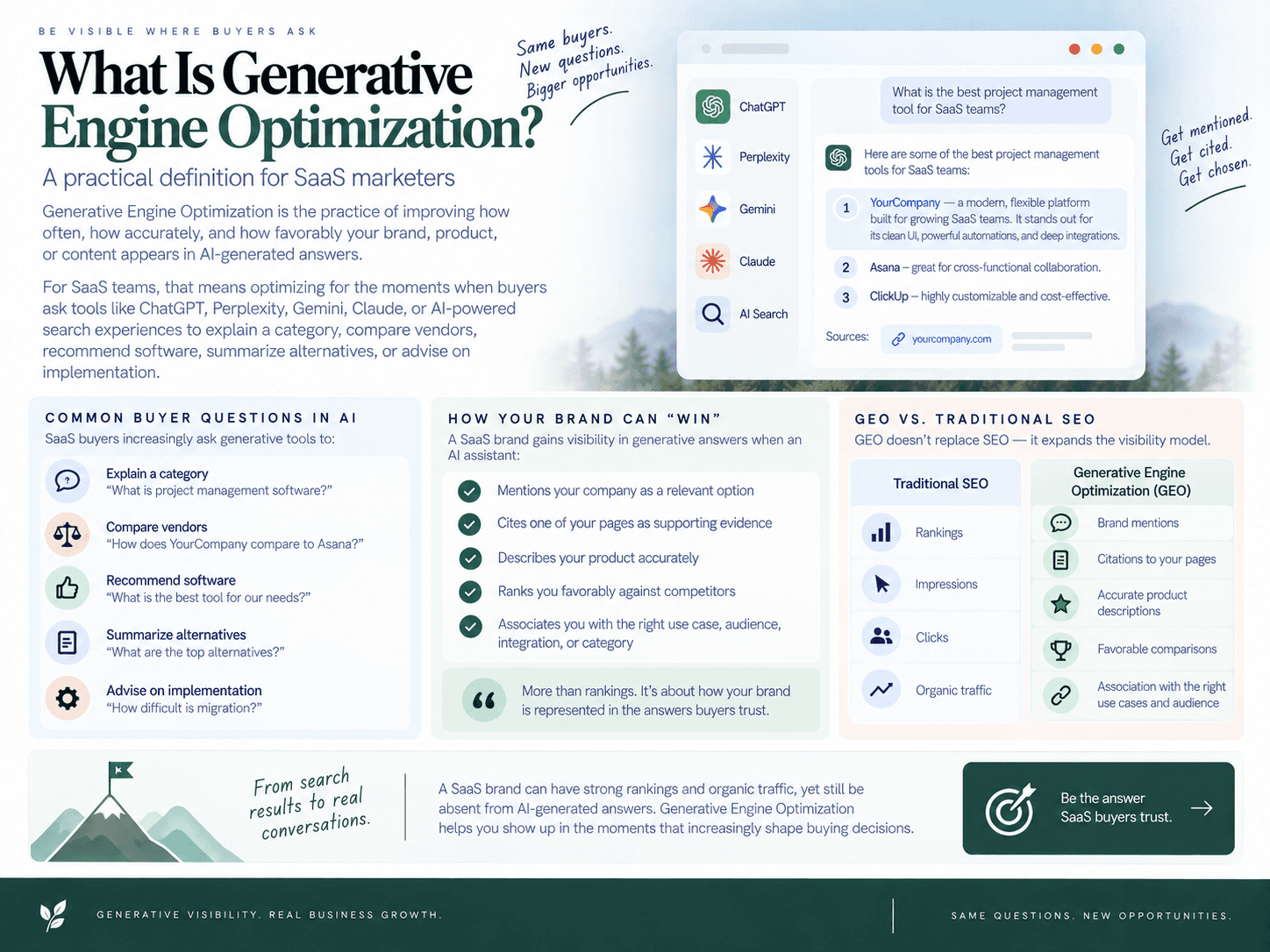
Generative Engine Optimization is the practice of improving how often, how accurately, and how favorably your brand, product, or content appears in AI-generated answers. For SaaS teams, that means optimizing for the moments when buyers ask tools like ChatGPT, Perplexity, Gemini, Claude, or AI-powered search experiences to explain a category, compare vendors, recommend software, summarize alternatives, or advise on implementation.
Traditional search visibility is usually measured by rankings, impressions, clicks, and organic traffic. GEO expands the visibility model to include how a generative system represents your company inside a synthesized answer. A SaaS brand can “win” in this environment when an AI assistant mentions it as a relevant option, cites one of its pages as supporting evidence, describes the product accurately, ranks it favorably against competitors, or associates it with the right use case, audience, integration, or category.
In practical terms, GEO asks questions like:
Does the AI answer mention our brand when buyers ask about our category?
Are we cited as a source, or are competitors and third-party sites shaping the answer instead?
Is our product described correctly, including our audience, features, integrations, and positioning?
Where do we appear in a recommended shortlist: first, middle, last, or not at all?
Is the sentiment positive, neutral, outdated, or inaccurate?
Which missing content assets would make us easier to understand, verify, and recommend?
For SaaS marketing teams, this makes Generative Engine Optimization less about chasing a single ranking and more about building an evidence system. AI platforms need clear, retrievable, well-structured information to understand what your product does, who it serves, how it compares, and when it is the right fit. Your website, documentation, comparison pages, integration pages, case studies, third-party mentions, and structured content all contribute to that picture.
What GEO is not
GEO is not keyword stuffing for AI. Repeating product terms, category phrases, or “best software” language across pages does not make a brand more trustworthy to generative systems. If anything, vague and repetitive content can make it harder for AI tools to extract specific, verifiable claims about your product.
It is also not prompt manipulation. SaaS teams cannot rely on clever prompt phrasing, hidden instructions, or attempts to “hack” an AI answer. Buyers ask varied, messy, high-context questions. A durable GEO strategy focuses on being consistently understandable across those questions, not on exploiting one prompt format.
Finally, GEO is not simply publishing AI-written content at scale. Generative engines are more likely to use and cite content that is useful, specific, current, and supported by clear evidence. Thin articles, generic comparison pages, and unsupported claims do little to help an AI assistant recommend your brand confidently.
The simplest way to think about GEO is this: make your SaaS product easy for AI systems to understand, verify, compare, and recommend. That requires content built for human buyers and machine interpretation at the same time: accurate product information, clear category association, credible proof, direct answers to buying questions, and source material strong enough to support AI-generated answers.
GEO vs SEO vs AEO: What Changes and What Stays the Same
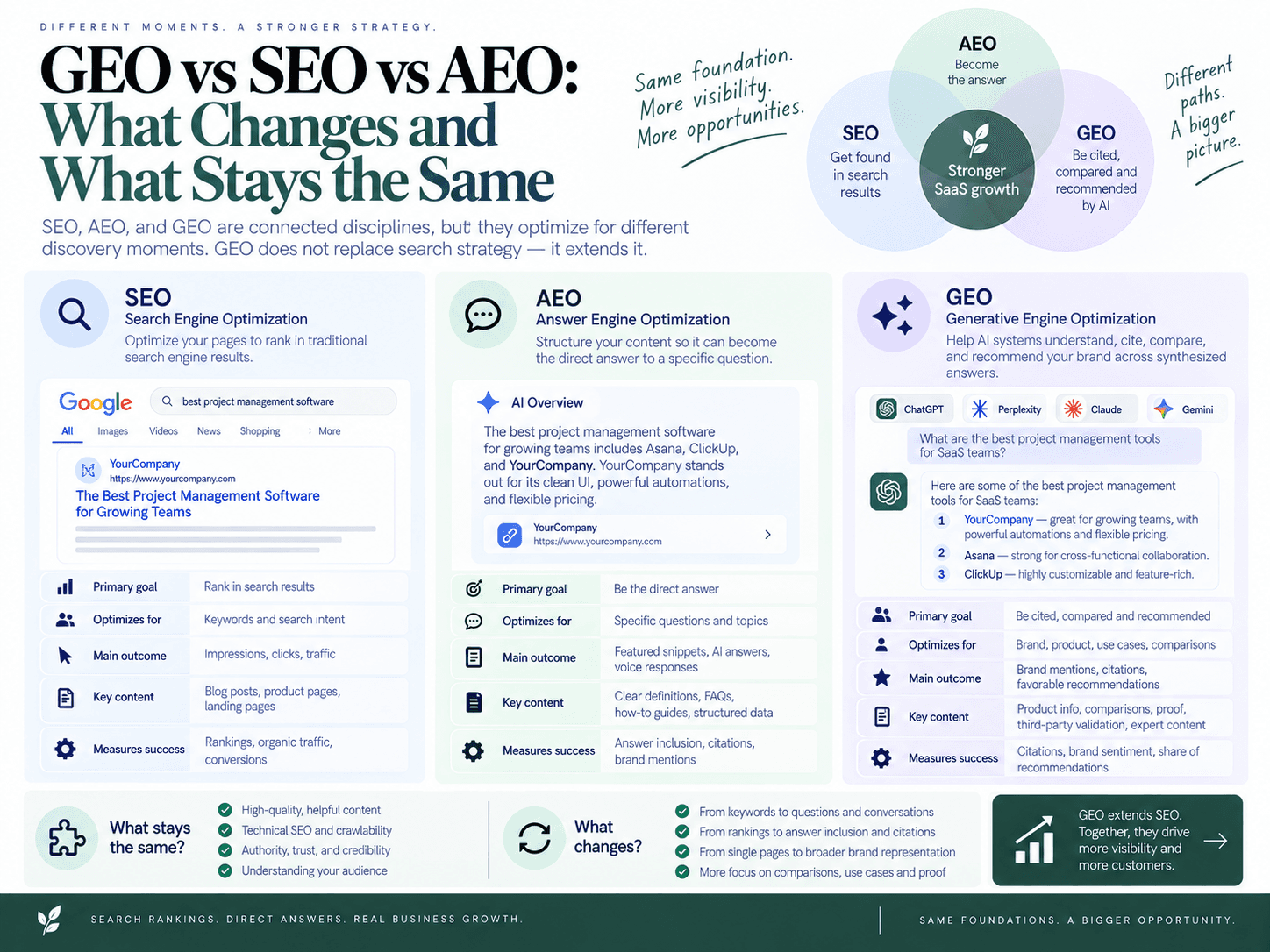
SEO, AEO, and GEO are connected disciplines, but they optimize for different discovery moments. SEO helps your pages rank in search results. AEO helps your content become the direct answer. GEO helps generative engines understand, cite, compare, and recommend your brand inside synthesized answers that may pull from many sources.
The important point for SaaS teams: GEO does not replace search strategy. It extends it. The same foundations that help Google understand your site also help AI systems interpret your category, audience, product fit, and proof. What changes is the unit of optimization. You are no longer optimizing only for a keyword and a ranked page; you are optimizing for how your brand appears across buyer prompts, comparisons, shortlists, and recommendation contexts.
Traditional SEO optimizes pages for search visibility
Traditional SEO is still the foundation. It focuses on making pages discoverable, indexable, relevant, and authoritative enough to rank in search engines. For SaaS companies, that usually means building content around use cases, pain points, integrations, alternatives, comparisons, product education, and category terms.
The core mechanics still matter:
Crawlable, technically accessible pages that search engines can discover and render.
Clear topical coverage across your category, use cases, customer segments, and product capabilities.
Internal links that connect related assets and help both users and crawlers understand content relationships.
Structured data that gives machines clearer context about pages, products, FAQs, articles, and organizations.
Authority signals from credible mentions, useful content, and trusted third-party references.
Freshness where the market, product category, integrations, or competitive landscape changes frequently.
For modern SaaS SEO, keyword lists alone are not enough. Teams need to go beyond keywords in modern SEO by connecting intent, content planning, internal linking, publishing workflows, and performance data. Those same assets become the raw material generative systems can retrieve, cite, and synthesize.
AEO optimizes answers for direct response formats
Answer Engine Optimization focuses on making content suitable for direct answers: featured snippets, voice answers, AI summaries, knowledge panels, and FAQ-style responses. If SEO asks, “Can this page rank?” AEO asks, “Can this passage answer the question clearly enough to be selected?”
Strong AEO content is concise, explicit, and well-structured. It defines terms clearly, answers common questions near the top of the page, uses descriptive headings, and supports claims with specific detail. For example, a SaaS integration page should not bury the answer to “Does this product integrate with HubSpot?” It should state the integration clearly, explain what it does, and link to setup documentation where appropriate.
This is where answer engine optimization for SaaS teams overlaps with GEO. Both reward clarity, structure, and usefulness. But AEO is usually centered on direct answers to discrete questions, while GEO is broader: it also includes how AI systems evaluate your brand in recommendation, comparison, and decision-making contexts.
GEO optimizes brand presence inside synthesized recommendations
Generative Engine Optimization is newer because AI assistants do more than retrieve a single answer. They interpret a prompt, gather or rely on available information, compare options, summarize tradeoffs, and generate a response in their own words. In that environment, your goal is not only to be cited. Your goal is to be represented accurately and favorably when the answer discusses your category.
For SaaS brands, GEO expands optimization into areas such as:
Prompt coverage: Do you have content for the questions buyers ask AI tools, such as “best tools for,” “alternatives to,” “X vs Y,” “software for,” and “how to implement” queries?
Entity consistency: Is your brand described consistently across your website, profiles, documentation, comparison pages, and third-party mentions?
Category association: Can an AI system confidently connect your product to the right market, use case, audience, and problem?
Third-party corroboration: Are there credible external sources that confirm what your own site says?
Comparison content: Do you explain how your product differs from alternatives using specific, supportable criteria?
Sentiment and recommendation context: When AI-generated answers mention your brand, do they describe it as a strong fit, a niche option, an incomplete choice, or not at all?
This is the biggest shift from classic search. In SEO, success often looks like a page ranking in position one. In GEO, success may look like being included in a shortlist, cited as a source, described accurately, ranked ahead of competitors, or recommended for a specific buyer profile. That makes AI search visibility a brand, content, and evidence problem—not just a rankings problem.
What stays the same is the need for useful, accessible, authoritative content. What changes is the emphasis on machine-verifiable context: clear product facts, connected topic clusters, decision-stage pages, integration and implementation resources, structured data, and credible corroboration. Practices like automated internal linking for topic authority can support this by helping related pages reinforce each other instead of leaving important content isolated.
In practical terms, SEO gets your pages discovered, AEO makes your answers extractable, and GEO makes your brand understandable and recommendable across multi-source AI responses. The strongest SaaS strategy treats them as layers of the same system: technical accessibility, useful content, clear answers, structured evidence, and buyer-focused assets that help both humans and generative engines make confident decisions.
How AI Platforms Surface SaaS Brand Recommendations
AI platforms do not recommend SaaS products from a single universal ranking system. Depending on the platform and query, they may draw from model training data, live web retrieval, search indexes, cited sources, knowledge graph-style entity understanding, user context, and patterns from prior generated responses. The practical takeaway for marketers is simple: your brand is more likely to appear in AI-generated answers when the available evidence makes it easy to understand what you do, who you serve, where you fit, and why you are credible.
They interpret the buyer’s prompt and intent
Most SaaS discovery prompts are not simple keywords. They are decision requests with context. A buyer might ask:
“What are the best tools for automated SEO content planning?”
“What are the top alternatives to [competitor]?”
“[Product A] vs [Product B] for a small SaaS team”
“Software for managing internal links in WordPress”
“How do I implement a scalable blog workflow for a Framer site?”
“Which tool is best for a founder who wants SEO execution without hiring an agency?”
The assistant has to infer the category, use case, audience, constraints, and buying stage. A “best tools” prompt may trigger a shortlist. An “alternatives” prompt may trigger competitive positioning. An implementation prompt may favor products with clear documentation, integrations, and workflow content. This is why What is GEO matters for SaaS: the optimization target is not only a page ranking, but how accurately a generative system understands the brand inside buyer-specific questions.
They retrieve or rely on source material
Some AI experiences answer from the model’s learned knowledge. Others use live retrieval, web search, or cited sources. Many use a combination. For SaaS recommendations, the system may look for signals such as product pages, comparison pages, alternatives articles, integration pages, implementation guides, reviews, documentation, third-party mentions, and recent updates.
If your site clearly states your category, audience, core features, integrations, use cases, benefits, proof points, and relevant limitations, the assistant has better material to work with. If those facts are scattered, vague, outdated, or only implied in sales copy, the system may summarize the brand poorly or skip it in favor of competitors with clearer evidence.
Citations also matter differently across platforms. A cited AI search answer may prefer accessible, well-structured pages that directly support the claim being made. A non-cited chatbot response may still be influenced by the broader web presence around a brand: how often it is associated with a category, which competitors it appears beside, and whether external sources reinforce the same positioning.
They synthesize shortlists, tradeoffs, and next steps
After interpreting the prompt and gathering context, the platform generates a synthesized answer. For SaaS, that often means a ranked list, a comparison table, a “best for” breakdown, or a recommendation with caveats. The answer may include phrases like “best for startups,” “strong for integrations,” “better suited for enterprise teams,” or “consider this if you need hands-off publishing.”
That synthesis is shaped by the evidence available online. Generative systems need enough clarity to connect your product to specific categories, audiences, workflows, and outcomes. They also need enough confidence to compare you against alternatives. A brand with a detailed integration guide, a clear use-case page, a fair comparison page, and updated product documentation gives the system more usable evidence than a brand with only a generic homepage.
This is the core mechanic behind AI search visibility: the easier your SaaS brand is to verify, compare, and explain, the more likely it is to be mentioned accurately when buyers ask AI platforms for recommendations.
The Signals That Influence AI Visibility for SaaS Brands
AI platforms are more likely to mention, cite, or recommend a SaaS brand when they can clearly understand what the product is, who it is for, how it compares, and what evidence supports its claims. In practice, AI search visibility depends less on one “optimization trick” and more on a body of specific, structured, verifiable content that helps generative systems synthesize confident answers.
Entity clarity and category association
Before an AI system can recommend your product, it needs to understand your brand as an entity. That means your site should make the basics unmistakable: product name, category, primary use cases, target audience, integrations, supported workflows, and differentiators.
For SaaS teams, vague positioning is a visibility problem. “The smarter way to grow” is weaker than “project management software for construction teams” or “customer onboarding software for B2B SaaS companies.” Clear category language helps AI systems connect your brand to buyer prompts such as “best onboarding tools for SaaS” or “software for managing construction projects.”
Use consistent naming: Keep your product name, company name, and feature names consistent across your website, documentation, profiles, and third-party listings.
State your category directly: Make it easy to associate your brand with a recognizable software category or emerging use case.
Define your audience: Specify whether the product is built for startups, enterprise teams, agencies, developers, marketers, finance teams, or another segment.
Document core use cases: Explain the jobs buyers hire the product to do, not just the features it contains.
Coverage of buyer questions across the funnel
Generative engines respond to questions, not just keywords. Strong SaaS SEO foundations still matter, but GEO requires coverage of the full buying journey: pain-aware research, category education, vendor comparison, implementation planning, and expansion use cases.
A SaaS brand with only top-of-funnel blog posts may be visible for educational prompts but absent from commercial prompts. To earn visibility in recommendation-style answers, your content library should cover questions like:
“What is the best tool for [specific use case]?”
“What are the best alternatives to [competitor]?”
“How does [your product] compare to [competitor]?”
“Which [software category] integrates with [platform]?”
“How do I implement [workflow] with a small team?”
“What should I look for when buying [software category]?”
The goal is not to create a separate page for every possible prompt. It is to build a connected content system that answers clusters of related buyer questions with enough specificity for both humans and machines to understand your fit.
Verifiable comparison and decision-stage content
Commercial AI answers often include shortlists, tradeoffs, and vendor recommendations. For those answers, unsupported claims are weak signals. Specific, verifiable statements are stronger: feature availability, integration support, audience fit, workflow examples, implementation requirements, pricing and packaging clarity where appropriate, and proof of outcomes.
Decision-stage assets are especially important because they give AI systems material to use when buyers ask comparative questions. SaaS teams should prioritize content such as:
Comparison pages: Explain how your product differs from specific competitors using clear criteria.
Alternative pages: Help buyers evaluate when your product is a strong fit compared with other options.
Best-tools pages: Cover the category landscape with transparent evaluation criteria.
Use-case landing pages: Connect your product to specific workflows, roles, industries, or team sizes.
Integration pages: Show how your product works with tools buyers already use.
Implementation documentation: Explain setup steps, migration paths, requirements, and best practices.
The more concrete the asset, the easier it is for an AI answer to describe your product accurately. “Works with your stack” is less useful than a dedicated integration page that explains supported platforms, common workflows, and setup guidance.
Authority, citations, and third-party corroboration
AI platforms may draw from your own website, but they can also be influenced by what other credible sources say about your brand. Third-party corroboration helps confirm that your product is real, active, and relevant to a category.
Useful authority signals include software directories, partner pages, integration marketplaces, analyst mentions, customer reviews, case studies, podcasts, industry roundups, reputable comparison articles, and customer stories. The strongest proof is specific: named customer examples, quantified outcomes, detailed use cases, and direct quotes that reinforce why buyers choose the product.
Your own content should also cite and support claims responsibly. If a page says your product is “best for scaling SaaS teams,” explain why: workflows supported, team roles served, implementation pattern, integrations, or customer proof. Generative systems need evidence to justify recommendations, especially when the prompt has commercial intent.
Freshness, structure, and machine readability
AI visibility is also shaped by how accessible and understandable your content is. Pages should be crawlable, well-structured, internally connected, and kept current. This is where traditional SEO foundations continue to support GEO.
Structured pages: Use descriptive headings, concise definitions, comparison tables, FAQs, and clear summaries where they help the reader.
Structured data: Add relevant JSON-LD schema so search engines can better interpret page type, organization details, products, FAQs, articles, and other entities.
Internal links: Connect related product, blog, comparison, integration, and documentation pages so important assets are not isolated. Strong automated internal linking for topic authority can help reinforce topical relationships across a growing content library.
Freshness: Update comparison pages, integration details, pricing references, screenshots, feature descriptions, and implementation guidance as the product and market change.
Source consistency: Align your website, documentation, social profiles, marketplace listings, and third-party descriptions so AI systems do not encounter conflicting brand facts.
The core principle is simple: make your SaaS brand easy to understand, verify, compare, and cite. Clear facts, decision-stage content, third-party proof, structured data, internal links, and updated pages all increase the odds that AI systems can confidently include your product in relevant answers.
How SaaS Teams Can Track and Improve Their GEO Presence
SaaS teams can improve their presence in AI-generated answers by treating generative visibility as an operating system: map the questions buyers ask, test representative prompts, measure how your brand appears, identify missing evidence, and turn those gaps into content assets that AI systems can understand, cite, and recommend.
Build a prompt universe around the buyer journey
Start by mapping the prompts a buyer might ask before, during, and after evaluation. Do not limit this to keyword variations. AI assistants are often used for complex, conversational research, so the prompt set should reflect real buying moments across the funnel.
Awareness: “How do I solve [problem] without hiring more people?” or “What is the best way to automate [workflow]?”
Research: “What tools help SaaS teams with [use case]?” or “Best software for [audience] that integrates with [platform].”
Consideration: “[Brand] vs [competitor],” “Alternatives to [competitor],” or “Which tool is better for a small SaaS team?”
Decision: “Best [category] tools for startups,” “Which [category] product has the fastest setup?” or “Compare pricing, integrations, and implementation effort.”
Implementation: “How do I connect [tool] to WordPress?” or “How do I roll out [workflow] across a content team?”
Expansion: “How do I scale [process] after publishing 100 articles?” or “How do I measure ROI from [category]?”
Group these prompts into themes instead of treating every question as a separate content idea. This helps you build a clean topic map that connects buyer language, intent, page types, and business value.
SEO Autopilot’s Prompt Universe is built for this kind of work. It maps 1,000 buyer-oriented prompts across the AI-assisted buying journey, organizes them into opportunity clusters, and measures OpenAI visibility for representative prompts from priority clusters.
Measure mentions, citations, rank, sentiment, and competitors
Once you have a prompt set, run representative prompts through the AI platforms that matter to your audience. For each answer, score what the engine does with your brand and your competitors.
Brand mention: Does the answer mention your product at all?
Website citation: Does it cite your site, docs, blog, comparison pages, or third-party references?
Recommendation position: If products are ranked or shortlisted, where do you appear?
Sentiment: Is the description positive, neutral, outdated, vague, or inaccurate?
Competitor presence: Which competitors appear repeatedly, and for which prompt types?
Message accuracy: Does the answer describe your category, audience, features, integrations, and fit correctly?
Missing proof: Does the answer exclude you because there is not enough visible evidence about pricing, integrations, use cases, implementation, customer outcomes, or comparisons?
This turns AI search visibility into a measurable workflow instead of a vague brand concern. The goal is not to control every generated answer; it is to understand where the market’s AI-assisted research journey already recognizes you, where competitors dominate, and where your content ecosystem lacks the evidence needed to support a recommendation.
Turn gaps into content assets
The most useful output from this audit is a prioritized list of assets to create or improve. If AI answers recommend competitors for “best tools” prompts, you may need stronger best-tools pages. If they mention a competitor for integration prompts, you may need integration pages and implementation documentation. If they describe your product inaccurately, you may need clearer product messaging, structured data, and better internal linking across related pages.
Comparison pages: Useful for “X vs Y” prompts where buyers need tradeoffs, audience fit, integrations, and implementation context.
Alternatives pages: Useful when buyers are dissatisfied with an incumbent and ask AI assistants for replacement options.
Best-tools pages: Useful for category-level shortlists and use-case-driven recommendations.
Integration guides: Useful when buyers ask whether your product works with tools they already use.
Implementation resources: Useful for prompts about setup, workflows, rollout, and adoption.
ROI pages and case studies: Useful when buyers need proof, business impact, or justification for internal stakeholders.
FAQs and supporting blog content: Useful for answering long-tail questions and reinforcing entity clarity around your product, category, and use cases.
SEO Autopilot’s Comparison Builder helps create evidence-backed commercial pages by combining product information with live competitor research. It supports brand-versus-competitor pages, competitor-alternative pages, and best-tools articles, giving SaaS teams a faster path from visibility gap to decision-stage content.
Create a repeatable improvement workflow
The strongest teams do not run a one-time AI audit and stop. They create a recurring workflow that connects measurement to publishing.
Refresh the prompt set: Add new buyer questions from sales calls, support tickets, product launches, competitor changes, and category shifts.
Test representative prompts: Re-run high-value prompts regularly and compare results over time.
Score the answers: Track mentions, citations, rank, sentiment, competitor presence, accuracy, and missing assets.
Prioritize content gaps: Focus first on prompts with commercial intent, strong buyer urgency, and repeated competitor visibility.
Create or improve assets: Build comparison pages, integration guides, implementation docs, proof pages, and supporting content.
Connect the content system: Use structured data, clear headings, descriptive copy, and automated internal linking for topic authority so related pages reinforce each other.
Move opportunities into production: Do not leave findings in a spreadsheet; create a publish backlog from content opportunities and execute on a consistent cadence.
This is where generative visibility overlaps with disciplined SaaS SEO: the teams that win are not chasing prompt tricks. They are building a content and evidence layer that makes their product easy to understand, compare, cite, and recommend across the full buying journey.
Conclusion: GEO Is a Content and Evidence System, Not a One-Time Tactic
GEO is not a shortcut for manipulating AI answers. It is the discipline of making your SaaS brand easier for generative engines to understand, verify, compare, and recommend across the buyer journey. That means your content must clearly explain who you serve, what category you belong to, which use cases you support, how you compare to alternatives, what proof supports your claims, and where buyers can find trustworthy source material.
The strongest SaaS teams will not abandon SEO. They will extend it. Crawlable pages, technical accessibility, structured data, internal links, topical authority, and useful content still matter. What changes is the operating model: instead of optimizing only for rankings and traffic, teams also need to measure how AI systems describe the brand, whether they cite the site, which competitors appear first, and which missing assets prevent confident recommendations.
A practical AI search visibility program should connect six activities into one repeatable workflow:
Prompt research: Map the real questions buyers ask AI assistants, from “best tools” and “alternatives” queries to integration, implementation, and comparison prompts.
Visibility tracking: Measure brand mentions, citations, recommendation position, sentiment, competitor presence, and accuracy in representative AI-generated answers.
Evidence-backed content: Build comparison pages, alternatives pages, best-tools articles, integration guides, implementation documentation, case studies, and proof-led commercial pages.
Structured publishing: Turn gaps into a prioritized content queue instead of leaving insights scattered across spreadsheets. If needed, use a system to create a publish backlog from content opportunities.
Internal linking and structure: Connect related pages so humans and machines can understand your topical coverage and product relationships.
Freshness: Update decision-stage assets as your product, competitors, integrations, pricing, and market narratives change.
SEO Autopilot is built around this kind of execution model. Its Prompt Universe maps 1,000 buyer-oriented prompts into opportunity clusters and measures selected OpenAI answers for mentions, citations, recommendation position, sentiment, competitor presence, and missing content assets. Its broader workflow then helps turn opportunities into briefs, articles, internal links, structured data, and scheduled publishing for CMS platforms including WordPress, Contentful, and Framer.
The next step is simple: audit the prompts your buyers are already asking AI assistants. For each prompt, identify whether your brand appears, how it is described, which competitors are recommended, what sources are cited, and which content asset would make your product easier to recommend. That audit becomes your roadmap for building a stronger, more verifiable presence in AI-generated buying journeys.

About the author: SEO Autopilot — Get recommended by Google and AI
SEO Autopilot is the SEO operating system for SaaS teams: it finds what to write from your site, competitors, and Search Console — then publishes evidence-verified comparison pages and intent-matched content on autopilot to WordPress, Framer, and more.
Areas of expertise: seo, aeo, geo, Search Engine Optimization, Answer Engine Optimization, Generative Engine Optimization, SEO Expert, Article Writer