SEO Automation Stack: A Beginner Guide + 7-Day Plan
Jump to: What to automate, stack, workflows, 7-day plan
This isn’t a theoretical “tool roundup.” It’s a practical, beginner-friendly rollout guide to automate SEO workflow steps safely—so you end the week with a working SEO automation stack: data → backlog → briefs → drafts → internal links → publishing → measurement.
The promise of SEO automation here is simple: reduce manual SEO ops (busywork, copy/paste, repetitive checks) while keeping the high-risk parts (strategy, product truth, final QA) human-led. The result should be more consistent publishing, faster throughput, and fewer missed opportunities from Google Search Console and competitor gaps.
Who this guide is for (and who it isn’t)
What you’ll have by day 7 (deliverables + KPIs)
What SEO automation actually means (and what it doesn’t)
What to automate vs. keep human (with a decision checklist)
The modern SEO automation stack (core components)
Suggested workflow A: Solo marketer
Suggested workflow B: Team (roles, handoffs, SLAs)
The 7-day rollout plan
Checklists and templates (copy/paste)
How to measure success (prove automation is working)
Common pitfalls (and how to avoid them)
Who this guide is for (and who it isn’t)
This guide is for you if:
You’re publishing (or trying to publish) on WordPress/Framer and your bottleneck is SEO operations: research, prioritization, briefing, internal linking, and keeping a steady calendar.
You already have (or can get) access to Google Search Console and want to turn real query/page data into a repeatable content pipeline.
You want an SEO automation stack that’s safe by default—with human-in-the-loop quality gates to prevent thin content, inaccuracies, or cannibalization.
You’re a solo marketer, SEO lead, founder, or small team/agency that needs more throughput without losing quality.
This guide is not for you if:
You’re looking for “press button, get rankings.” Real results still require strategy, differentiation, and editorial QA.
Your site has major technical issues (indexing blocked, severe duplication, broken templates) and you’re not ready to fix foundations first.
You can’t commit to a basic operating rhythm (even 30 minutes/day). Automation amplifies consistency—if the cadence doesn’t exist, it can’t scale it.
What you’ll have by day 7 (deliverables + KPIs)
By the end of the 7-day plan, you should have a functioning system—not just documents. Here’s what “done” looks like.
Deliverables (tangible outputs):
Connected data sources (at minimum: GSC) and a repeatable export/report you can run weekly.
A prioritized SEO backlog (topic/page-level) with scoring (impact, effort, confidence) and clear next actions.
3–5 SEO briefs generated and finalized (with intent, angle, outline, entities, internal link targets, and QA notes).
At least 1–3 drafts created, edited, and moved through a defined QA gate (more if you have a team).
Internal linking pass completed for published/scheduled posts (including anchor text and target selection rules).
Scheduled or published content in your CMS with a consistent cadence locked in.
A measurement loop (simple dashboard) that tracks leading indicators immediately and lagging indicators over time.
Success KPIs (what to measure right away):
Throughput: time-to-brief, time-to-first-draft, time-to-publish (aim to cut each by 30–50% over 2–4 weeks).
Consistency: posts/week and briefs/week (even a modest target like 2 briefs + 1 publish per week beats sporadic bursts).
Opportunity coverage (leading indicator): % of GSC opportunities reviewed weekly; % turned into backlog items; % moved to brief.
Internal link velocity: internal links added per new post + number of existing pages updated with relevant links.
Quality gates (non-negotiables): Every automated step should end in a human “stop-the-line” check before it can publish. If you only take one idea from this guide, take this: automate the assembly line, not the judgment.
What SEO automation actually means (and what it doesn’t)
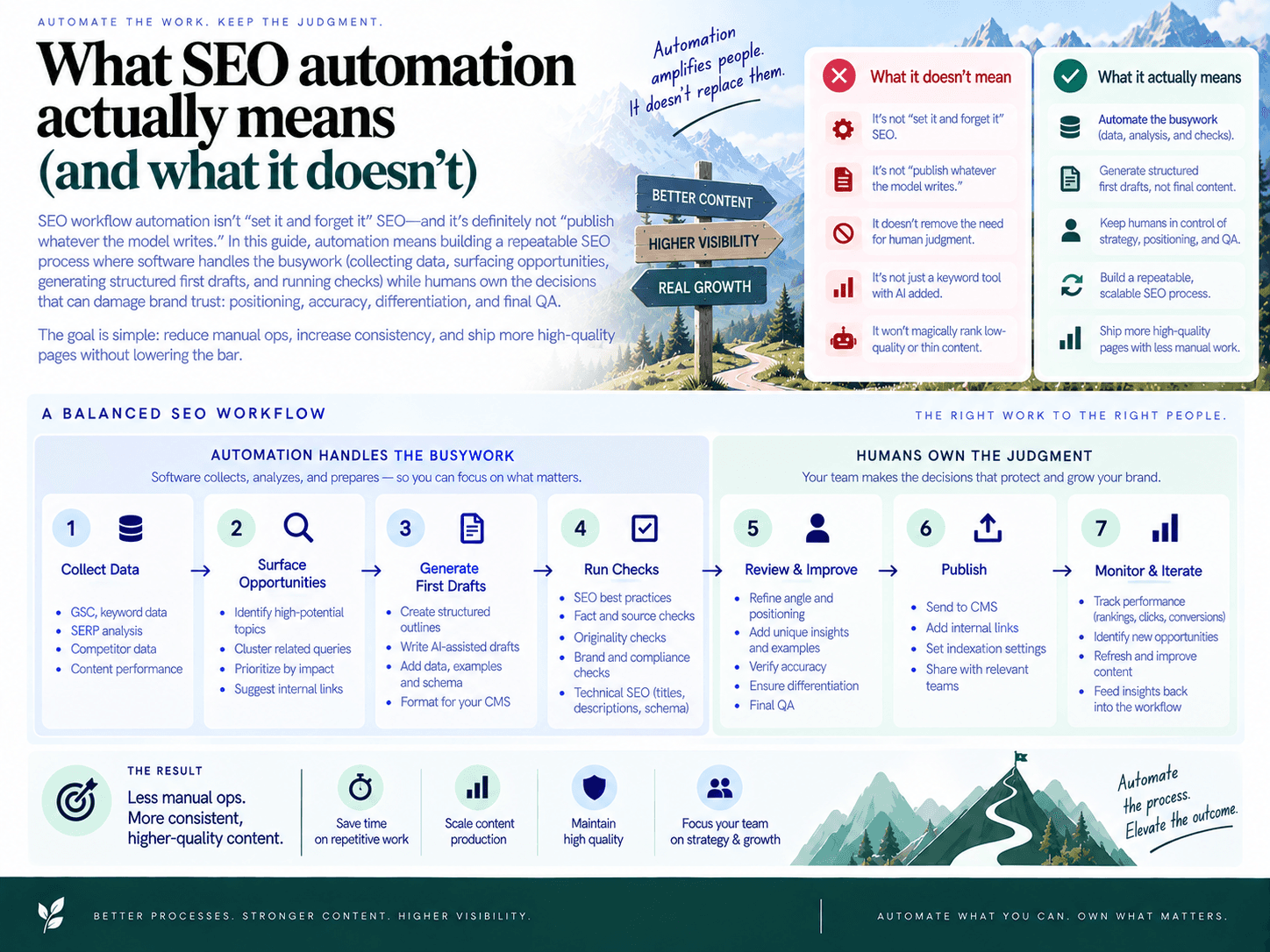
SEO workflow automation isn’t “set it and forget it” SEO—and it’s definitely not “publish whatever the model writes.” In this guide, automation means building a repeatable SEO process where software handles the busywork (collecting data, surfacing opportunities, generating structured first drafts, and running checks) while humans own the decisions that can damage brand trust: positioning, accuracy, differentiation, and final QA.
The goal is simple: reduce manual ops, increase consistency, and ship more high-quality pages without lowering the bar.
Automation vs. AI vs. templates vs. integrations
These terms get mixed together. They’re related, but not interchangeable:
Automation = the workflow runs with minimal manual steps. Example: “Every Monday, pull last 28 days of GSC queries, flag decaying pages, and create backlog cards with recommended actions.”
AI = a capability inside the workflow, usually for generating or transforming content. Example: creating an outline, extracting entities, drafting intro variations, or summarizing SERP patterns for a brief.
Templates = standardized formats that keep quality consistent. Example: one brief template per intent type (how-to, comparison, alternative, product-led use case) so writers don’t reinvent structure each time.
Integrations = the plumbing that moves data between tools. Example: GSC → sheet/database → task board → doc → CMS schedule.
If you only adopt AI without automation, you’ll still be stuck with scattered docs, ad-hoc keyword research, and inconsistent publishing. If you only adopt automation without human guardrails, you’ll publish faster… and compound mistakes faster too.
The 80/20: where automation saves time without hurting quality
The highest-leverage automations are the ones that (1) are repetitive, (2) have clear inputs/outputs, and (3) are easy to verify. That’s the 80/20 of a scalable SEO process:
Opportunity discovery (safe to automate): pull and categorize GSC queries, identify pages with declining clicks/CTR, detect topic gaps vs. competitors, and cluster keywords into page-level topics.
Prioritization inputs (semi-automate): estimate potential impact with simple scoring (impressions, position, business fit), then have a human confirm what actually matters.
Brief creation (automate the skeleton, keep the angle human): generate a structured brief (intent, H2s, FAQs, entities, internal link targets, CTA placement), then have a human set the POV and unique angle.
Draft acceleration (AI-assisted, human-edited): use AI SEO content for a first draft, rewrites, or expansions—but require human editing for originality, product truth, and “why us.”
On-page + internal linking checks (automate checks; approve changes manually): suggestions for titles, headings, schema prompts, and internal links; a human approves relevance and avoids spammy anchors.
Publishing ops (automate scheduling and checklists): pre-publish QA checklist, CMS scheduling, indexation request, and post-publish monitoring.
What you should not optimize for: maximal automation. Optimize for fewer missed opportunities and more consistent shipping with reliable quality gates.
Common failure modes (spam, cannibalization, broken linking)
Automation increases throughput—which means it also increases the blast radius of bad decisions. Here are the common ways “SEO automation” goes wrong, plus the guardrail you should add from day one.
Failure mode: AI content spam / thin pages
What it looks like: generic intros, repeated advice, no original examples, and pages that don’t match the query intent.
Guardrail: require a human-added “value layer” before publish: unique POV, real screenshots/process, product specifics, expert quotes, or original data. If a draft can’t pass this gate, it doesn’t ship.Failure mode: factual errors and product misrepresentation
What it looks like: wrong features, outdated pricing/limits, incorrect steps, or invented claims.
Guardrail: a “product truth check” in every brief/draft: link to source-of-truth docs, confirm screenshots, and require an SME or owner approval for any claim that affects trust or conversion.Failure mode: keyword cannibalization (you publish faster into the same intent)
What it looks like: multiple pages targeting the same query set; rankings oscillate; internal links compete; GSC shows impressions spread across similar URLs.
Guardrail: enforce a one-intent-one-URL rule in your backlog. Before creating a new page, automation should search your existing URLs + top queries and prompt a human decision: update/merge vs. new page.Failure mode: internal link spam or irrelevant anchors
What it looks like: too many links, repeated exact-match anchors, links that don’t help the reader, or links jammed into unrelated paragraphs.
Guardrail: cap internal links per section, require “reader reason” (why the link helps), and review anchors for natural language. Automate suggestions; keep placement/approval human.Failure mode: scaling output without a measurement loop
What it looks like: more content, but no clarity on what’s working; old posts decay; teams keep publishing instead of updating winners.
Guardrail: establish a weekly measurement routine tied to the workflow: what shipped, what indexed, what moved in GSC, what should be refreshed next.
Bottom line: treat automation as a production system. Use it to standardize and accelerate the repeatable steps—then add explicit human-in-the-loop gates where brand, accuracy, and strategy live. That’s how you scale an AI SEO content pipeline without becoming “another site that publishes noise.”
What to automate vs. keep human (with a decision checklist)
If you only remember one rule about what to automate in SEO, make it this:
Automate anything that’s repeatable, data-heavy, and reversible. Keep humans on anything that’s strategic, brand-sensitive, or easy to get “almost right” in a dangerous way.
The goal of an SEO automation stack isn’t “replace humans.” It’s human in the loop SEO: automation moves work forward fast, and humans add judgment at clear quality gates so you can scale without publishing thin, inaccurate, or off-brand content.
Quick rule-set: decide in 60 seconds
Automate when the task is: repetitive, based on structured inputs (GSC/keyword lists), and has a clear pass/fail check.
Automate with guardrails when the task is: creative but templatable (briefs, outlines, first drafts).
Keep human when the task is: positioning, persuasion, product truth, compliance, or high reputational risk (E-E-A-T).
Never fully automate publishing and internal linking changes without a review step—because mistakes propagate site-wide.
Decision checklist (risk-based): should this SEO task be automated?
Use this checklist before you automate new steps. If you answer “yes” to the first two and “no” to most of the risk flags, it’s usually safe to automate.
Repeatable? Will you do this weekly/monthly with the same inputs?
Well-defined output? Can you describe what “good” looks like in a few bullets?
Reversible? If it’s wrong, can you undo it quickly (and not harm dozens of pages)?
Low brand risk? Would a small mistake embarrass you publicly or mislead customers?
Low factual risk? Is it unlikely to create incorrect claims, pricing, legal, or medical advice?
Low cannibalization risk? Could it accidentally create/target overlapping pages?
Easy to QA? Can a human verify quality fast with a checklist (not “read for an hour and vibe-check”)?
Rule of thumb: If QA takes longer than doing it manually, don’t automate that step yet—tighten your template, inputs, and pass/fail criteria first.
Automate: data collection, clustering, gap detection, prioritization inputs
This is the safest, highest-ROI category of SEO tasks to automate because it’s numbers-in, numbers-out. Humans should still decide the final priorities and page strategy.
Task | Automate? | Human QA step (quality gate) | Output |
|---|---|---|---|
Pull GSC queries/pages (impressions, clicks, CTR, position) | Yes | Spot-check date range, brand queries filtering, and page mapping | Clean dataset for opportunities |
Detect “striking distance” terms (e.g., positions 8–20 with impressions) | Yes | Confirm the query matches the page intent (not a mismap) | Quick-win list (refresh/optimization candidates) |
Content decay detection (traffic/click drop over time) | Yes | Validate seasonality vs. true decay; check indexing changes | Refresh backlog candidates |
Competitor gap extraction (keywords/topics they rank for that you don’t) | Yes | Confirm relevance to your product + audience; remove “tourist traffic” keywords | Gap list + topic clusters |
Clustering keywords into topics / intents | Mostly | Manually review cluster names and intent splits; merge/split obvious mistakes | Topic clusters mapped to page types |
Backlog scoring inputs (potential, effort, fit, intent match) | Yes | Override scores for strategic priorities and constraints (brand, legal, roadmap) | Prioritized backlog draft |
Safeguard: automate the inputs and recommendations—but make a human accountable for the final “create vs. update vs. merge” decision to avoid cannibalization.
Automate: first-draft briefs, outlines, and draft generation
This is where speed gains are biggest—and where quality risk increases. The winning pattern is: automation creates a strong starting point; humans finalize angle, accuracy, and differentiation.
Task | Automate? | Human QA step (quality gate) | Output |
|---|---|---|---|
Brief skeleton (intent, target query, secondary terms, sections) | Yes | Confirm search intent + page type (post vs. landing vs. glossary) and unique angle | Brief v1 |
SERP pattern extraction (common headings, FAQs, format expectations) | Mostly | Ensure you’re not copying competitor structure 1:1; add your POV and examples | Outline guidance |
Entity/coverage suggestions (topics to include, terms to define) | Yes | Remove irrelevant entities; ensure terminology matches your product reality | Coverage checklist for the writer |
First draft generation (sections filled in) | Yes, with strict rules | Editor validates: factual/product accuracy, originality, examples, and usefulness | Draft v1 (not publish-ready) |
Title/meta description options | Yes | Pick the one that matches intent, avoids clickbait, and reflects on-page content | Metadata ready for CMS |
Guardrails for draft automation:
No “black box” claims: require sources, product screenshots, or internal references for any factual statement that could be wrong.
Differentiate by default: add a required section for your unique POV (framework, template, real workflow, or example).
One page = one job: enforce a single primary intent per URL to reduce accidental overlap.
Automate: internal link suggestions + implementation checks
Internal linking is perfect for automation because it’s pattern-based—just don’t let automation spray links everywhere. Keep it relevant and intentional.
Task | Automate? | Human QA step (quality gate) | Output |
|---|---|---|---|
Suggest internal link targets (related pages, hubs, money pages) | Yes | Confirm topical relevance + user value; ensure destination is the best next step | Shortlist of 5–15 targets |
Anchor text suggestions | Mostly | Avoid exact-match repetition; keep anchors natural and specific | Anchor options per link |
Detect orphan pages / low internal link count | Yes | Verify the page should exist (not outdated or redundant) | Linking to-do list |
Implementation validation (broken links, redirect chains, nofollow mistakes) | Yes | Review exceptions (intentional noindex, canonicalized pages) | QA report: pass/fix |
Safeguard: cap internal links per page (e.g., 5–10 new links per update) and require a “why this link helps the reader” check for each suggested addition.
Keep human: positioning, product truth, E-E-A-T, editing, final QA
These steps are where brands win (or lose). Automate assistance, not accountability.
Task | Automate? | Human QA step (quality gate) | Output |
|---|---|---|---|
Topic selection aligned to strategy (ICP, pipeline, category narrative) | No | Explicit “why now” + how it supports business goals | Approved topic + angle |
Positioning & differentiation (your POV vs. generic SERP content) | No | Ensure it’s defensible, specific, and reflected throughout the article | Clear thesis + messaging |
Product accuracy (features, pricing, integrations, limitations) | No | SME or product owner sign-off; update screenshots/details | Truth-checked content |
E-E-A-T additions (real examples, experience, quotes, author creds) | No (assist only) | Verify authenticity; avoid fabricated “case studies” or fake stats | Trust signals embedded |
Editorial pass (clarity, structure, originality, tone) | No | Read as a user; remove fluff; ensure scannability | Publish-ready draft |
Final pre-publish QA (cannibalization, links, metadata, schema, UX) | No (checklist-driven) | One owner signs off; document changes | Approved release |
Non-negotiable: never publish automatically generated content without a human edit pass. That’s the difference between scalable content ops and scalable risk.
One-page checklist: safe automation defaults (beginner-friendly)
Automate by default: GSC exports, opportunity detection, clustering, backlog scoring inputs, internal link suggestions, on-page checks.
Automate with strict QA: briefs, outlines, first drafts, titles/meta variants.
Keep human: strategy, intent decisions, angle, product truth, final edit, final publish approval.
Add a “kill switch”: if a page fails QA (accuracy, duplication, cannibalization risk), it goes back to brief—not to publish.
This is the operating principle behind a durable SEO automation stack: move faster everywhere you can, and put humans exactly where quality and brand risk live.
The modern SEO automation stack (core components)
The easiest way to think about an SEO automation stack is as a connected system that turns signals into shipping content—without relying on “hero effort.” The goal isn’t to automate strategy; it’s to automate the content pipeline so you consistently move from data → decisions → briefs → drafts → publish → links → measurement.
High-level flow (diagram in words):
GSC automation + competitor gaps →
Prioritized backlog (what to build next) →
Briefs (what “good” looks like) →
Drafts (assisted writing, human-edited) →
On-page checks (prevent obvious SEO mistakes) →
Internal linking (connect new + old pages) →
Scheduling/publishing (QA gates + CMS workflow) →
Measurement loop (rank/traffic → refresh triggers back into backlog)
Below are the core layers, with inputs, outputs, and how information should move through the system.
1) Data layer: Google Search Console (GSC) as the source of truth
This layer answers: “What is Google already showing us for (and where are we underperforming)?” For beginners, this is the safest place to start because it’s your own first-party performance data.
Inputs: GSC Queries, Pages, Countries/Devices, Dates; index coverage; sitemap status.
Automation: Scheduled exports (daily/weekly), anomaly flags (drops/spikes), auto-tagging opportunities (positions 4–15, high impressions/low CTR, decaying pages).
Outputs: A table of opportunities like:
Quick wins: high impressions + position ~4–15 (optimize existing page)
CTR lifts: high impressions + low CTR (title/meta/test snippets)
Content decay: pages losing clicks over time (refresh/expand)
Cannibalization flags: multiple URLs ranking for same query cluster
Quality gate (human-in-the-loop): Confirm the “opportunity” maps to a real page intent. If the query intent doesn’t match the page, don’t just tweak headers—route it to backlog as a new page or content restructure.
2) Competitive intel: competitor keyword gaps & topic coverage
This layer answers: “What are competitors getting traffic from that we aren’t addressing (or can’t rank for yet)?” It prevents the stack from becoming purely reactive to your current footprint.
Inputs: Competitor domains, keyword sets, top pages, topic categories, SERP features, content formats.
Automation: Keyword gap pulls, clustering by topic/intent, detection of “missing pages” (topics you don’t cover), and “weak pages” (you cover but thin/outdated).
Outputs: A list of topic clusters with:
Primary intent (informational/commercial/navigational)
Suggested page type (guide, comparison, alternatives, template, integration, landing page)
Estimated difficulty vs. authority fit (quick/medium/long bets)
Quality gate: Filter gaps by business fit (product relevance, ICP, conversion path). A huge gap list is useless unless it becomes a shippable backlog.
3) Prioritization engine: scoring opportunities into a backlog
This layer turns “interesting data” into an execution queue. Without this, automation just produces spreadsheets and anxiety.
Inputs: GSC opportunities + competitor gaps + current site inventory (existing pages, content types, internal link structure) + effort estimates.
Automation: Auto-scoring and routing into buckets:
Optimize existing (refresh, CTR test, internal links)
Create new (net-new page)
Consolidate (merge/redirect to fix cannibalization)
Outputs: A prioritized backlog with clear fields:
Opportunity type + target page (or “new URL TBD”)
Primary keyword/theme + supporting questions
Intent + funnel stage
Score (impact/confidence/effort/fit)
Owner + status (Briefing → Drafting → Editing → Scheduled → Live)
Quality gate: Do a quick cannibalization check before you greenlight “new content.” If you already have a page that should own the topic, route the work to refresh/consolidate instead of creating duplicates.
4) Brief builder: SERP + intent + structure + FAQs + angle
This is where you protect quality while moving fast. A strong brief prevents low-value AI drafts and keeps writers aligned.
Inputs: Backlog item + SERP observations (top-ranking page patterns) + brand/product positioning + required entities/terms + internal links to include.
Automation: First-draft brief generation:
Search intent summary (what the page must accomplish)
Outline with H2/H3 suggestions
FAQ/questions to answer (People Also Ask style)
Angle suggestions (what makes your content different)
Snippet targets (definitions, steps, comparisons)
Outputs: A brief that is specific enough to draft from in one sitting.
Quality gate: A human must confirm: (1) the angle is true for your product, (2) claims can be supported, and (3) the outline matches intent (no fluff sections).
5) Draft builder: assisted writing with brand + product inputs
This is the “speed layer,” not the “truth layer.” Use it to accelerate structure and first pass copy, then enforce editorial standards.
Inputs: Approved brief + brand voice rules + product facts (features, limitations, pricing constraints) + proof points (case studies, screenshots, quotes).
Automation: Generate a draft that follows the brief, includes placeholders for proof, and suggests CTA placements.
Outputs: A complete draft with:
Clear intro (who it’s for, what they’ll get)
Scannable sections and step-by-step instructions
Examples and edge cases
Draft title + meta description options
Quality gate: Human edit required for: accuracy (no invented facts), originality (not generic rephrasing), product alignment, and expertise signals (firsthand steps, screenshots, real workflows).
6) On-page checks: titles, headers, schema prompts, image alt text
This layer catches easy-to-miss SEO basics at scale—especially helpful when publishing frequently.
Inputs: Draft content + target query/theme + CMS fields (title, slug, meta description, OG tags).
Automation: Pre-publish checks and suggestions:
Title length + uniqueness checks
Header structure sanity check (H1/H2/H3)
Meta description presence + variation suggestions
Schema recommendation prompts (FAQ/HowTo where appropriate)
Image alt text suggestions + missing image detection
Broken link checks
Outputs: A “ready-to-publish” checklist and corrected fields.
Quality gate: Don’t blindly add schema/FAQs. Only include structured data and FAQs that are genuinely answered on the page and match intent (avoid “schema spam”).
7) Internal linking system: suggestions + anchors + updates
This is the compounding layer. Publishing without internal links is like launching pages without distribution.
Inputs: New draft URL/topic + your existing site map + top-performing pages + pages that need a boost.
Automation:
Suggest incoming links (existing pages that should link to the new page)
Suggest outgoing links (new page linking to relevant existing pages)
Anchor text variations (natural, not repetitive)
“Link insertion” checklist (where in the paragraph it belongs)
Outputs: A set of internal link tasks:
5–15 links to add for each new page (depending on site size)
Anchor + source URL + target URL + placement guidance
Quality gate: Relevance over volume. If the link doesn’t make the sentence better for a reader, skip it. Also enforce one canonical “owner” page per intent to reduce cannibalization.
8) Scheduling/publishing: calendar + CMS integration + QA gates
This layer makes consistency automatic. It’s where your content pipeline either becomes a real system—or dies in drafts.
Inputs: Approved draft + on-page fields + internal link tasks + images.
Automation:
Auto-create CMS drafts from approved documents
Scheduling to a content calendar (with assigned owners)
Pre-publish QA checklist enforcement (can’t mark “ready” until checks pass)
Post-publish tasks: request indexing, add to sitemap if needed
Outputs: Published/scheduled posts with clean metadata, correct formatting, and completed internal linking.
Quality gate: “No publish without checks.” Minimum bar: correct intent, accurate claims, unique value, internal links added, and one clear CTA aligned to the page purpose.
9) Measurement loop: rank/traffic tracking + refresh triggers
This layer closes the loop so your system improves itself. It’s how automation turns into compounding results instead of one-time speed.
Inputs: GSC performance after publish, page engagement signals, conversions (if tracked), indexation status.
Automation:
Weekly performance summaries per page and per cluster
Alerts for: indexation failures, sudden drops, or wins (page hits positions 8–20 with high impressions)
Refresh triggers: “update this post” tasks when decay detected or new GSC queries appear
Outputs: A steady stream of refresh and optimization backlog items—often higher ROI than net-new content.
Quality gate: Don’t “chase noise.” Require a minimum data threshold (e.g., 28 days, enough impressions) before making major changes—unless it’s a clear technical/indexing issue.
Bottom line: A modern SEO automation stack isn’t a pile of tools—it’s a connected workflow with explicit inputs/outputs and human QA gates. If information flows cleanly through these nine layers, you’ll ship faster, miss fewer opportunities, and keep publishing consistent without sacrificing quality.
Suggested workflow A: Solo marketer (fast, safe, repeatable)
If you’re a one-person team, your job isn’t to “do more SEO.” It’s to run content operations that reliably turns data into shipping pages—without lowering quality. This solo marketer SEO workflow is a minimal viable rhythm you can repeat every week with clear time boxes and three non-negotiable quality gates.
Operating principle: automate the busywork (pulling data, clustering, first drafts, internal link suggestions) and keep humans in charge of decisions (positioning, truth, editing, and final publish QA).
Weekly cadence: backlog review → brief → draft → edit → publish
Plan on a 5-day loop that produces 1–2 published posts/week consistently (more if you’re repurposing or updating existing pages). The point is repeatability, not hero sprints.
Monday (45–60 min): Backlog review + pick next piece
Input: GSC opportunities (queries/pages), competitor gaps, last week’s performance notes.
Do: select one primary target page to create or refresh; confirm intent and “why we win.”
Output (Definition of Done): one backlog card promoted to In Progress with target query, page type (new vs. refresh), and success metric (e.g., “move from position 9→5” or “+20% clicks”).
Tuesday (60–90 min): Brief in one sitting
Automate: SERP pattern summary, headings/outline suggestions, FAQ candidates, entity/topic coverage.
Human decisions: angle, unique POV, product truth, examples, and what you will not cover (scope control).
Output (DoD): a 1–2 page brief with title options, outline, internal links to include, and a clear CTA.
Wednesday (60–120 min): Draft fast (then stop)
Automate: first draft from the brief, rephrasing, expanding sections, formatting into your CMS structure.
Human add-ins: your experience, screenshots, exact steps, opinions, and constraints (what actually works in your product/industry).
Output (DoD): complete draft that is structurally correct (H2/H3s, bullets, examples) but not “final-polished.”
Thursday (45–75 min): Edit + on-page checks
Do: tighten intro, remove fluff, verify claims, add E-E-A-T signals (proof, experience, author/brand credibility), confirm intent match.
On-page essentials: title tag, meta description, H1, headers, image alt text, and any schema prompts relevant to the page type.
Output (DoD): publish-ready draft with verified facts and a clear “next action” for the reader.
Friday (30–60 min): Internal links + publish + measure
Automate: internal link suggestions (from/to), anchor variants, orphan-page checks.
Human QA: ensure every link is context-relevant, anchors are natural, and you’re not forcing links just to “add links.”
Output (DoD): post published (or scheduled) with internal links implemented, indexing requested (if appropriate), and tracking notes logged.
Solo throughput target: 1 publish/week at minimum (non-negotiable). Once stable, move to 2/week by increasing automation in drafting and internal link updates—not by skipping editing.
Daily cadence: 30-minute SEO ops loop
This is the glue that keeps your SEO content workflow from drifting. Set a recurring 30-minute block each weekday.
10 min — GSC pulse check: scan top movers (up/down), new queries, pages with rising impressions but flat clicks (CTR opportunity).
10 min — Backlog hygiene: add 1–3 new opportunities, merge duplicates, tag by intent (informational/commercial), and mark cannibalization risks.
10 min — Pipeline unblock: do the one small task that prevents shipping (request a SME answer, fetch a screenshot, confirm pricing/features, find one supporting source).
Rule: daily loop is for keeping the machine running—not for deep work. Deep work stays in the weekly blocks above.
Quality gates: pre-brief, pre-publish, post-publish
These are your “human-in-the-loop” checkpoints that prevent AI-assisted speed from turning into thin or risky content.
Gate 1 — Pre-brief (5 minutes): “Should we publish this page at all?”
Is this a new page or a refresh? (If a similar page exists, prefer refresh/merge.)
Is intent clear and winnable with your authority and resources?
Do you have a credible angle (data, experience, product expertise) that won’t be a generic rewrite?
Pass/Fail: if you can’t articulate “why we win” in one sentence, don’t brief it yet.
Gate 2 — Pre-publish (10–15 minutes): “Would I trust this if I were the reader?”
Accuracy: verify product claims, numbers, and steps. Remove anything uncertain.
Originality: add at least 2–3 concrete elements competitors won’t have (screens, examples, templates, hard-won advice).
Cannibalization check: confirm you’re not targeting the same query with multiple posts; if you are, consolidate and pick one primary URL.
Internal links: 3–8 relevant links (mix of supporting + conversion) with natural anchors.
Pass/Fail: if the post reads like a generic summary, it doesn’t ship.
Gate 3 — Post-publish (10 minutes, 48–72 hours later): “Did Google and humans accept it?”
Check indexation status (and request indexing if needed).
Confirm the page renders correctly (mobile, images, headings, table formatting).
Scan early signals: impressions starting, CTR baseline, engagement sanity check.
Pass/Fail: if impressions are zero after a reasonable window and similar pages index fine, investigate technical/noindex/canonical issues before writing more.
Solo checklist (copy/paste)
Backlog: 1 priority item chosen + intent confirmed + “why we win” written
Brief: outline + angle + FAQs + entities + CTA + internal links to include
Draft: complete structure + examples + placeholders resolved
Edit: fact-checked + tightened + aligned to intent + on-page basics done
Links: internal links added (relevant, non-spammy) + orphan check
Publish: scheduled/published + indexing action taken + measurement note logged
This workflow is intentionally boring—and that’s the point. Consistent publishing beats occasional bursts, and a clean operating rhythm is how solo marketers scale SEO without losing control of quality.
Suggested workflow B: Team (roles, handoffs, and SLAs)
If you’re running a team SEO workflow, automation only helps if ownership is crystal clear. The goal is a repeatable content production process where data → backlog → brief → draft → publish happens without Slack chaos, bottlenecks, or quality regressions. This is SEO operations with guardrails: fast handoffs, explicit “definition of done,” and human-in-the-loop quality gates.
Roles (who owns what)
Here’s a lean role model that works for most teams (you can combine roles if you’re small):
SEO Lead (Owner of outcomes): sets goals/KPIs, prioritizes backlog, approves briefs, resolves cannibalization, ensures coverage of GSC + competitor gaps.
Writer (Owner of the draft): writes from the brief, adds examples, sources claims, flags missing product truth, delivers a clean draft that matches intent.
Editor (Owner of quality + consistency): enforces voice, structure, originality, “so what?”, and removes fluff; runs QA checklist; ensures the article earns the click.
SME / Product Marketing (Owner of factual/product accuracy): validates claims, screenshots, workflows, compliance, pricing/feature statements; adds credible POV.
Publisher / Content Ops (Owner of shipping): formats in CMS, metadata, schema, images, internal linking implementation, indexation request, and post-publish checks.
Rule: One person owns each stage, but everyone follows the same artifacts and checklists. That’s how you scale speed without losing control.
Handoff artifacts (so nothing gets lost)
Every handoff should move a single “packet” of information through the pipeline. Avoid “review this doc” ambiguity by standardizing these artifacts:
Backlog card (SEO Lead owns)
Inputs: GSC query/page data, competitor gap, business priority, search intent, notes on cannibalization risk.
Includes: target page type (new vs. refresh), primary query + variants, estimated difficulty/effort, internal link targets, success metric (e.g., “lift CTR on page X”).
Definition of done: scored + ranked + assigned + due date set.
Brief (SEO Lead drafts/approves; Writer executes)
Includes: intent, angle, outline (H2/H3), entities/terms to include, FAQs, examples to add, sources required, internal/external link requirements, CTA.
Quality gate: SEO Lead signs off that the angle is differentiated and doesn’t cannibalize an existing URL.
Definition of done: “writer-ready” brief with clear POV and constraints.
Draft (Writer owns; Editor finalizes)
Includes: completed outline, visuals placeholders, citations where needed, product references flagged for SME verification.
Quality gate: Writer confirms it meets intent, includes the required sections, and is not a paraphrase of top SERP results.
Definition of done: editor-ready draft (not a rough outline).
QA checklist (Editor owns; Publisher verifies in CMS)
Includes: accuracy checks, originality, title/H1 alignment, header structure, internal links relevance, metadata completeness, schema prompts, image alt text, CTA placement.
Definition of done: all checks pass or are explicitly waived with a reason.
Pro tip: Put these artifacts in one system (project board + doc template + CMS checklist). Automation can generate first drafts, but the artifacts are what prevent rework.
SLAs and throughput targets (speed with predictability)
SLAs keep work moving. Without them, “waiting for review” becomes your real bottleneck. Use these as starting targets and adjust after two weeks of real data:
Backlog triage SLA: new opportunities scored + assigned within 48 hours.
Brief creation SLA: 2–5 briefs/week per SEO Lead (depending on complexity). For fast-moving teams, aim for 1 brief/day.
Draft SLA: first draft delivered in 2–4 business days per post (shorter for refreshes).
Edit SLA: editorial pass returned within 24–48 hours.
SME review SLA: fact/product review completed within 24–72 hours. (If SMEs are tight, limit their scope to “redline only,” not rewriting.)
Publish SLA: after final approval, post scheduled/published within 24 hours, including internal links and metadata.
Throughput targets to start: 2 posts/week for a small team; 4–8 posts/week for a content team with multiple writers. The point isn’t volume—it’s predictable output and coverage of opportunities.
Approval model: human-in-the-loop + versioning (no quality regressions)
To move fast safely, lock in where humans must approve—and what can be automated without permission.
Gate 1: Pre-brief approval (Strategy + risk)
Owner: SEO Lead
Checks: intent match, SERP type, uniqueness/differentiation, cannibalization risk, business fit.
Automation allowed: keyword clustering, SERP extraction, brief skeleton generation.
Gate 2: Pre-publish approval (Quality + truth)
Owner: Editor + SME (as needed)
Checks: factual/product accuracy, original examples, clear POV, no thin/duplicate sections, correct claims and screenshots.
Automation allowed: on-page checks (title length, missing H2s, schema suggestions), grammar assists, internal link suggestions (not auto-inserted without review).
Gate 3: Post-publish validation (Impact + maintenance)
Owner: SEO Lead + Publisher
Checks: indexing, canonical correctness, internal links live, GSC performance tracking, refresh trigger set.
Automation allowed: performance alerts, decay detection, broken link checks.
Versioning rule: One source-of-truth doc per post (brief + draft + changelog). Edits happen via suggestions/comments, and the Editor resolves. This prevents “final-final-v7” chaos and makes the workflow measurable.
Two operating rhythms (choose one)
Pick a cadence based on team size and how quickly you need to ship.
1) Weekly batch (best for small teams)
Mon: SEO Lead runs GSC + competitor gaps → refreshes backlog priorities.
Tue: Brief batch (2–5) created + approved.
Wed–Thu: Writers draft; Editor starts rolling edits as drafts land.
Fri: SME review + final edits + Publisher schedules/publishes + internal links.
2) Daily flow (best for higher velocity)
Every day: 15-minute “SEO ops standup” (SEO Lead + Editor + Publisher). Goal: unblock reviews, confirm what ships today, and assign next briefs.
Rolling handoffs: as soon as a brief is approved, it enters writing; as soon as a draft is done, it enters editing; as soon as editing passes, it enters publishing.
Preventing bottlenecks (the usual failure points)
SME is the bottleneck: limit SME scope to verification; require writers to highlight claims needing review; use a “default approve in 72 hours” rule for low-risk posts.
Editor is overloaded: standardize structure and checklists; enforce “writer-ready draft” definition; use a light copy edit for low-risk updates and a heavy edit for flagship pages.
Publisher is stuck reformatting: enforce formatting rules in the draft (heading levels, tables, image notes), and use a CMS-ready template.
Automation creates spammy internal links: require relevance checks (same intent cluster), cap links per page, and use descriptive anchors—not keyword-stuffed anchors.
Teams ship cannibalizing pages: backlog card must include “existing URL check” and a clear decision: refresh, merge, or new page.
When this is working, your team SEO workflow becomes predictable: opportunities get captured, content moves through a defined pipeline, and publishing becomes a habit—not a scramble.
The 7-day rollout plan (do this first)
This SEO automation plan is designed to get you from “we have data everywhere” to a working, repeatable pipeline: GSC + competitor gaps → prioritized backlog → briefs → drafts → internal links → schedule/publish → measurement. It’s not about automating everything—it’s about setting up an SEO implementation system that ships content consistently without sacrificing quality.
How to use this 7-day SEO plan: time-box each day, produce the deliverable, and move on. You can refine later—shipping the first loop is the win.
Suggested time budget: 60–120 minutes/day (solo). Teams can parallelize and finish faster.
Minimum viable output by Day 7: 1–2 posts published + 2–4 scheduled, a prioritized backlog, and templates/QA gates.
Quality rule: anything that can harm brand trust, factual accuracy, or product truth stays human-owned.
Day 1: Connect GSC + define goals, KPIs, and site constraints
Goal: establish your source of truth and the rules of the road so automation doesn’t create chaos.
Time: 60–90 minutes
Checklist
Connect/verify Google Search Console (domain property preferred) and confirm the correct site is selected.
Define your primary SEO objective for the next 30–60 days (pick one):
More qualified organic leads
More demo/trial signups
More top-of-funnel traffic for a product category
More revenue pages ranking for commercial intent
Set baseline KPIs (record today’s numbers):
Lagging: clicks, impressions, conversions from organic
Leading: posts published/week, time-to-publish, number of GSC opportunities processed into backlog
Document site constraints:
CMS (WordPress/Framer/etc.), who can publish, approval steps
Indexing rules (noindex areas, staging domains, canonical patterns)
Existing content types (blog, landing pages, docs), brand voice references
“Do not write about” list (regulated claims, sensitive topics)
Create a single workspace to run the pipeline (one spreadsheet/board is enough):
Columns: Topic/Keyword cluster, Intent, Target URL (new or existing), Stage (Backlog → Brief → Draft → Edit → Scheduled → Live), Priority score, Notes
Definition of done (Day 1):
GSC connected and exporting data reliably
Baseline KPI snapshot saved
One “pipeline board” created with stages and owners
Written constraints + quality rules documented (even as bullet points)
Day 2: Pull queries/pages → find quick wins + decay + cannibalization
Goal: use GSC to identify the easiest wins and the pages that need updates—this is the fastest path to measurable impact.
Time: 90–120 minutes
Checklist
Export from GSC (last 28 days + last 3 months):
Queries (with clicks/impressions/position/CTR)
Pages (with clicks/impressions/position/CTR)
Tag three opportunity buckets:
Quick wins: position ~4–15 with high impressions (improve CTR + on-page relevance)
Content decay: pages where clicks dropped vs. prior period (refresh/update)
Cannibalization suspects: multiple pages ranking for the same query cluster
Create 10–20 backlog candidates from GSC alone:
For each: query/theme, suggested action (refresh vs new), current URL(s), notes on intent mismatch
Set your first automation rule (simple but powerful):
Any query with high impressions + position 4–15 becomes a backlog item automatically
Any page with click drop > X% becomes a refresh candidate (pick X=20–30% to start)
Quality gate (human-in-the-loop): before creating new pages, confirm whether an existing page should be updated instead (to avoid cannibalization).
Definition of done (Day 2):
10–20 GSC-derived opportunities added to the pipeline board
At least 3 refresh candidates identified (with the existing URL)
At least 3 quick wins identified (with target query + page)
A short cannibalization watchlist created (query → competing URLs)
Day 3: Run competitor gaps → cluster into topics and pages needed
Goal: stop missing obvious topics your competitors already capture, then convert gaps into a manageable structure.
Time: 60–120 minutes
Checklist
Pick 3–5 true organic competitors (not just business competitors). List their domains.
Pull competitor keywords/pages (via your preferred SEO tool or exported reports) and identify:
Gap keywords: they rank, you don’t
Coverage gaps: entire topic areas missing on your site
Format gaps: comparisons, alternatives, templates, how-tos, integration pages
Cluster into 10–30 topic groups (don’t overthink it):
Cluster name → primary intent (informational / commercial / navigational)
Suggested page type (blog post, landing page, glossary, docs)
Notes on angle or differentiation you can win with
Map clusters to your site architecture:
Which clusters deserve a hub page?
Which clusters should support an existing product/feature page?
Quality gate (human-in-the-loop): sanity-check intent. If the SERP is product-led and you publish a generic blog post, you’ll waste time (automation won’t save you).
Definition of done (Day 3):
10–30 clusters created from competitor gaps
Each cluster has an intent + page type recommendation
At least 10 new backlog candidates added from gap analysis
Day 4: Build a prioritized backlog (scoring model + effort estimates)
Goal: turn a pile of ideas into a ranked queue your team can execute every week without debate.
Time: 90–120 minutes
Checklist
Merge all opportunities into one backlog (GSC quick wins, decay/refreshes, competitor gaps).
Add a lightweight scoring model (keep it consistent; perfect is the enemy):
Impact: expected traffic/value if it ranks (1–5)
Confidence: do you have proof? (GSC impressions, competitor rankings, past wins) (1–5)
Effort: time/complexity to produce + review (1–5; higher = harder)
Fit: alignment with product, audience, and brand (1–5)
Compute a priority score (example):
(Impact × Confidence × Fit) ÷ Effort
Assign each item:
Type: Refresh / New / Quick win optimization
Owner (even if it’s just “You”)
Target URL (existing or “new page”)
Pick the first production batch:
3–5 items to brief (mix 1 refresh + 1 quick win + 1–3 new pages)
Quality gate (human-in-the-loop): before locking the top 5, do a 15-minute “cannibalization check” to ensure you’re not creating duplicates of existing pages.
Definition of done (Day 4):
A single prioritized backlog with at least 20 items
Top 3–5 items selected for content production
Each top item has a clear page type, intent, and target URL decision
Day 5: Generate 3–5 briefs (one per intent type) + set templates
Goal: make briefs the “handoff contract” so drafting can be automated/assisted without producing generic content.
Time: 90–150 minutes
Checklist
Create a brief template you’ll reuse (minimum fields):
Target keyword + cluster
Search intent (what the searcher is trying to accomplish)
Unique angle (how you’ll be meaningfully different/better)
Outline (H2/H3 structure)
Must-include talking points (product truth, examples, screenshots, data)
E-E-A-T notes (who is speaking, what experience/proof is included)
Internal links to add (target pages + suggested anchors)
External references (only if needed; prioritize primary sources)
CTA (what action should a qualified reader take?)
Produce 3–5 briefs from your top backlog items:
Include at least one of each: informational, commercial investigation (e.g., “best X”), and refresh/update
Define your “brief quality bar”:
No brief ships without a unique angle + product truth inputs
No brief ships without an intent call and a target URL decision
Quality gate (human-in-the-loop): if the brief could apply to any company, it’s not ready. Add specificity: your workflow, your POV, your product constraints, real examples.
Definition of done (Day 5):
3–5 briefs completed and attached to backlog cards
A reusable brief template saved for future weeks
Clear “brief acceptance criteria” documented
Day 6: Create drafts + human editing workflow + E-E-A-T inserts
Goal: speed up drafting while keeping credibility high—this is where most teams either win (quality + speed) or lose (thin AI output).
Time: 2–4 hours (depending on number of drafts)
Checklist
Draft from each brief (1–3 drafts if solo; teams can do 3–5):
Follow the outline exactly (reduce “wandering draft” time)
Include concrete examples, steps, and decisions (not just definitions)
Add or request assets: screenshots, templates, mini case studies
Insert E-E-A-T proof points (non-negotiable):
Specific experience (“Here’s how we do it…”)
Constraints (“This works when…, avoid when…”)—adds trust fast
Accurate product claims (confirm features, pricing, limitations)
Run an editorial QA pass (human):
Factual accuracy check (especially stats, legal/medical claims, product details)
Originality/duplication check (avoid paraphrasing competitor pages)
Intent check (does this satisfy the query better than what’s ranking?)
Remove fluff; tighten intros; make steps skimmable
Define your editing workflow (so it repeats weekly):
Draft → Edit → SME review (optional) → Final SEO/publish QA
Set an SLA (e.g., editor returns within 48 hours; SME within 72 hours)
Quality gate (human-in-the-loop): “No publish without truth.” A human signs off that claims match reality and the content adds value beyond generic summaries.
Definition of done (Day 6):
At least 1 post fully edited and ready to publish
At least 1–3 additional drafts in “edit/review” stage (or ready to schedule)
A documented editing/approval flow with owners and time expectations
Day 7: Internal linking pass + schedule/publish + measurement setup
Goal: ship. Then set the measurement loop so your system improves automatically over time.
Time: 90–150 minutes
Checklist
Internal linking pass (for each post going live):
Add 3–8 relevant internal links to supporting/related pages
Add 2–5 links from older relevant pages pointing to the new post (this is where results accelerate)
Use natural anchors (avoid repetitive exact-match “SEO spam” anchors)
Confirm links are contextually relevant and not forced
On-page publish QA:
Title tag + H1 aligned but not identical
Meta description written for CTR (not stuffed)
Headers match intent; table of contents if long
Images optimized + descriptive alt text where it helps
Canonical correct; noindex not accidentally enabled
Publish or schedule:
Publish 1–2 posts today
Schedule 2–4 additional posts over the next 2 weeks (even if drafts are “good enough” pending minor edits)
Measurement setup (simple, reliable):
Create a tracking sheet/dashboard for: URL, target query cluster, publish date, internal links added, index status, 7/14/28-day clicks
Submit indexing request in GSC for newly published/updated URLs (when appropriate)
Set two weekly triggers:
Refresh trigger: if clicks drop 20–30% over 28 days, resurface for update
Quick win trigger: if impressions high + position 4–15, resurface for optimization
Quality gate (human-in-the-loop): internal links must be relevant and useful, not “added because automation suggested them.” If a link doesn’t help a reader, don’t ship it.
Definition of done (Day 7):
1–2 posts published (or at minimum: ready and scheduled)
2–4 posts scheduled with dates
Internal linking completed in both directions (new → old, old → new)
A measurement sheet/dashboard exists with weekly review triggers
By the end of this 7-day SEO plan, your SEO implementation system should run on a weekly cadence: review opportunities → select priorities → brief → draft → edit → internal links → schedule/publish → measure → refresh. Once that loop exists, adding more automation becomes low-risk—because the quality gates and definitions of done are already in place.
Checklists and templates (copy/paste)
Use these as your default operating documents. They’re designed to reduce decision fatigue and keep your SEO automation stack consistent: data → backlog → brief → draft → publish → internal links → measurement. Copy/paste into Google Docs, Notion, ClickUp, Jira, or a plain text file.
Backlog scoring template (Impact, Confidence, Effort, Fit)
Score every opportunity the same way so your backlog stays objective (and automation doesn’t turn into random content output). This also makes it easy to justify “why this page next?” to stakeholders.
Scoring scale (recommended): 1 (low) to 5 (high). Total score = (Impact + Confidence + Fit) − Effort.
Impact: Estimated organic upside (traffic, conversions, pipeline). Higher if the topic maps to a high-intent offer, key product category, or proven converting pages.
Confidence: How sure are you this will work? Higher if you already rank, competitors are beatable, or GSC shows impressions.
Effort: Time + complexity. Higher if it needs SME review, original data, design, dev changes, or many screenshots.
Fit: Brand/product relevance + strategic alignment. Higher if you’re uniquely qualified to win (E-E-A-T, proprietary data, direct experience).
Backlog card template (copy/paste):
Title / Working H1:
Primary keyword:
Search intent: (informational / commercial / transactional / navigational)
Target URL (new or existing):
Content type: (blog post / landing page / comparison / template / glossary)
Source: (GSC query, competitor gap, customer question, sales call, product launch)
Evidence:
GSC impressions/clicks (if existing):
Current rank / page (if applicable):
Competitors ranking (top 3):
Notes on cannibalization risk: (What existing page could overlap? What’s the differentiation?)
Internal link targets: (which money pages should this support?)
Impact (1–5):
Confidence (1–5):
Effort (1–5):
Fit (1–5):
Total score:
Owner:
Status: (Backlog → Briefing → Drafting → Editing → Ready to publish → Published → Refresh)
Due date / Sprint:
Definition of done (backlog): Every item has an owner, a target URL decision (new vs. refresh), a cannibalization note, and a score you can sort by.
SEO brief template (intent, angle, outline, entities, FAQs, links)
This SEO brief template is your main quality gate between “automation output” and “publishable content.” The brief should be specific enough that two different writers would produce similar structure and intent coverage.
Page goal: (What should the reader do next? Subscribe, request demo, start trial, view product feature, etc.)
Primary keyword:
Secondary keywords: (3–8 closely related terms; avoid stuffing)
Search intent: (informational/commercial/transactional/navigational)
ICP + reader context: (who they are, what they’re trying to solve, what they already know)
Angle / differentiation (non-negotiable):
What will we say that competitors don’t?
What proof can we add? (screenshots, workflow, benchmarks, original examples)
Target URL:
SERP notes (quick scan):
What’s ranking? (guides, listicles, tool pages, videos)
Common sections competitors include:
What’s missing / weak we can exploit:
Recommended structure:
Proposed title (SEO title):
Proposed H1:
Intro promise: (what the reader will achieve in 1–2 sentences)
H2/H3 outline: (include “how-to” steps, examples, and decision points)
Entities & terminology to include: (tools, standards, concepts Google expects for topical completeness)
FAQs (3–6): (from SERP “People also ask,” support tickets, sales objections)
Internal links (planned):
Link out to 2–5 existing pages: (URL + reason + suggested anchor)
Pages that should link back to this one: (to add after publish)
External references (only if needed): (official docs, credible sources; avoid link padding)
Conversion path / CTA: (primary + secondary; where it appears in the article)
Constraints & must-not-say: (product accuracy, legal/compliance, claims to avoid)
Success metrics: (e.g., reach top 10 for X, increase CTR on existing query set, assist conversions)
Definition of done (brief): Clear intent, unique angle, structured outline, internal linking plan, and product truth constraints. If any of those are missing, your draft will be slow and/or generic.
Draft QA checklist (accuracy, originality, internal links, CTAs)
This is your fast content checklist to keep humans in the loop. Run it on every draft before it hits the CMS.
Accuracy + product truth
All factual claims are verifiable (or removed).
Product features, pricing, integrations, and limits are correct today.
Examples reflect real workflows (not vague “you can do X” filler).
Originality + value
The intro matches the search intent and sets a clear payoff.
At least 1–3 sections are uniquely yours (templates, steps, screenshots, decision framework, data).
No “thin” sections: every H2 adds a new idea, instruction, or example.
Intent match + completeness
The page answers the primary query directly (no burying the lead).
Secondary questions are addressed with concise sections or FAQs.
Content type matches the SERP (guide vs. comparison vs. landing page).
On-page structure
One clear H1; headings are descriptive and scannable.
Short paragraphs; uses lists/tables where it improves clarity.
Includes “next step” guidance (what to do after reading).
Internal links (quality over quantity)
3–8 internal links added where they genuinely help the reader.
Anchors are specific (not “click here”), and not spammy/exact-match repeated.
Links support the intended funnel (informational → commercial pages).
Cannibalization check
Confirms no existing page targets the same primary intent + keyword.
If overlap exists, you chose one: consolidate, reposition, or use a canonical/redirect plan.
CTA + conversion path
Primary CTA appears once above the fold or near the first “aha” moment.
Secondary CTA appears near the end and matches intent stage.
No hard sell on informational intent—keep it helpful and relevant.
Editorial polish
Grammar/spelling pass done.
Removes repetition, generic filler, and “AI-sounding” phrasing.
Reads like one coherent author voice (consistent tone and terminology).
Definition of done (draft): Accurate, differentiated, internally linked, intent-aligned, and edited to your brand voice.
Publishing checklist (metadata, schema, images, indexing request)
This is your on-page SEO checklist for the final mile—where many teams lose wins due to missing basics. Use it as a release gate before you hit “Publish.”
Metadata
SEO title is unique, matches intent, and is not duplicated across the site.
Meta description is written (not auto-generated), aligns with the query, and includes the main benefit.
URL slug is short, readable, and stable (avoid changing later).
On-page elements
H1 matches the page topic; headings follow a logical hierarchy.
Primary keyword is naturally present in H1 and early body copy (no stuffing).
Images compressed; descriptive filenames where practical; alt text added for accessibility and context.
Tables, steps, and lists are formatted cleanly (especially for mobile).
Schema (if applicable)
Add appropriate schema prompt/markup plan (e.g., Article, FAQ, HowTo) only when content truly matches.
FAQ sections are real FAQs, not keyword dumps.
Internal linking implementation
All planned internal links added with correct anchors.
Add 2–5 “reverse links”: update older relevant pages to link to the new page.
Ensure no broken links; avoid linking to pages you plan to redirect soon.
Technical sanity checks
Page is indexable (no accidental noindex, canonical points to itself unless intentional).
Correct category/tags (if your CMS uses them) to avoid thin archive issues.
Open Graph/social image set (optional, but helps distribution).
Launch + measurement
Submit URL for indexing (via Google Search Console) when appropriate.
Add annotation in your tracking doc (publish date, target query set, updates made).
Set a 7–14 day check: indexation status, early impressions, CTR, and internal link performance.
Definition of done (publish): Page is live (or scheduled), indexable, internally connected, and trackable—so you can learn fast and iterate without guessing.
How to measure success (and prove automation is working)
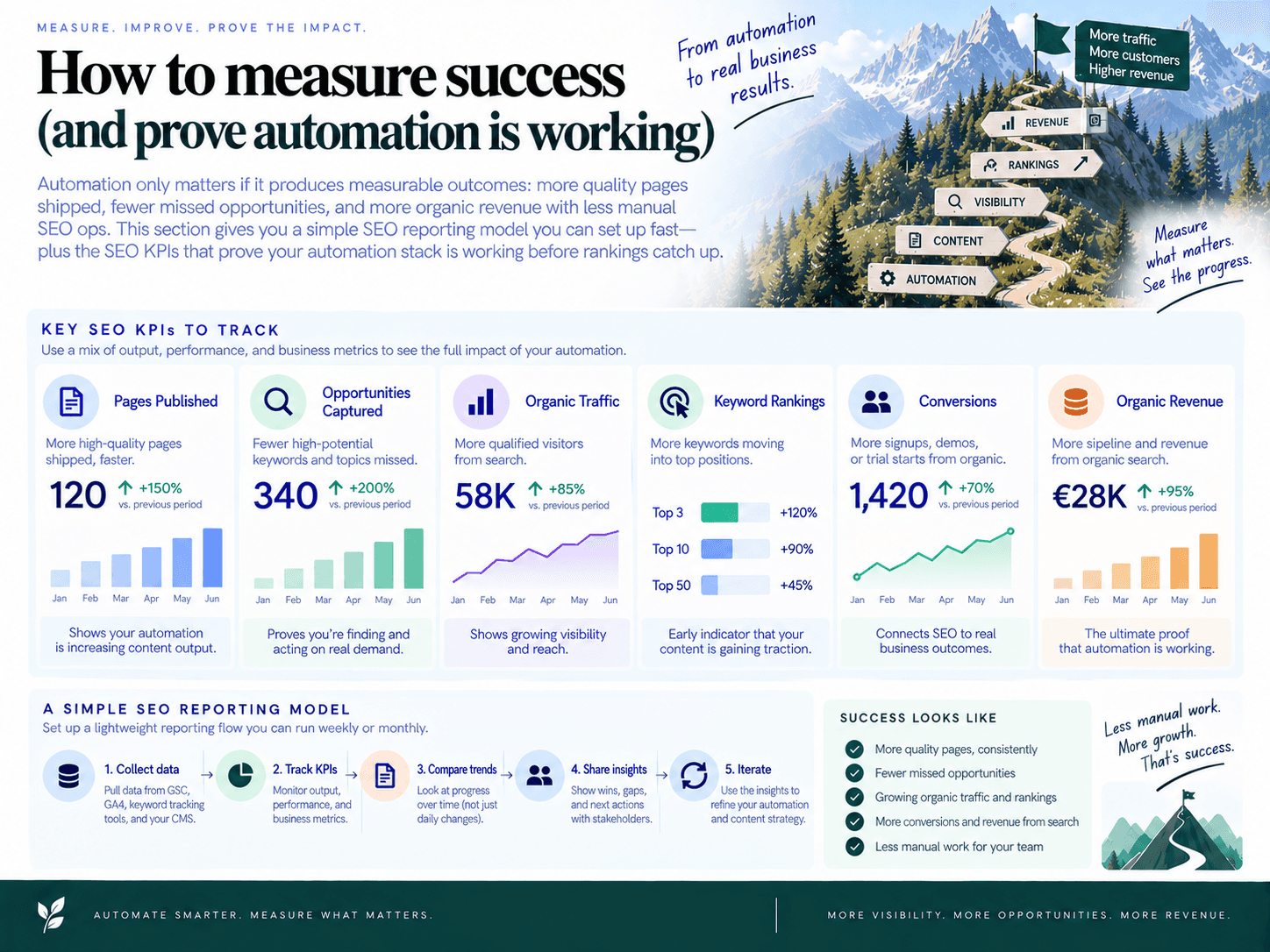
Automation only matters if it produces measurable outcomes: more quality pages shipped, fewer missed opportunities, and more organic revenue with less manual SEO ops. This section gives you a simple SEO reporting model you can set up fast—plus the SEO KPIs that prove your automation stack is working before rankings catch up.
Set the baseline first (so you can prove lift)
Before you change the machine, snapshot where you are today. Otherwise “it feels faster” turns into opinion instead of proof.
Content velocity baseline: posts/week, briefs/week, and average time-to-publish (idea → live).
Opportunity baseline: count of GSC queries/pages with impressions but low clicks, plus competitor-gap topic count.
Performance baseline: organic sessions, clicks, impressions, CTR, average position (site-wide and by content type).
Quality baseline: indexation rate, engagement (time on page / scroll depth), conversion rate (trial/demo/newsletter), and update rate (refreshes/month).
Tip: Store baselines in a single doc/tab labeled “Week 0”. Your goal is to show change vs. Week 0 every week for the first month.
A simple dashboard concept (one page, no fluff)
If your dashboard can’t answer “Are we shipping faster without hurting quality?” it’s not doing its job. Use one page with four blocks:
Production (leading): how fast you ship.
Coverage (leading): how well you’re capturing known demand (GSC + gaps).
Quality (leading/lagging): whether what you ship deserves to rank and convert.
Outcome (lagging): traffic, rankings, and pipeline.
Recommended cadence: update leading indicators weekly; review lagging indicators bi-weekly/monthly (rankings and revenue move slower).
Leading indicators (prove progress before rankings move)
Leading indicators are your “this is working” evidence in the first 7–30 days. These are also the easiest to influence with automation.
Throughput / content velocity
Briefs/week (target: +2–5x vs baseline)
Drafts/week (target: +2–3x)
Posts published or scheduled/week (target: consistent cadence—e.g., 2–5/wk depending on team size)
Time-to-publish (target: cut by 30–60% by removing manual handoffs)
Coverage metrics (miss fewer opportunities)
% of high-impression GSC queries addressed with a mapped page (new or updated) (target: +10–20% per month early on)
Gap closure rate: competitor-gap topics moved into backlog → briefed → shipped (track stage conversion)
Refresh coverage: % of decaying pages reviewed/updated each month (target: 10–20% of top pages/quarter)
Operational quality gates (avoid “AI spam” failure modes)
QA pass rate: % of drafts that pass your checklist on first edit (target: trending up)
Cannibalization checks completed: % of new pages with a “does this overlap?” review (target: 100%)
Internal link velocity: internal links added/updated per published page (target: 5–15 relevant links depending on site size)
Indexation readiness: % of published URLs with correct canonicals, sitemap inclusion, and noindex status verified (target: 100%)
Lagging indicators (the business results)
These show whether you’re building compounding organic growth. They typically move after you’ve shipped consistently and Google has processed changes.
GSC clicks & impressions (overall and by content cohort: “published last 30 days”)
Average position distribution: number of queries/pages in positions 1–3, 4–10, 11–20
CTR improvements on pages you updated (titles/meta and intent alignment)
Non-branded organic sessions (separate from branded to avoid false positives)
Conversions from organic (trial/demo starts, leads, purchases, newsletter signups)
Assisted conversions from organic (if your sales cycle is longer)
Make your SEO reporting actionable: track the pipeline, not just traffic
Most SEO reporting fails because it only measures outcomes (traffic/rankings) and ignores the system. Treat your workflow as a funnel and measure stage conversion:
Opportunity detected (GSC query, decaying page, competitor gap)
Backlog item created (scored + prioritized)
Brief produced (intent + outline + angle + internal links + references)
Draft completed (with citations/product truth + E-E-A-T)
Published (metadata + schema prompts + indexing request)
Internally linked (new page linked from relevant hubs; older pages updated)
Measured (tracked in GSC; next action decided)
What to look for: bottlenecks and drop-offs. Example: if briefs are flying but publish rate is flat, you don’t have an automation problem—you have an editing/approval capacity problem.
Suggested targets (realistic starter benchmarks)
Targets depend on site size and authority, but these are safe “beginner automation” goals that prioritize consistency over volume.
Content velocity: move from 0–1 posts/week → 2 posts/week within 30 days (solo); 4–10 posts/week (small team).
Time-to-publish: reduce from ~10–20 hours/post to ~4–8 hours/post (including editing/QA) by systemizing briefs, drafts, and checks.
Coverage: map and address 20–50 GSC opportunities/month (depends on site size); close 10–30 competitor-gap topics/month in backlog stages.
Quality: keep indexation readiness at 100%; maintain or improve engagement and conversion rate as volume increases.
Refresh triggers: when automation should re-surface updates
The easiest SEO wins often come from refreshing existing pages. Build automated triggers so pages come back to you without a manual audit.
Traffic decay: clicks down >20–30% over the last 28 days vs. prior period (exclude seasonality where relevant).
High impressions, low CTR: queries with strong impressions but CTR below your site’s median (title/meta + intent mismatch).
Position “almost winners”: queries/pages sitting in positions 4–15 (often a content depth, internal linking, or relevance tweak away).
Internal link opportunities: new page published → prompt an internal linking pass across relevant existing pages within 7 days.
Product/factual drift: pricing/features updated, screenshots outdated, or policy changes—trigger immediate refresh regardless of SEO metrics.
Quality safeguards: what must be true for a “win” to count
Automation can inflate output while silently hurting the brand. Make your wins conditional on quality gates.
No thin/duplicate content: each published page has a unique angle, clear intent match, and adds information gain (not a rephrase of your other posts).
No cannibalization: every new URL has a defined primary query and a documented relationship to existing pages (merge / differentiate / redirect if needed).
Internal links are relevant: links are added because they help the reader navigate—not to “sprinkle keywords.” Anchors should be natural and varied.
Product truth is verified: claims, specs, pricing, and steps are checked by a human (especially for YMYL or technical topics).
Bottom line: the best SEO reporting shows a compounding loop: more opportunities captured → higher content velocity → consistent publishing → better internal link structure → more pages ranking → more conversions. If your leading indicators are trending up and quality gates stay green, your automation stack is doing its job—even before the traffic spike arrives.
Common pitfalls (and how to avoid them)
Automation makes SEO faster—but it also makes mistakes faster. The goal isn’t “maximum automation.” It’s higher throughput with fewer quality regressions, using clear guardrails and human-in-the-loop quality gates. Below are the most common SEO automation mistakes (especially with AI), plus concrete prevention steps you can bake into your workflow.
1) Automating the wrong work (strategy vs. execution)
The fastest way to break your SEO is to automate decisions that require context: positioning, audience pain, product truth, and “why this page should exist.” Automation is best at repeatable execution (collecting data, drafting options, checking consistency), not at choosing your strategy.
What it looks like: publishing lots of content that’s “technically optimized” but off-message, irrelevant to your ICP, or disconnected from your product’s actual value.
Fix: keep strategy human. Automate the assembly of inputs (GSC queries, competitor gaps, SERP patterns), but have a human approve the final “topic + angle + CTA.”
Guardrail (quality gate): every brief must include:
Target persona / job-to-be-done
Primary conversion action (demo, signup, lead magnet, etc.)
Unique angle (what you can say that generic pages can’t)
Why you’re credible (data, experience, screenshots, examples)
Operational tip: create a “Do Not Automate” list: pricing/claims, legal/compliance, medical/financial advice, competitor comparisons, and anything that requires real-world verification.
2) Thin/duplicative AI content (and the brand risk that comes with it)
The biggest AI content risks aren’t “Google will penalize you for using AI.” The risk is you ship content that’s generic, unoriginal, or factually wrong—and that quietly erodes trust, conversions, and brand authority.
What it looks like: repeated intros/outros, fluffy sections, rephrased competitor content, or “definition soup” that doesn’t help the reader decide or do anything.
Fix: use AI for structure and speed, then require human-added “proof.” Add at least 2–3 of the following to every post:
Original examples from your workflows (screenshots, step-by-step, templates)
First-party insights (what you saw in GSC, what changed after a fix)
Product specifics (how it’s done in your tool/process—without turning the post into a brochure)
Expert review (SME pass for claims, edge cases, and terminology)
Data points you can cite and verify (with sources your team trusts)
Guardrail (quality gate): add a “No fluff” QA checklist before publish:
Each section answers a real question from the SERP (not just “covers a keyword”).
No repeated phrases/paragraph patterns across posts.
All claims are verifiable or clearly framed as opinion/experience.
Every post includes a concrete next step (checklist, workflow, decision tree).
Prevention: maintain a small internal “style + claims” document: preferred terminology, banned hype words, how you describe your product, and a list of claims that require citations.
3) Keyword cannibalization from rapid publishing
When your pipeline speeds up, keyword cannibalization becomes the silent killer: multiple pages compete for the same intent, rankings oscillate, and Google can’t decide which URL is the best answer.
What it looks like: two posts both targeting “SEO automation,” or a new post outranking (or confusing) an older high-performing page, causing traffic drops across both.
Fix: make “intent mapping” a required backlog step. Every backlog item should have:
Primary query cluster
Intent type (informational / commercial / navigational / transactional)
Assigned canonical URL (existing page to update vs. net-new page)
Closest existing pages (top 3 internal URLs that overlap)
Guardrail (quality gate): before writing, do a 2-minute site check:
Search site:yourdomain.com "primary keyword"
Scan GSC for the query and see which URL already gets impressions/clicks
If a relevant page exists: update/expand it instead of creating a new one
When you should consolidate instead of publish:
Two pages have the same intent and similar outlines
Both pages rank 11–30 and keep swapping positions
Backlinks point to the “wrong” version of the page
Automation-safe step: automate cannibalization alerts using a weekly report: queries with impressions going to multiple URLs + declining average position.
4) Internal link spam and irrelevant anchors
Automated internal linking can quickly turn into a mess: repeated exact-match anchors, links shoehorned into unrelated paragraphs, or too many links that dilute relevance. It’s a common SEO automation mistake because it’s “easy to automate” but hard to do tastefully.
What it looks like: every post links to the same money page with the same anchor, or links appear where they don’t actually help the reader.
Fix: optimize for relevance and navigation, not link volume. Good internal links behave like helpful footnotes.
Guardrail (quality gate): apply these rules before inserting links:
Context-first: only link when the surrounding sentence introduces a concept the target page expands on.
Anchor variety: prefer partial-match and descriptive anchors over repeated exact-match anchors.
Limit per section: cap links per section (e.g., 1–2) unless it’s a resource hub.
Avoid forced cross-links: if it doesn’t help the reader complete the task, skip it.
Automation-safe step: let automation suggest link targets, but require a human to approve:
the exact anchor text
the placement sentence
whether the link belongs at all
5) Ignoring indexing + technical constraints (the “published but invisible” problem)
You can have a perfect backlog and a fast content machine—then still get zero results because pages don’t index, templates break metadata, or your CMS creates duplicate URLs. Automation tends to hide these issues because output volume increases while visibility doesn’t.
What it looks like: posts are published on schedule, but they don’t show up in search, impressions stay flat, or Google indexes the wrong canonical version.
Fix: add a technical QA gate to your publishing workflow (takes 5–10 minutes per post, saves weeks of confusion).
Pre-publish checklist:
One clear indexable canonical URL (no conflicting canonicals)
Title/H1 are unique (no template collisions)
Meta description present (even if Google rewrites it, it’s a good control)
Schema is appropriate (only if it matches the content)
Images are compressed + alt text is descriptive (not keyword stuffing)
Post-publish checklist (within 24 hours):
Request indexing in GSC (for priority pages)
Verify the page is accessible (200 status, not blocked by robots/noindex)
Confirm the correct canonical is recognized
Check internal links: at least 2–5 relevant inbound links from older pages (where appropriate)
Automation-safe step: schedule a weekly “indexation and coverage” sweep: new URLs published vs. indexed, plus any spikes in “Duplicate, Google chose different canonical.”
Bottom line: Speed is only a win if it compounds quality. Keep humans responsible for strategy, truth, and editorial standards—then let automation handle the repeatable work with clear gates. That’s how you avoid the most common SEO automation mistakes while still publishing consistently.
Next steps: Build your stack and ship your first week
If you take one thing from this guide, make it this: the goal isn’t maximal automation. The goal is consistent publishing with fewer missed opportunities—because your pipeline reliably turns real demand (GSC + competitor gaps) into shipped pages (briefs → drafts → internal links → publish → measure).
Your next step is to pick a minimal stack you can run every week, add a couple of safe automation layers, and put the rest behind human quality gates. That’s how you get the speed benefits of content automation without the brand and SEO downside of thin, duplicated, or inaccurate output.
Start small: one content type + one workflow
Start with a single “lane” you can repeat. Most teams win fastest by choosing one of these:
Refresh lane (lowest risk): update decaying pages from GSC (CTR/rank drops, impressions rising but clicks flat).
Expansion lane (highest upside): new pages from competitor gaps + untapped GSC queries.
Programmatic support lane (controlled): templates + variations (only if you can keep uniqueness and usefulness high).
Then choose one workflow rhythm (solo or team) and commit to it for 2–4 weeks before you “upgrade” anything.
Minimum viable stack (MV-stack) to start: GSC → opportunity list → prioritized backlog → brief template → draft + edit → internal link pass → schedule/publish → measurement loop. You can do this with a handful of SEO automation tools (spreadsheets + GSC exports + a writing assistant + an internal linking helper) before you ever consider a full SEO platform.
Scale safely: add automation layers over time
Once your first week ships and you’ve proven you can publish consistently, scale in layers—only where it’s low-risk and reversible.
Layer 1 (safe): Automate data collection + alerts
Scheduled exports from GSC, rank tracking, and simple alerts for spikes/drops.
Human gate: confirm the issue/opportunity is real (seasonality, tracking changes, site issues).
Layer 2 (safe): Automate clustering + backlog scoring inputs
Topic clustering, intent labels, and basic scoring (Impact/Confidence/Effort/Fit).
Human gate: final prioritization call (avoid cannibalization; ensure fit with business goals).
Layer 3 (medium): Automate brief creation
SERP pattern extraction, outline suggestions, FAQ ideas, entity/term coverage, internal link candidates.
Human gate: positioning, angle, differentiation, and “what we know is true” product claims.
Layer 4 (medium): Draft generation
Use assisted writing to get to an editable draft faster.
Human gate: accuracy, originality, examples, editorial quality, and E-E-A-T signals.
Layer 5 (medium/high): Internal linking + publishing automation
Automated suggestions, broken-link checks, anchor audits, and CMS scheduling.
Human gate: relevance (no “internal link spam”), correct anchors, and conversion intent.
Rule of thumb: automate anything that is repetitive and easy to verify; keep humans on anything that is hard to verify or expensive to get wrong.
When to consider an end-to-end platform
At some point, duct-taping multiple SEO automation tools becomes its own full-time job. Consider moving to an end-to-end SEO platform when one (or more) of these is true:
You’re publishing at volume (e.g., 8–20+ pieces/month) and coordination overhead is slowing you down.
Quality gates are inconsistent across writers/editors, causing rework or brand risk.
Opportunity coverage is slipping (GSC queries and competitor gaps keep piling up unaddressed).
Internal linking is lagging behind new content (pages publish but never get integrated).
You need governance: roles, permissions, versioning, approvals, and an audit trail.
Reporting is fragmented and you can’t clearly connect “inputs shipped” to “results earned.”
Even then, buy based on workflow fit—not feature checklists. A good platform should make your operating system easier to run (data → backlog → brief → draft → link → publish → measure) while making quality gates unavoidable.
Your commitment for the next 7 days: ship a working pipeline and at least one piece of content through it end-to-end. After that, iterate. The compounding advantage isn’t the toolset—it’s the cadence.

About the author: SEO Autopilot — Get recommended by Google and AI
SEO Autopilot is the SEO operating system for SaaS teams: it finds what to write from your site, competitors, and Search Console — then publishes evidence-verified comparison pages and intent-matched content on autopilot to WordPress, Framer, and more.
Areas of expertise: seo, aeo, geo, Search Engine Optimization, Answer Engine Optimization, Generative Engine Optimization, SEO Expert, Article Writer